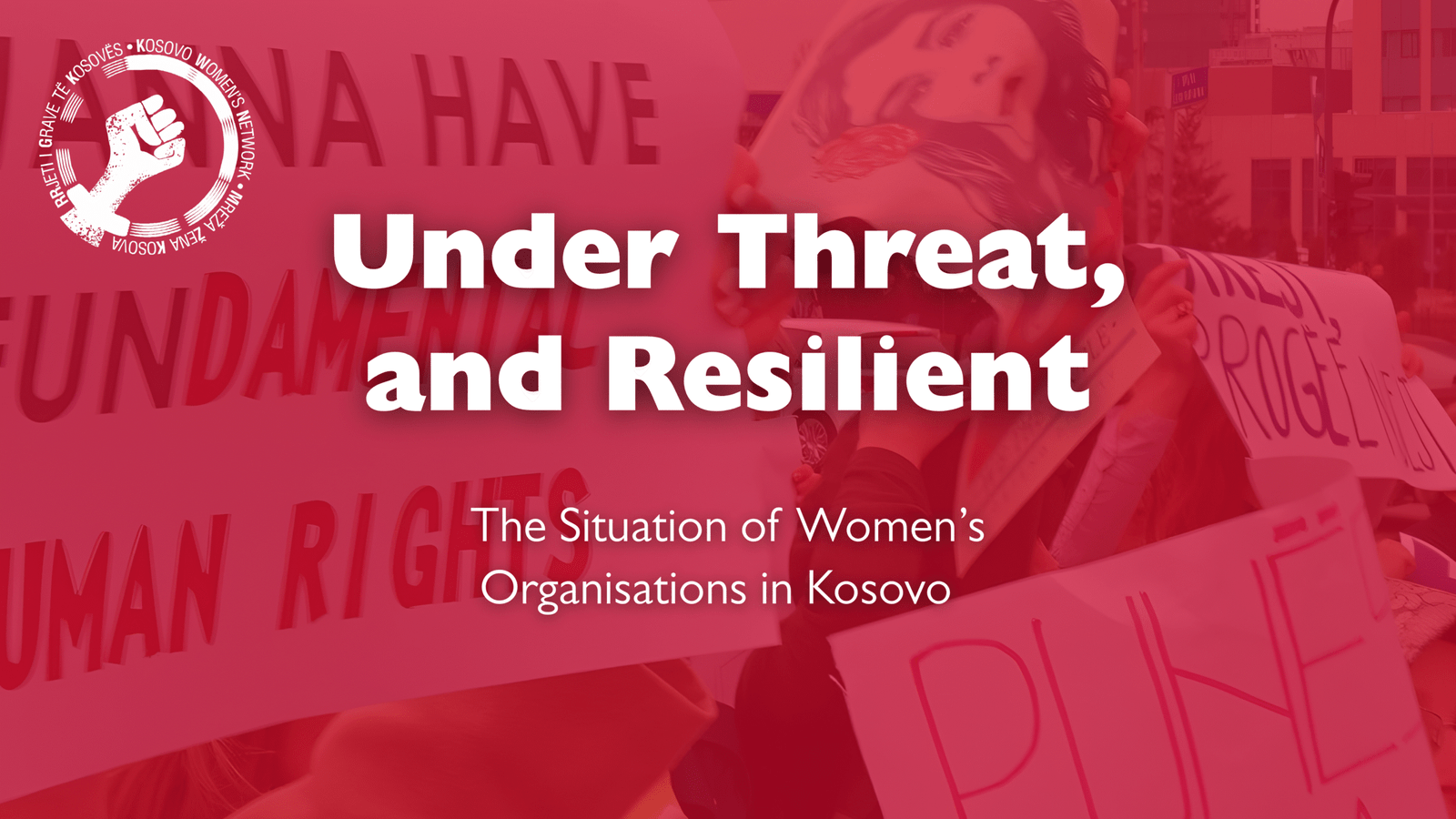
The Kosovo Women’s Network has published the report “Under Threat, and Resilient – The Situation of Women’s Organisations in Kosovo”, which analyses the current state of women’s rights organisations in Kosovo in the context of rapid geopolitical changes and shifts in the funding climate. The study is based on surveys and face-to-face interviews with 103 women’s civil society organisations (WCSOs) representing the interests of women of all ethnicities, ages and abilities in both rural and urban areas.
The evidence gathered shows that women’s organisations have been a driving force behind key achievements towards inclusive democracy, good governance, the rule of law, access to justice and human rights, contributing to progress towards membership in the European Union. However, despite their important role, organisations are under threat due to global changes in funding trends. Some bilateral donors and private foundations have reduced support suddenly and significantly. Shifts in priorities are being observed also within the European Union.
Over the past two years, 40% of organisations reported a decline in funding. 59% had no income secured for 2026, while only 9% had funds secured for 2027 and beyond. As a result of lack of funding, more than 22 staff members have lost their jobs, and at least 49 activists have reduced their working hours. Budget cuts also have led to reduced services, support for women’s economic empowerment, advocacy, watchdog functions, awareness-raising campaigns, education and research. The situation has contributed to stress, insecurity and professional burnout among activists.
Report findings show that Kosovo’s enabling environment for civil society in general is in line with international human rights standards. However, improvements to philanthropy, volunteering, taxation and funding frameworks would facilitate organisations’ access to resources. 81% of interviewed organisations have received support from Kosovo institutions in the past, although contracts lasted on average less than five months, indicating room for improvement in the sustainability of this support, not the least in light of decreased international funding. The report recommends that the Administrative Instruction on public–private partnerships is adopted and that a dedicated state budget line for support to civil society organisations is established. It also calls for improvements to legal frameworks for fundraising and volunteer engagement, to preserve an independent and functional civil society.
Regarding recommendations for international donors, the report emphasises the need for adequate, long-term and flexible funding, including core support for organisations engaged in research, monitoring and advocacy.
Despite the challenges outlined, 91% of organisations stated that they will continue their work even without donor funding, demonstrating resilience and strong commitment to activism.
The report is being shared with various donors in Kosovo and abroad to inform and encourage sustainable support for women’s organisations.
This publication was produced with the financial support of The Kvinna till Kvinna Foundation.