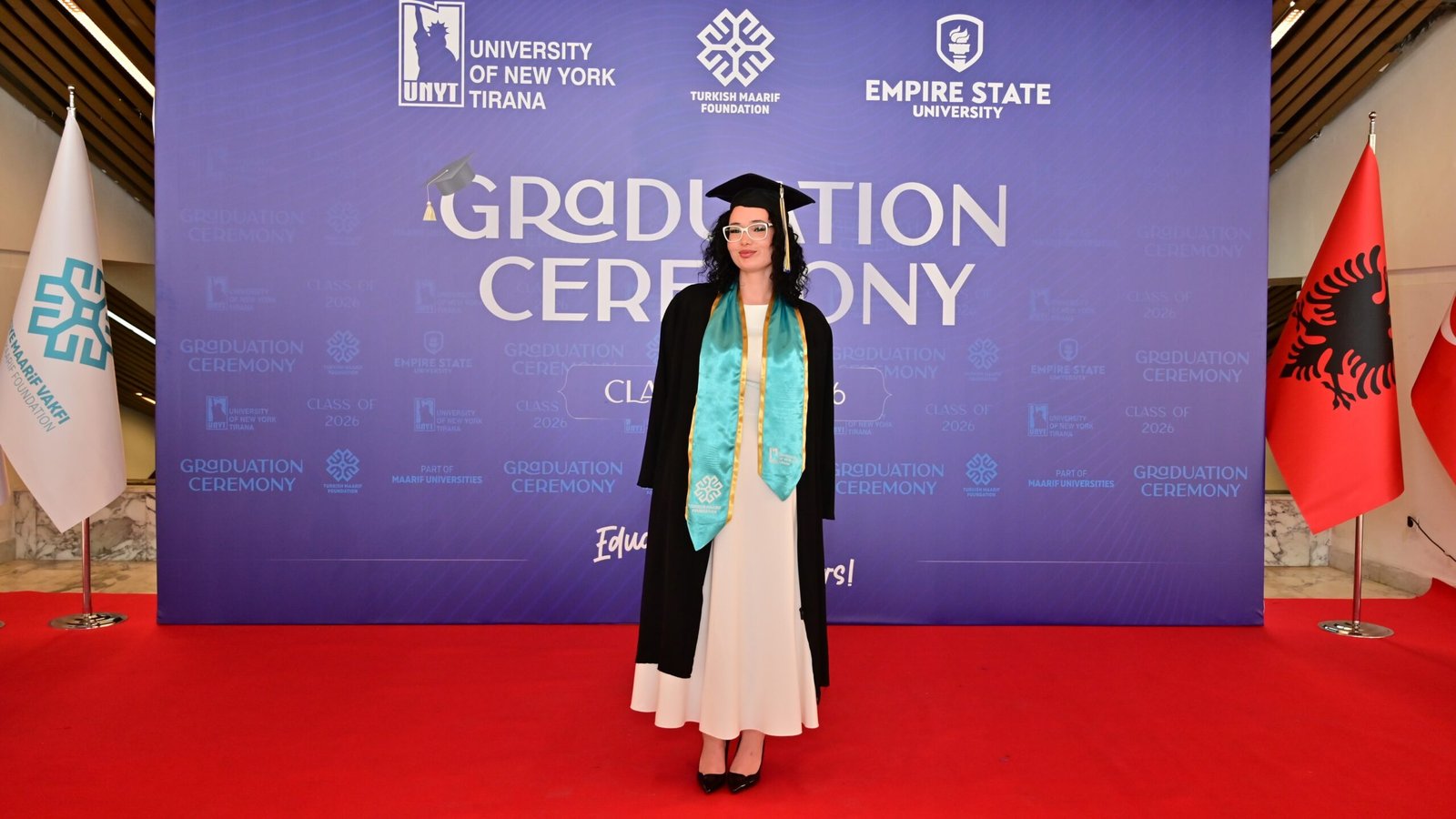
Engjellushe Basha chose to dedicate her Bachelor’s thesis to exploring what civil society organisations can achieve in post-conflict societies, using the Kosovo Women’s Network (KWN) as a case study. For Engjellushe, the story of KWN is also, in part, a personal one. Engjellushe lives in Albania, where she studies Political Science and International Relations at the University of New York Tirana, but she has family roots in Kosovo.
When asked why she dedicated her Bachelor’s thesis to this topic, Engjellushe explains:
“I’ve been raised by women who have dedicated their entire lives to activism, to empowering women and to advancing women’s rights and gender equality, so it was natural for me to pick this topic for the first ‘serious work’ I got to do in my field of study.”
She continues by explaining how she noticed a lack of knowledge about KWN and its work among her peers. “I thought I could be the one to introduce KWN to the youth in Albania”, she says. “I want my peers, my female friends, the women in my life who will read this to know that there is a big community of people working and dedicating their entire lives to helping our lives become easier and better … I want my readers to know that in times of need, if there ever is a need, there is this big community waiting to support them … I think it’s important to bring back that spirit of community and togetherness.”
The thesis traces KWN’s origins and development, beginning with the foundations laid by the “Motrat Qiriazi” and “Nënë Tereza” associations. Engjellushe explains how these initiatives built networks of trust, solidarity and community support that became the foundation for collective action. She highlights the importance of KWN’s early focus not only on providing humanitarian assistance, but also on advocating women’s rights and the integration of gender equality into Kosovo’s emerging institutions.
“KWN mobilized female voices at a time when new governance structures were coming into being, making sure that gender equality was not a sideshow but one of the democratic pillars for Kosovo’s resiliency”, states Engjellushe.
Among the examples of KWN’s advocacy highlighted in the thesis are its contributions to implementing the United Nations Security Council Resolution 1325 on Women, Peace and Security in Kosovo.
“Resolution 1325 called for women’s participation in peace and security processes, but in Kosovo, it entrenched patriarchal traditions and institutional resistance that posed significant obstacles. In response KWN organised workshops, developed coalitions, and lobbied institutions, with the aim of including women in the debates on peace and security.”
The thesis highlights several legislative and policy achievements that Engjellushe identifies as milestones in KWN’s advocacy. These include the incorporation of the Istanbul Convention into the Constitution of Kosovo, as well as the adoption of the Law on Protection from Domestic Violence and the Law on Sexual Harassment, both of which were drafted on the basis of KWN’s research and policy recommendations. Moreover, Engjellushe explores KWN’s work to strengthen labour rights and improve the quality of education, highlighting its contibutions to the Kosovo Programme for Gender Equality and gender-mainstreamed education policies. Overall, Engjellushe says she was surprised by the high percentage of KWN policy recommendations that have historically been incorporated into legal frameworks.
“My entire life, I’ve heard about the impact of KWN and civil society organisations in general, but actually reading the facts, seeing reports and learning how much work there is behind was eye-opening. I didn’t know how much work was being put into advancing gender equality or labour rights or education reforms … It was surprising to learn how many areas of life KWN gives input and support to.”
Moreover, Engjellushe was happy to find how big of an impact KWN has had on encouraging women to come forward and report abusers and sex offenders. “During my interview with Adelina [KWN Programme Director for Gender-based Violence], she told me about the number of cases of sexual assault that were reported after one of KWN’s campaigns. I learned that the number of reports rose from 500 to 3000 per year”, she says. “To see that women finally feel safe and comfortable enough to come forward thanks to the work of KWN is touching.”
Reflecting on KWN’s impact in her thesis, Engjellushe concludes that “…KWN was a catalyst for reform”, arguing that civil society can serve as a transformative force in post-conflict societies. “It [KWN] integrated gender equality in national strategies, in EU integration and in law and thus, made gender issues a key part of democratisation”, she states.
At the same time, her research acknowledges the challenges that persist, including weak institutions and entrenched patriarchal norms, underscoring the continued importance of KWN and its allies in advancing gender equality.
KWN’s success is attributed to its strong partnerships with other civil society actors and international partners, as well as its focus on broad coalition-building across ethnic, gender, social and generational divides. The thesis also highlights the importance of research and evidence-based advocacy, which has enabled KWN to “persuade policymakers through empirical evidence.”
Having recently completed her Bachelor’s degree, Engjellushe is now preparing to pursue a Master’s, where she hopes to study International Relations with a minor in Gender Studies. “That is part of the reason I chose this topic for my thesis – I want to continue working on this … I hope one day I get to be part of the organisation and the work that you do every day”, she says.
As Engjellushe’s thesis demonstrates, KWN’s work continues to inform academic research both in Kosovo and beyond. Several students in Kosovo and abroad have utliised KWN’s research to inform their studies. Students interested in gender equality, women’s rights and public policy are encouraged to draw from KWN’s extensive collection of resources and publications. KWN also welcomes opportunities to support students through interviews with staff and internship placements.