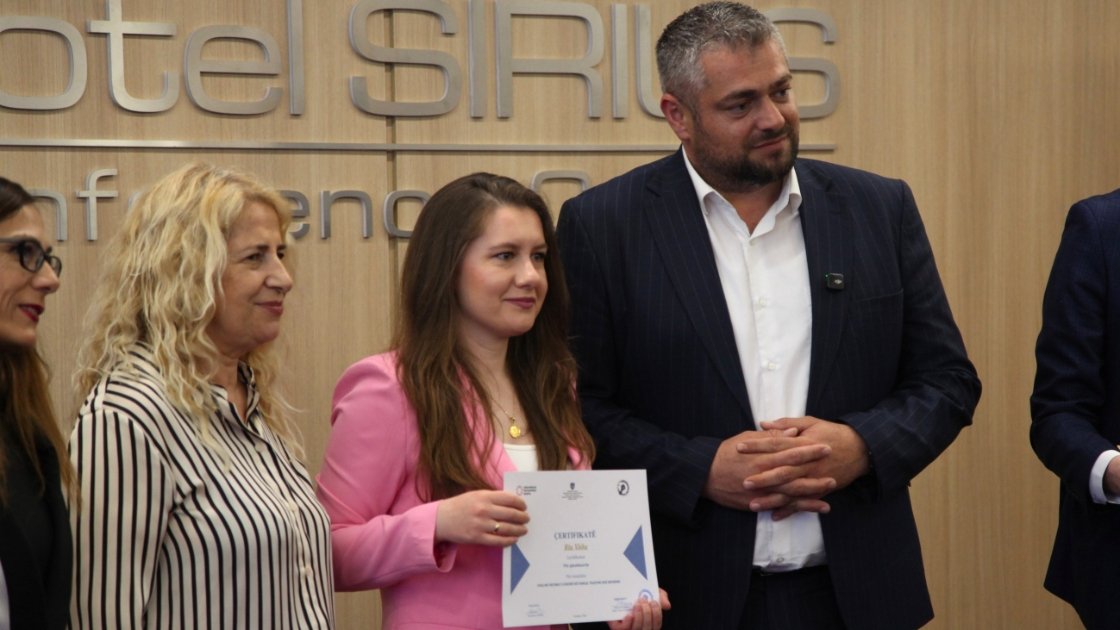
The Agency for Gender Equality (AGE) in cooperation with Kosovo Cadastral Agency (KCA) on June 15 launched the “Administrative Instruction (GRK) No. 03/2016 on Special Measures for Registration of Joint Immovable Property on Behalf of both Spouses”, where representatives of governmental institutions of central and local level, representatives of international organizations and civil society, including Kosovo Women’s Network (KWN) representatives, took part. This Administrative Instruction (AI) was approved by the Government of Republic of Kosovo in March 2016.
Participants at this event were addressed by the Prime Minister of Kosovo, Mr. Isa Mustafa; Mr. James Hope, Mission Director at USAID/Kosovo; Ms. Edi Gusia, Acting Chief Executive of AGE; Ms. Leonora Selmani, Head of the Legislation Division at AGE; Ms. Afërdita Thaçi, Head of IT Department at KCA; Ms. Arbena Shehu, Head of Notaries Chamber; and Ms. Leonora Sylejmani from KCA.
“I urge all citizens of the Republic of Kosovo to benefit from this affirmative action, since its implementation means contribution to Kosovo’s economic and overall strengthening” said Prime Minister Mustafa.
Further, Ms. Sylejmani presented to participants the “Form on procedures for registration of joint property”, and there was a screening of the video clip prepared by AGE with support by USAID, which since today will be shown on Radio Television of Kosovo (RTK), as part of many activities within the awareness raising campaign to be delivered in the coming months.|
This AI, among others, regulates the responsibility of institutions in the procedure of joint property registration (Art. 5), as well as exempts the citizens from the registration service fee (Art. 6).
“Since March 2016, when this AI came into force, 144 cases have been initiated on registering the joint property,” emphasized Ms. Gusia.
For KWN, the launching of this IA came in a very suitable time, since KWN has already started the implementation of the project where KWN activists are going door to door in 7 municipalities to support women in registering their property, a project that is supported by the Promoting Private Sector Employment (PPSE) project of Swisscontact, financed by the Swiss Government in Kosovo, as well as the Kosovo Women’s Fund with support from European Office (EU) Office in Kosovo and Austrian Development Agency (ADA).
Any initiative undertaken by KWN in this field is consistent with the objectives of its advocacy to ensure women’s rights to property and inheritance.
Below you can find the names and the contact details of the 12 KWN member organizations in 7 different municipalities throughout Kosovo, which are implementing this KWN’s project:
Prishtina:
- NGO Dera e Hapur in Prishtina; Tel.: 044 124 423, 049 120 544; E-mail: c_opendoor@hotmail.com;
- NGO Rikotta in Prishtina (and Prevallac); Tel.: 044 429 432; E-mail: p_hajzeri@hotmail.com;
- NGO Dita in Prishtina; Tel.: 044 178 135; E-mail: dita.zeneli@hotmail.com;
- NGO Femrat Aktive të Gjakovës in Gjakova; Tel.: 044 188 642; E-mail: f_aktive@yahoo.com, v_rizvanolli@yahoo.com;
- NGO Alma in Peja; Tel.: 044 257 443; E-mail: shemsijeseferi2012@hotmail.com, ojqalma@gmail.com;
- NGO Venera in Peja; Tel.: 039 423 669, 044 223 418; E-mail: ngo-venera@live.com;
- NGO Dora Dorës in Prizren; Tel.: 044 216 616, 044 670 067; E-mail: info@doradores.org;
- NGO Gora in Prevallac; Tel.: 045 260 311, 049 645 496; E-mail: sevda.gora@hotmail.com;
- Mitrovica’s Women Association for Human Rights in Mitrovica; Tel.: 044 165 751, 049 130 365; E-mail: mitrovica.wahr@gmail.com, vetone_veliu@yahoo.com;
- NGO Flaka in Lipjan; Tel.: 044 375 410; E-mail: melidedushaj@hotmail.com;
- NGO Parajsa jonë in Babush i Muhaxherëve, Lipjan; Tel.: 044 657 928; E-mail: parajsajone@live.com, vela_sylbija@hotmail.com;
- The Initiative for the Integration of Communities (IPIK) in Brezne, Dragash; Tel.: 044 351 899; E-mail: ojq.ipik@hotmail.com