Ministry of Education Marks Milestone in Gender Budgeting

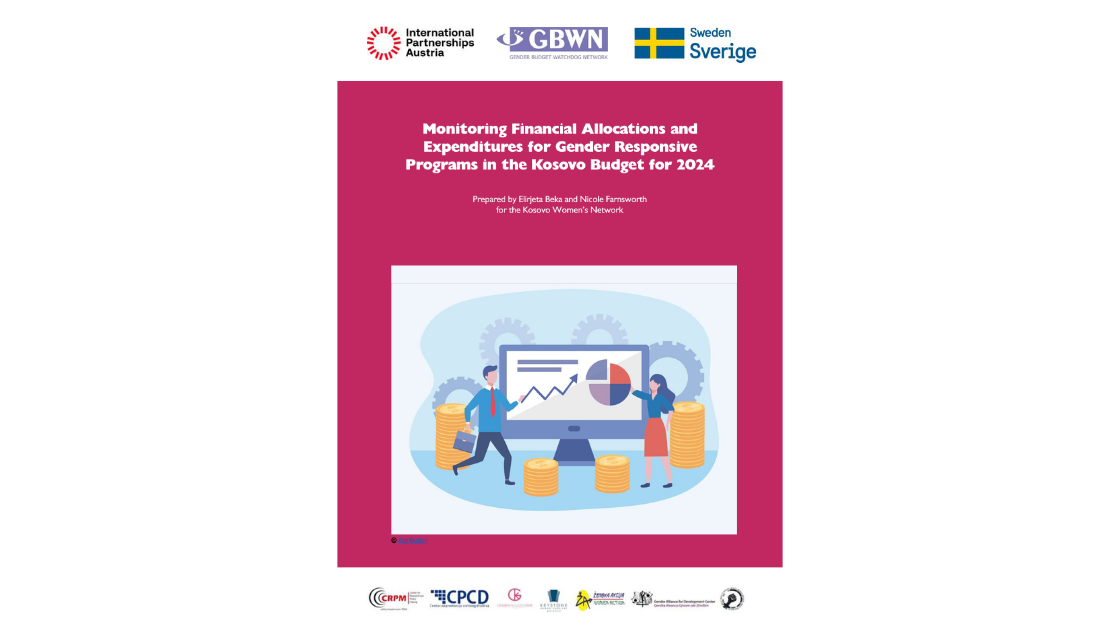
Since March 2015, the Ministry of Education, Science, and Technology (MEST) and Kosovo Women’s Network (KWN) have been collaborating on institutionalizing Gender Responsive Budgeting (GRB) in MEST. 
   July marked a great success in this collaboration, since MEST prepared a GRB annex for its annual budget with KWN support. MEST has successfully prepared and attached this annex to its annual budget, marking the first step towards institutionalizing GRB in its budget documents and processes. This annex includes gender disaggregated information regarding public universities’ scholarship recipients, as well as gender disaggregated data on MEST staff, including by salary level. Such data can help elucidate inequalities in MEST budget allocations and within one of the most important sectors of Kosovo: Education. Identifying inequalities in prior spending can provide important information in planning for more equitable expenditures in the future. 
     GRB is now a legal obligation for budget organizations in the Republic of Kosovo. The new Law on Gender Equality 05/L-020 has a specific article on GRB, which obliges budget organizations to integrate GRB in their budget processes and documents. Further, the Budget Circular 2016/02 released by the Ministry of Finance in July 2015 encouraged all budget organizations to include GRB in their annual budgets. MEST’s annex can serve as a positive example for other ministries in the Republic of Kosovo in the future. 
   The Ministry of Labour and Social Welfare (MLSW) achieved a related success, by also provided gender disaggregated data in their budget document 
While GRB is a simple concept and a legal obligation, it remains a new practice in Kosovo and beyond. Only a few countries have successfully integrated GRB in their budget documents (see, for example, Austria, the State of Berlin and Andalusia. Thus, MEST in Kosovo is now among the leading examples of how gender can be integrated into budget documents. 
    KWN and MEST collaboration towards institutionalizing GRB was funded by the Austrian Development Agency (ADA). KWN support to MLSW was supported by Deutsche Gesellschaft fuer Internationale Zusammenarbeit (GIZ).

Ajshe Osmani Nuhiu: Proud to Have Her among Us

Ajshe Osmani Nuhiu passed away at the age of 70 on August 16, 2015 from a difficult disease. She was born in 1945 in a village near Viti. Since health was her passion, she finished high school for medicine in Prishtina and then continued her studies in the same field in Belgrade. 
     After her studies, she started working at the Kosovo Health Secretariat as a Coordinator for Preventive Health. She practiced this profession with great will and passion for more than 20 years. Her work included collaborating with UNICEF to provide drinking water for people in rural areas. More than 100 water pipes were provided to residents of different villages. She received a medal for her significant contribution and was decorated by UNICEF, the Federal Ministry of Health and the Presidency of Kosovo. 
     At that time, Ajshe also served as a Member of Parliament. In 1990 she was dismissed from her position since she did not accept to work for Serbian institutions. After that, she was never employed. This, motivated Ajshe to find other ways to help people in need, especially women and girls. 
     After the war in Kosovo, she was part of the labor unions of Kosovo and later on she founded the Association of Women Pensioners called “Vita Jeta”. Its mission was to empower and emancipate women pensioners by offering them psycho-social assistance, rehabilitation and health protection. 
     With her tremendous energy she welcomed many members into the organization. She increased the number of members from a few hundred to more than 1000. She enriched their lives with various activities, lectures and topics important to women pensioners, especially in the field of justice and human rights. Thanks to her engagement and advocacy together with other Vita-Jeta staff, more than 600 women received free medical checkups for osteoporosis disease. 
     “Hundreds of women, thanked our mother hundreds of times for the psycho-social contribution with which she provided them,” said Arber Nuhiu, son of Ajshe. 
     Rabije Slivova, coordinator of “Vita Jeta spoke of Ajshe as a very active woman who loved life. “Even during the last days of her life she gave us courage, and she spoke to us about our future activities that we will organize together. Since 2000, the year when the Association was founded, Ajshe has worked a lot with all the members of the Association,” Rabije said. “She will undoubtedly remain forever in our hearts and minds.” 
     Ajshe Nuhiu was a great support and inspiration for all women pensioners, who have cherished the hope for an active life after giving their contribution to this country for many years in education, health and other fields. 
     Her death is a great loss for Kosovo Women’s Network and especially for women pensioners. She has provided women pensioners with unlimited support and space to develop their creativity, as well as promote their interests and needs in a country where the status and living conditions for pensioners is very difficult. 
     “I am convinced that her work and contribution will remain as a guide for us and many other women who hope for an active life in their third period of life,” said Veprore Shehu, Executive Director of Medica Kosova.


Photo credit: GIZ, 2015

Budget Analysts at the Ministry of Finance Take On Gender Responsive Budgeting

On August 5, an important milestone was reached with the Ministry of Finance. This Ministry incorporated Gender Responsive Budgeting (GRB) in their Budget Circulars 2016/02 for central and local budget organizations, in accordance with the new Law on Gender Equality (2015).  On Augst 6, KWN met with the budget analysts of this ministry to discuss how they can advise budget organizations on how to integrate GRB in their budget documents.

As the organiser of this workshop and one of KWN’s close partners in seeking to institutionalize GRB in Kosovo, Deutsche Gesellschaft für Internationale Zusammenarbeit (GIZ) welcomed the officials and introduced the agenda. Alexandra Fehlinger from GIZ (Project Leader, Reform of Public Finance Systems) thanked the participants for their presence, also stating, ‘’I am not trying to convince you that GRB is the most important thing in the world, but today I would like to tell you that GRB is better budgeting. Something that Kosovo needs.’’
 
Indeed GRB can contribute to more effective, efficient and transparent spending that benefits more Kosovars, including women and men. Petrit Popova, Head of the Department for Municipal Budget, expressed his interest in this subject while noting that it might be a delicate one. He suggested changes that could be made within the budget to make it more equal for men and women. They, as budget analysists, must take on the responsibility to make a change by talking to budget organizations to incorporate this.  
 
After this positive note, Lukas Fischer from GIZ (Advisor; Component Leader “Support to Tax Administration” Reform of Public Finance Systems in Kosovo) gave examples of succesfull international experiences in integrating GRB into budget documents. He mentioned concrete examples from Berlin, Austria and Andalusia. However, he emphasized that due to the diverse nature of budget documents and contexts, there is no one way to “do GRB”. Therefore, participants discussed that Kosovo needs to identify the best way to carry out GRB as per its particular legal framework and processes. Pilot initiatives by KWN in the Ministry of Labour and Social Welfare, Ministry of Education, Science and Technology, Municipality of Kamenica and Municipality of Gjakova, supported by GIZ and the Austrian Development Agency, can serve as models for how Kosovo may be able to institutionalize GRB in the future.
 
Nicole Farnsworth and Donjeta Morina (KWN) proceeded to explain Kosovo’s new legal requirements  for GRB, what GRB entails, how this can be translated into central and local budget documents and how this has been done in the past with the aforementioned budget organizations in Kosovo. They specifically referred to the concrete steps taken by the Municipality of Kamenica and the Ministry of Labour and Social Welfare towards institutionalizing GRB.
 
Participants asked both general and specific questions on how to incorporate information from gender analyses in different economic categories. Following some lively discussions, most participants agreed on the need to delve deeper into the materials presented and perhaps organize follow-up discussions to further examine specific challenges that they might face in implementing their legal responsibilities related to GRB.