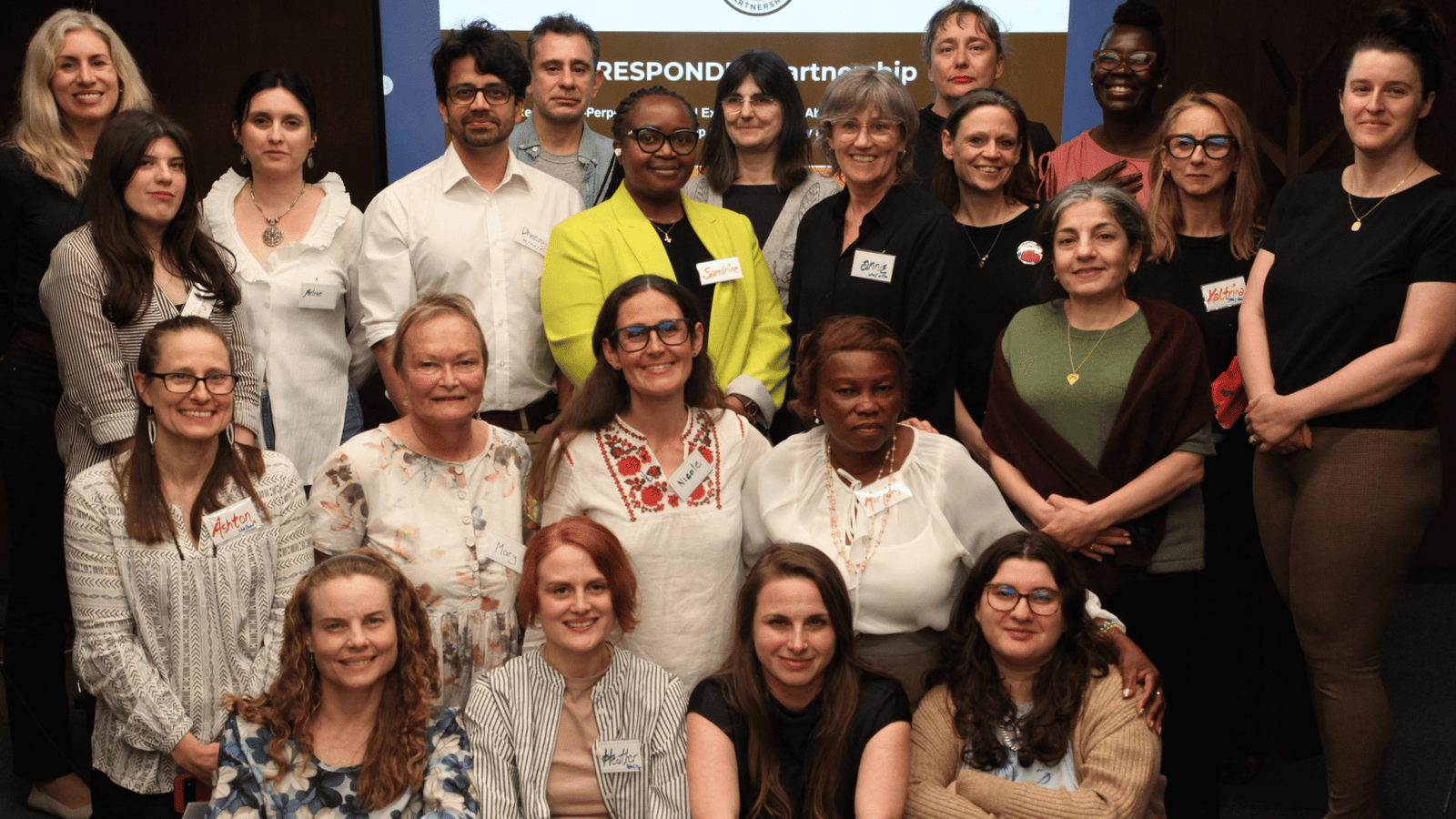
Elmaze Gashi, KWN Board Chair; Nicole Farnsworth, Editor; and Ariana Qosaj-Mustafa from the Office of the President of the Republic of Kosovo present 1325 Facts & Fables on 10 December 2011.

KWN Launches 1325 Facts & Fables: A Collection of Stories with Policy Implications

On 10 December 2011, KWN released its latest publication 1325 Facts & Fables: A collection of stories about the implementation of United Nations Security Council Resolution 1325 on Women, Peace and Security in Kosovo.

KWN did not initially plan to conduct additional research on 1325. However, via voluntary efforts from committed interns and additional funding secured from Austrian Development and Cooperation for basic research costs and publishing, KWN was able to carry out extensive research on the issue and produce a book. The public release, attended by 110 people, served to launch 1325 Facts & Fables in hard copy and electronic versions.

The book is already serving as an effective advocacy tool, making women’s voices heard in politics and future decision-making. KWN has received extensive positive feedback about the book:

“I think it should be read in school. This book is exactly what anyone teaching gender rights needs in the classroom. It combines excellent fieldwork with reflections on the emergence and development of the norm of human security.”
– Anna Di Lellio, Ph.D., professor of International Relations at the New School and New York University

“The report/book on 1325 in Kosovo is wonderful! Seldom can you read such down-to-earth and frank analysis on these issues. I opened the file two hours ago and just could not stop reading.”
– Elisa Tarnaala, Gender, Peace & Security Working Group

“I wanted to say that I have found the 1325 book the most accessible and informative of all reports I’ve read since being in Kosovo. Well done to you and all involved.”
– Mary Packer, gynecologist and activist working in Kosovo

KWN Launches New Mechanisms for Citizens to Voice Concerns to Politicians

Through the “Voters’ Voice” project, launched on 16 September, voters contacted KWN to make complaints and suggestions about politicians or policies at the municipal or national level. Citizens could call anonymously a toll-free number every working day from 9:00 to 17:00, send an email or attend public meetings. The project received support from the British Embassy and the Post and Telecommunications of Kosova (PTK).

The Voters’ Voice initiative enabled citizens to make their priorities known to elected officials. When coupled with advocacy, the initiative forced politicians to acknowledge citizens’ needs as priorities rather than secondary obligations.

From 16 September to 31 October, 610 calls were made to the “Voters’ Voice” hotline. People’s main concerns were: corruption among politicians; electricity cuts; water reductions; the absence of water utility systems especially in villages where inhabitants drink water from untested wells; the lack of sewage systems in villages; and unpaved roads in rural areas. They also complained about nepotism, unemployment, poverty, pension and the political situation in North Mitrovica. Citizens expressed additional concerns during public meetings in eight municipalities: Gjakovë, Vushtrri, Kastriot, Viti, Prizren, Drenas, Mitrovicë and Fushë Kosovë.

KWN released its first report detailing citizens’ priorities on 10 November, and it received broad media coverage. The report was delivered to Deputy Prime Minister Hajredin Kuçi and all parliament deputies.

The KWN research team (clockwise from left corner), Elizabeth Carolan, Dafina Beqiri, Albana Lumi, Ali Misimi and Dr. Lynne Alice) discuss the methodology.

KWN Monitors UNSCR 1325 Implementation in Kosova

Starting in June, a KWN research team interviewed key figures from Kosovar public life to document and assess the implementation of UNSCR 1325 in Kosova. Their research included interviews with local politicians, civil society activists, UNMIK staff, and other leading figures. The research attempted to determine if the resolution on women, peace and security, passed by the UN Security Council in 2000 and applicable to all states, has been implemented in Kosova over the past eight years. The resolution covers areas such as the inclusion of women in decision-making and peace-building, efforts to mainstream gender awareness into peace-keeping missions and the protection of women and girls from gender-based violence during and after conflict.

Dr. Lynne Alice of Deakin University in Australia coordinated the research. Since working at the University of Prishtina from 2001 to 2003, she has returned to Kosova many times to assist with various civil society and university initiatives. She spent two months overseeing the research carried out by the local research team: Dafina Beqiri, Albana Lumi and Ali Misimi. Elizabeth Carolan, an intern from Ireland, also assisted with the research. The research was supported by UNDEF and UNIFEM.

Zena Zenama undertook a similar research initiative in Bosnia and Herzegovina. Lynne Alice and members of the research team traveled to Sarajevo in September to assist with the final stages of data collection there. On the seventh anniversary of UNSCR 1325 on 31 October, the executive summary of the report was widely distributed via email. KWN released the final report on 5 December in Prishtina at the Grand Hotel.

KWN Organizes, Participates in Debates on Kosova’s New Constitution

KWN was very active in reviewing Kosova’s draft constitution from a gender perspective and making recommendations to the Commission for Drafting the Constitution. KWN involved its member organizations, activists and citizens to make recommendations to the Committee. Members of the Committee, legal experts, gender experts and EU representatives have attended the meetings, listening to citizens’ concerns.

On 25 Feb., KWN and the National Democratic Institute (NDI) organized a debate on the Constitution with Parliamentary women at the Parliament. One of the main issues raised was including in the Constitution a quota of 40 percent representation of both genders at all levels of government, including the Parliament and ministries.

On 26 Feb., the Prime Minister’s Office for Good Governance organized a debate in which a KWN representative spoke about the draft constitution from a gender perspective. She said that the draft Constitution was quite vague in regards to ensuring a gender balance at all levels of political decision-making, as well as ensuring human rights for women.

On 1 Mar., KWN members further discussed the Constitution with Commission representatives Minister of
Justice Nekibe Kelmendi, Lirije Osmani and Gjyljeta Mushkolaj and gender expert Vjosa Dobruna at Hani i
Roberteve Restaurant.

In addition to the quota, another issue debated was whether to include UNSCR 1325 in the Constitution. While a member of the Commission felt it was too ambitious to be implemented by Kosova’s institutions and should not be included, activists argued that it had to be included so Kosova would abide by international standards. Including UNSCR 1325 in the Constitution would give activists the legal framework for demanding that the government implement it.

At the end of the meeting, KWN presented an award to Minister Nekibe Kelmendi for her outstanding support of women’s rights.

On 2 March, KWN sent recommendations to the Commission that the Constitution should include:

  • The quota of 40 percent participation in all levels of government from the Law on Gender Equality;
  • UNSCR1325 in the list of international conventions and instruments;
  • Mechanisms guaranteeing that the Agency for Gender Equality will ensure implementation and monitoring of international and Kosovar legal acts toward gender equality;
  • Provisions that guarantee women’s and men’s right to own property;
  • Specific references to equality within marriage for property and personal relations for both spouses;
  • Provisions that ensure women and men employees receive equal pay for equal work, as well equal conditions and rights in the workplace; and
  • Provisions that ensure women will not lose citizenship following marriage with a foreigner.

KWN Participates in “Women and Politics” Roundtable

On 16 February 2011, in Hotel Prishtina, the National Democratic Institute (NDI) organized a “Women and Politics” roundtable with visiting Albanian women leaders. The aim of the Albanian delegation comprised of 23 women from political parties, women’s forums, civil society and media, was to exchange experiences in politics, challenges faced during campaigns and new strategies for successful advocacy; establish new contacts; and expand women’s networking regionally.

Participants share lessons learnt with women involved in political organizations, including the importance of addressing political differences in order to focus in issues of similar interest; the need for a common, powerful voice in political debates; and ways for overcoming political pressure from party leaders, etc. The panelists from Kosovo, Flora Brovina, Member of the Parliament of Kosovo, and Igballe Rogova from the Kosovo Women’s Network (KWN) recommended empowering women’s voices, furthering democratization within political parties, strengthening discussions on women’s position in politics and other issues.

Panelists from Albania included Mirela Roshi from the Socialist Party, Irini Shehu from the Democratic Party and Edlira Çepani from AS@N NGO. They mentioned similar topics, as well as the insufficient promotion of women in media, as a key factor contributing to the limited number of elected women in parliament. There were also discussions among other participant women.

Participants expressed their willingness to meet again in Kosovo or Albania. Through networking and information-sharing, they believed common challenges could be overcome. At the end of the meeting, NDI-Albania thanked KWN for their contribution in 2008 towards encouraging a network among women in politics and civil society in Albania.

KWN Publishes Report Monitoring the Implementation of UNSCR 1325

On 5 Dec. 2007, KWN publicly released its report Monitoring Implementation of United Nations Security Council Resolution 1325 in Kosovo at the Grand Hotel in Prishtina. This research report resulted from interviews with key figures in public life in Kosova, including politicians, civil society activists, UNMIK staff and other persons in leading positions in Kosovar institutions. The report documents and evaluates the implementation of UNSCR 1325 on Women, Peace and Security in Kosova.

Many people attended the public release, including KWN member organizations, media, officials from governmental institutions and representatives from international offices in Kosova. The speakers included Regional Manager for UNIFEM Osnat Lubrani, UNIFEM Project Manager for Kosova Flora Macula, Shqipe Krasniqi from the Agency for Gender Equality, KWN Executive Director Igballe Rogova and Dafina Beqiri, a KWN researcher who contributed to writing the report.

Participants decided to prepare a work plan in cooperation with legal and gender experts based on the recommendations made in this report. KWN later organized a working group that compiled a work plan, which outlined concrete steps that Kosovar institutions can take towards implementing Resolution 1325. KWN held a meeting on 8 Mar. 2008 at the Grand Hotel attended by member organizations, gender experts and government representatives where the plan was finalized.

The “Women Propose” publication outlined women’s recommendations for political party platforms.

KWN Campaign Encourages Political Parties to Work for Women

The Kosova Women’s Network (KWN) Political Parties Work for Women Campaign aimed to incorporate women’s preferences and ideas into political parties’ electoral platforms for the 2004 general elections. To do this, from November 2003 through March 2004, the Network organized meetings with women from all of Kosova’s 30 municipalities. Women from politics, civil society and all ethnic communities in Kosova participated.

As a result, 30 Women’s Advocacy Groups were formed – one representing each municipality. The groups met with women in each municipality to discuss the priorities and concerns they had for their communities. More than 1000 women attended these meetings. Based on their discussions, the Women’s Advocacy Groups drafted platforms of women’s political preferences, which were submitted to political parties.

KWN and OSCE organized a roundtable to present the campaign’s results and to promote the publication “Women Propose,” which included women’s recommendations. Shqipe Pantina was KWN’s Campaign Coordinator. The wide media coverage at the local and national level contributed greatly to the campaign’s success. The campaign was supported by the OSCE Democratization Department with technical assistance from STAR Network of World Learning and UNIFEM.

Regional Activists Strategize, Present Documentary on UNSCR 1325

In April 2005, women activists from the region gathered in Skopje, Macedonia with support from UNIFEM to share information and strategize about how to implement United Nations Security Council Resolution (UNSCR) 1325 on Women, Peace and Security in the region. This came after two prior meetings on the same topic in Prishtina in January 2004 and Sarajevo in October 2004.

During the meeting, RTV21 screened a documentary that was made during the regional workshop in Sarajevo. This was the first documentary film ever produced on UNSCR 1325. In the film, regional women leaders spoke about the importance of the Resolution and how they have used it.

The documentary was aired on RTV21, as well as in Bosnia and Herzegovina, Croatia, Serbia and New York by UNIFEM and the Department of Peacekeeping Operations (DPKO) at the United Nations. After airing the film, RTV21 organized a debate in which KWN members and government representatives discussed the film and the implementation of UNSCR 1325 in Kosova.

Women Support Peace-building in South East Europe

On 19 April, at the “Summit of Women for Sustainable Peace in South East Europe,” the Regional Women’s Lobby for Peace and Security in South East Europe, including women politicians and civil society representatives from Bosnia and Herzegovina, Croatia, Macedonia, Montenegro, Serbia, Albania, and Kosova, met in Vienna. During the meeting, they discussed the political situation in their countries and how women could influence peaceful solutions to political conflicts in the region. Participants created a strategy for 2007. The summit concluded with a statement written by the Regional Women’s Lobby, which they sent to the United Nations Security Council. The declaration stated:

The Lobby expresses its grateful support to Ahtisaari’s proposal on the future status of Kosovo; the Lobby encourages the Security Council to guarantee that the new resolution on Kosovo recognizes the right to human security for all women and men as the foundation for sustainable peace in Kosovo and the region; the Lobby welcomes the higher standards set by Mr. Ahtisaari’s proposal on the protection of the rights of all ethnic and religious communities and their full integration in Kosovar society, and; the Women’s Regional Lobby recognizes the right of displaced citizens to return to Kosovo, and that the Government of Kosovo should support their integration.

KWN took the responsibility for organizing the logistics and proceedings of the Regional Women’s Lobby meeting, with financial support from UNDEF and UNIFEM.

Women in Black Network Serbia, KWN Form Women’s Peace Coalition

The Kosova Women’s Network cooperated with Women in Black Network Serbia to form the Women’s Peace Coalition on 7 May 2006. The coalition, comprised of activists from Kosova and Serbia, seeks to make women’s perspectives more visible in the political affairs of Serbia and Kosova. Striving toward just and sustainable peace, the Women’s Peace Coalition works for the inclusion of women in peace-building processes as equal partners. Founded on women’s solidarity, it is an independent citizens’ initiative that crosses national, ethnic, and religious borders, barriers, and divisions. The coalition has received ongoing support from the United Nations Development Fund for Women (UNIFEM).

In its first major action, the coalition issued a statement to inform Kosova’s final status negotiations on preservation and protection of cultural heritage sites in Serbia and Kosova. In a letter to the negotiation teams, the coalition stressed the need to identify and preserve cultural sites like churches, mosques, and cathedrals from physical degradation and political exploitation. “Cultural sites are linked to the cultural heritage, history and communities of all ethnic groups, and thus all ethnic groups have the right to share, preserve and protect these heritage sites,” the statement said.

Throughout 2006, the Women’s Peace Coalition wrote letters to and met with key decision-makers, namely UN Secretary General Envoy in Charge of the Negotiations on the Future Status of Kosova President Martti Ahtisaari. Thus, the coalition contributed to the implementation of UNSCR 1325 by making women’s voices heard in peace processes.

September marked a historical moment for sustainable peace in Kosova, Serbia, and the region.
The Women’s Peace Coalition held a three day conference on “Women, Peace and Security” in Struga, Macedonia to bring visibility to the work of women peace activists in creating stable and just peace in the region. The conference occurred parallel to the official negotiations on the final status of Kosova. In a joint statement, sixty Kosovar and Serbian women’s peace activists concluded that peace in the region is not possible without the active participation of women. Further, they supported the independence and territorial integrity of Kosova as a civil state with a functional legal system. They also demanded that the needs of all citizens, women and men, form the basis for peace and security in Kosova; that the relevant institutions adopt a concept of human security, especially from a gender perspective, according to UNSCR 1325; and that women be included in all decision-making processes at all levels.

Opposing official politics that bring divisions and conflict, the Women’s Peace Coalition made plans to continue building trust, women’s solidarity, and mutual support toward the creation of lasting and just peace in the region.

During the conference, the coalition created a one-year action plan. The plan called for increased dialogue between women of all ethnic groups from Serbia and Kosova through encounters and discussions about security for vulnerable groups, Kosova’s final political status, and women’s involvement in decision-making. Women-led organizations with similar missions in Serbia and Kosova made plans to hold more networking and joint activities. Organizations also planned to further support women’s human rights, especially reproductive rights.

The numerous agreements reached among the Serb and Kosovar participants during the conference demonstrated how negotiation processes surrounding Kosova’s final status missed opportunities for peace by failing to involve women.
In a historic moment, Women in Black Network Serbia representatives apologized for the crimes and terror committed in their name by the Serbian regime against Kosovar Albanians. The apology was broadcast on Radio Television Kosova, marking the first public apology made for crimes committed against Albanians during the war. Activists noted the importance of official apologies in the healing process as a necessary prerequisite for sustainable peace.