Delays in issuing electronic monitoring devices are failing to protect victims of violence

The Kosovo Women’s Network has expressed deep concern over the incident that occurred this morning in Fushë Kosovë, where a husband attempted to murder his wife. According to media reports, the same man had previously been arrested for domestic violence. This is the second such case within four days. In both instances, the victims had sought help from the authorities. In Fushë Kosovë, four days ago, the attempted murderer was only held in pre-trial detention for 48 hours. Upon release, he tried to kill his wife.

Femicide and recurring cases of gender-based violence are the result of institutional inaction. Kosovo’s legislation mandates that perpetrators of violence undergo rehabilitation programs and be fitted with electronic monitoring devices to protect victims and prevent recidivism. Unfortunately, the Ministry of Internal Affairs has thus far failed to finalize this process, and perpetrators are free to roam without any monitoring by the Kosovo police.

Kosovo’s institutions must take urgent measures to ensure the protection of victims and the prosecution of perpetrators of violence against women and girls, as well as gender-based violence, by ensuring the serious implementation of the Istanbul Convention. Prosecutors, in cooperation with the police, should conduct risk assessments and improve inter-institutional cooperation to better manage cases by the police and relevant institutions.

Each case of gender-based violence must be analyzed to identify systemic failures in providing protection and to develop additional preventive measures. A victim-centered approach should provide comprehensive support, while measures to combat the proliferation and illegal use of small arms should be taken immediately. The Kosovo Women’s Network will monitor the institutional response to this case and all cases of gender-based violence. We remain open to cooperation and assistance for victims of gender-based violence, through free legal counseling and referral to relevant institutions. If you need free legal assistance for cases of gender-based violence, or know someone who does, please contact us at: 048 105 800.  

The Kosovo Women’s Fund supports five organizations with approximately €50,000

The Kosovo Women’s Network (KWN) today announced the recipient organizations of the 20th round of
grants from the Kosovo Women’s Fund (KWF). KWN has provided organizational support to five KWN
member organizations, funded by the Sigrid Rausing Trust, amounting to €50,000.
These grants will directly contribute to the implementation of KWN’s current 2023-2026 Strategy,
developed by KWN members to jointly address the gender inequalities they have identified in Kosovo.

The recipient organizations of the 20th round are:
Art Without Limit – €9,840.00
Committee of Blind Women of Kosovo – €9,996.00
She Solutions / Ajo Zgjidhje – €10,000
Center for the Promotion of Women’s Rights – €9,975.00
Women’s Inclusion Center (Ženski Inkluzivni Centar) – €10,000.00

New Media Commission Law Violates Law on Gender Equality 

The Kosovo Women’s Network (KWN) deplores the parliament’s decision to remove prior commitments to gender equality from the new Law on the Independent Media Commission (IMC), adopted Thursday.  

Article 10 of the prior Law required that at least two of the IMC’s seven members should be female. The new Law contains no such requirement, even though it increased the quota to three instead of two representatives from minority ethnic groups.  

The government and parliament’s failure to require a gender balance in the IMC is in violation of the 2015 Law on Gender Equality, which requires that all bodies in Kosovo maintain a gender balance, defined as 50% of either gender.  

KWN is deeply concerned by the parliament’s failure to ensure that the Law on Gender Equality is implemented. Women’s underrepresentation in decision-making can contribute to women’s voices being insufficiently heard in decision-making processes. As a result, the IMC’s work may not adequately reflect women’s needs and priorities in the future. 

We further share the concerns expressed by the European Union and OSCE that the Law does not reflect recommendations made by the Council of Europe. 

Recalling our recent research that discusses the harms that social media can inflict on women, girls and LGBTI persons, we are also concerned that the Law does not contain clear criteria and procedures for addressing harmful content such as gender-based cyberviolence. 

Therefore, KWN urges the parliament to revisit this Law in close consultation with legal, media, gender, and civil society experts; to amend Article 14, ensuring equal participation of women and men in the IMC; and to establish clearer criteria and procedures for addressing harmful content, particularly gender-based cyberviolence. 

Moreover, KWN calls on the government and parliament to ensure implementation of the Law on Gender Equality in future legislation and policies by involving a quota for women and men’s equal (50%) participation in all bodies. This is essential for equality, representation, inclusivity and more democratic decision-making that represents the interests of women and men. KWN further calls for a gender quota with regard to minority groups’ participation in commissions like the IMC and other decision-making bodies so that diverse women and men’s voices are heard. 

KWN remains committed to supporting the government and parliament to implement the Law on Gender Equality through evidence-based research, commenting on draft laws and further dialogue. We call upon the government and parliament to better utilize our expertise, as well as that of the other civil society organizations, the Agency for Gender Equality and gender equality officers across ministries and municipalities in policymaking processes towards preventing further such violations of the Law on Gender Equality. 

The Gender Budget Watchdog Network (GBWN) is pleased to invite all interested civil society organizations to express their interest in participating in our online information sessions

The Gender Budget Watchdog Network (GBWN) is pleased to invite all interested civil society organizations to express their interest in participating in our online information sessions on July 1, from 2-4pm via Zoom. You can join using the following link:  

https://us02web.zoom.us/j/83287208962?pwd=LCsowlGFjlc3Zb1algavtvWd4tvZs8.1

The aim of these sessions is to provide more information about the Call for Applications for Capacity Building and Sub-Granting in Gender and Climate Change Financing. We will provide details about the call and answer any questions that participants may have. This is an excellent opportunity to learn more about the GBWN e-academy and sub granting scheme and how it can be used to promote gender equality in the region. 

We strongly encourage all interested organizations to express their interest and participate in these online information sessions.  

This call is part of the project “STRENGTHENING TRANSPARENCY AND ACCOUNTABILITY FOR GENDER EQUALITY IN WESTERN BALKANS AND MOLDOVA (GENDER BUDGET WATCHDOG NETWORK, PHASE II), funded by the Austrian Development Agency and the Swedish International Development Cooperation Agency. 

Please confirm your participation by June 30 by emailing elirjeta@womensnetwork.org. 

Call for Proposals in English: https://womensnetwork.org/public-call-for-applications-for-capacity-building-and-sub-granting-in-gender-and-climate-change-financing/ 

Public Call for Applications for Capacity Building and Sub-Granting in Gender and Climate Change Financing

Call Reference No: 2841/06/24

Project: STRENGTHENING TRANSPARENCY AND ACCOUNTABILITY FOR GENDER EQUALITY IN WESTERN BALKANS AND MOLDOVA (GENDER BUDGET WATCHDOG NETWORK,PHASE II)

Financed by: Austrian Development Agency and Swedish International Development Cooperation Agency

Implementing partners: Center for Research and Policy Making, Gender Alliance for Development Centre; Centre for Civil Society Promotion; Kosovo Women’s Network; Women Action; Gender Knowledge Hub, Keystone Moldova

The Gender Budget Watchdog Network (GBWN) announces a public Call for Applications for Capacity Building and Sub-Granting in Gender and Climate Change Financing by the Gender Budget Watchdog Network from N. Macedonia, Serbia, Albania, Bosnia and Herzegovina, Kosovo, Montenegro and Moldova.

Public Call for Applications for Capacity Building and Sub-Granting in Gender and Climate
Change Financing -You can find it Here.

Grant Scheme Application Form and Concept Note -You can find it Here.

Gender-Responsive Budgeting: A Workshop for Our Members

Today, KWN organized a workshop on Gender Responsive Budgeting (GRB) for its members at the Kosovo Women’s Office. This workshop is part of a series that KWN will hold with its member organizations to explain GRB, analyze annual budgets, review the Medium Term Budget Framework, and participate in public hearings.

During the workshop, participants discussed the needs that should be met by municipal budgets in their annual plans. They also shared best practices and knowledge on steps to take when they encounter resistance to their requests. Key points of discussion included issues related to disabled children, transportation, and gender.

Our members came from the municipalities of Novo Bordo, Podujevë, and Obiliq.

If you need support on gender-responsive budgeting, contact elirjeta@womensnetwork.org.

OPDMK marks Dystrophy Week with the opening of the new center 

The organization of persons with muscular dystrophy of Kosovo – OPMDK marked the beginning of the “Dystrophy Week 2024” activity with the ceremonial opening of an office that will provide services to people of this category of society. 

In her speech, the executive director of OPMDK, Antigona Shestan, expressed her gratitude to everyone who contributed to the fulfillment of this long-standing request, which has been appealed to for 12 years. 

“Today we breathe more freely, in our new facility, where we can start work and implement other projects. “This will be a place where people with disabilities will meet, cry about their problems, discuss their needs and lobby to fulfill them,” she said. 

We would like to thank everyone who supported us and made the opening of the office possible, Mrs. Resmije Rrahmani (Biba), mobilizer of women with disabilities of OPMDK. 

“This time we are celebrating muscular dystrophy week differently. It is a great joy that we are opening our office, our place that will serve as a space in which we will develop our activities and is open to all those who need it,” she added. 

The “Dystrophy Week 2024” program includes other awareness-raising activities that will be carried out in public places, on the Lidhja Square, with the aim of solving the problems faced by people with disabilities. 

KWN continues to support the significant work of OPMDK on improving the well-being of persons with disabilities, with an emphasis on girls and women, with the belief that together we will achieve even better results in this direction. 

Gender-Responsive Budgeting and Taxation: Enhancing Equality in Kosovo 

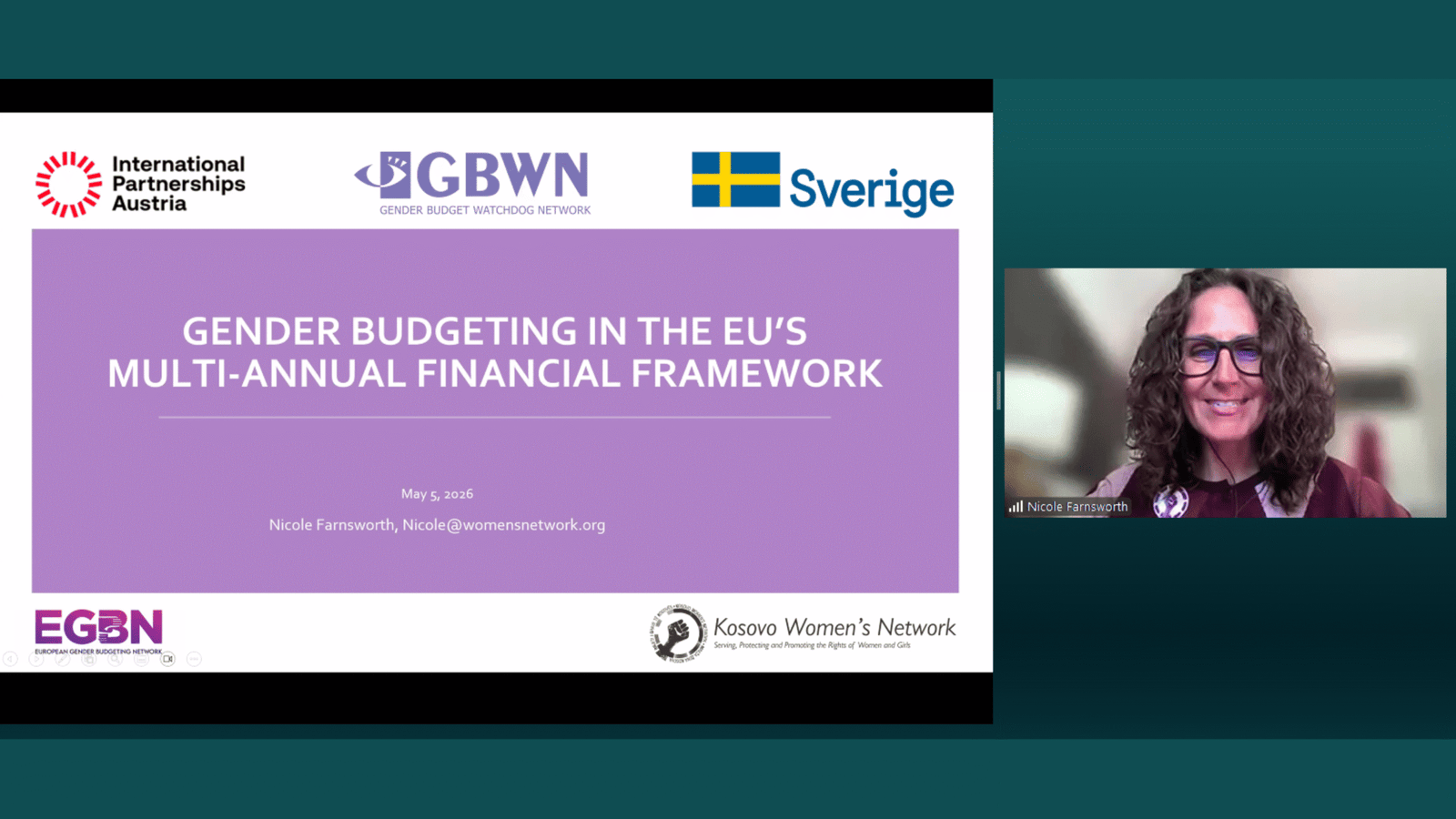
Elirjeta Beka, our Gender Responsive Budgeting Coordinator, recently participated in the Gender Responsive Budgeting (GRB) Community of Practice in Skopje, presenting the Kosovo Women’s Network (KWN) paper titled “Gender-Responsive Taxation in Kosovo: Enhancing Equality Through Progressive Policies.” Emphasizing the critical need for gender analysis in tax policy, her presentation took place during the panel on “National Strategies: Effective Budgeting for Equality.” Despite GRB being a legal obligation in Kosovo since 2015 and part of the Law on Gender Equality, issues such as the lack of harmonization with other laws, inconsistent implementation across public institutions, and limited public access to GRB annexes persist. These challenges underscore the need for more comprehensive and transparent implementation of GRB. 

The current tax system in Kosovo does not fully consider gender disparities, often exacerbating inequalities faced by women, including lower employment rates, lower wages, and a greater burden of unpaid care work. To address these issues, KWN recommends eliminating gender bias in taxation, increasing progressivity in personal and corporate income tax rates, and conducting gender impact assessments of the tax system. Additionally, policy options such as introducing financial transaction and carbon taxes, applying reduced VAT rates on essential goods, and exempting menstrual hygiene products from taxes are vital steps toward promoting social equity and enhancing economic participation and fairness for women in Kosovo. 

Renowned experts from around the world participate in the Community of Practice, organized by the Gender Budget Watchdog Network, of which KWN is an active member. The conference was supported by the Austrian Development Agency and Swedish International Development Agency. 

KWN Shares Achievements at 21st Annual Meeting 

The 21st annual membership meeting of the Kosovo Women’s Network was held on Saturday, May 25. It was attended by participants from member organizations, partners, and collaborators from state institutions, friends, and supporters 

In her introductory speech, the Chairman of the Board of KWN, Ariana Qosaj Mustafa, highly appreciated the Network’s work during 2023 in implementing its strategy. She emphasized the importance of unity and the continuous commitment of all members as an essential factor for success. 

She recalled the story of Network’s tireless dedication, which has managed to create a powerful movement that serves as an example in the region and continues to pave the way for future generations. 
 
The Minister of Justice, Mrs. Albulena Haxhiu, expressed thanks and gratitude for the Network’s three decades of work and commitment in protecting the rights of women and girls and advocating for equality. Ms. Haxhiu called for the joining of forces and pledged to continue cooperation to achieve new societal progress.

Member of Parliament Eliza Hoxha was also part of the Assembly. In her speech, she welcomed the will and persistence of women to achieve their goals, seeing this effort as a window of opportunity for all women who want to change their reality. “By stepping outside the boundaries set by society, women become part of platforms that empower and support each other,” she added. 

International support is essential in this path toward gender equality and justice. Sandra Horina, Adviser and Head of the Office, Austrian Development Cooperation in Kosovo, described the KWN as a successful example of empowering women in the region. She thanked the Network for its relentless work and capacity building of its members, expressing continued support for their future projects. 
 
 “The network has laid the cornerstones for equality and has played a key role in empowering women’s organizations,” said Vlora Tuzi Nushi, Head of the Office in Kosovo, UN Women. She expressed UN Women’s support for the Kosovo Women’s Network and added that they would continue to take responsibility for implementing the agenda for gender equality in Kosovo and internationally. 
 
 Safete Rogova, an actress, humanist and women’s rights activist, moved many emotions guests with her interpretation of the poem “I am with you”. She dedicated it to her sister and all women activists, marking 35th anniversary of the activism of the Qiriazi Sisters Association.  

This year, the annual “Sevdije Ahmeti” award was given to Sakibe Doli Dobruna, a consultant for the Safe House in Gjakova. “This award is a testament to the hard work and dedication of all women who have fought and continue to fight for gender equality and social justice.” – said Mrs. Sakibe. 
 
KWN staff reported on the results throughout 2023, towards implementation of the KWN Strategy for 2023-2026. Some of the achievements mentioned included:             

  • More than 70% of the KWN Strategy for 2023 has been implemented. 
  • 253 women have participated in decision-making processes, totaling 6,447 since 2012.  
  • KWN has influenced 10 public policies, reaching a total of 267 influenced policies since 2012. 
  • 10 different women’s organizations actively participated in the EU accession processes. 
  • The EU accession documents significantly better reflect the gender perspective, integrating up to 75% of KWN comments.  
  • KWN contributed to the Law on Public Finances, with 11 KWN members participating in the 2023 budget consultation 
  • 556 individuals were inspired to defend their right to quality health services, totaling 2,555.  
  • 20 women have submitted complaints to the relevant authorities for violation of health rights.  
  • 3 laws and public policies related to the participation of women in the labor force have been improved, totaling 6.  
  • 25 diverse women and men have been made aware of women’s rights to inheritance and property, totaling 10,143. 
  • 178 women who experienced gender-based violence received legal assistance (28 in 2023). 
  • Institutions have improved their performance and legal infrastructure to address gender-based violence. 
  • 92 institutional representatives have been trained to implement the legal framework. 
  • Awareness raising about gender-based violence has improved. 
  • 17 cases of gender-based violence were monitored. 
  • 10 schools were observed, and 5 advocacy initiatives towards improving curricula and teaching methods from a gender perspective were undertaken. 
  • 7 joint initiatives with members and organizations in the region, totaling 261 since 2012. 
  • 29 grants were given to 25 organizations, totaling 281 grants to 153 organizations since 2012. 
  • 4 policy changes resulted from advocacy initiatives of KWF grantees .


The 21st Annual KWN Membership Meeting was funded by the European Union Office in Kosovo, the Austrian Development Agency (ADA), and co-financed by the Swedish International Cooperation and Development Agency (Sida), the Kvinna till Kvinna Foundation, and the Sigrid Rausing Trust.   

Throughout the year, the KWN’s efforts for gender equality have been supported by the United Nations Population Fund (UNFPA) and UN Women. 

Reaction: Lack of Public Consultations regarding the Medium-term Expenditures Framework(MTEF)

Honorable Prime Minister of Republic of Kosovo, Mr. Kurti,

Honorable Minister of Finance, Labour and Transfers, Mr. Murati,

The Kosovo Women’s Network (KWN) is deeply concerned about the Ministry of Finance, Labour and Transfers’ (MFLT) recent publication of the Medium-Term Expenditure Framework (MTEF) for 2025-2027. The MTEF bypassed the public consultation process mandated by Regulation (GRK) no. 05/2016 on minimum standards for public consultation process. Public consultations are essential for transparency and to ensure the MTEF reflects the needs of all citizens, including women, men, girls and boys.  This lack of transparency also hinders citizens’ and experts’ ability to analyze the budget’s intended impact, particularly regarding gender equality.

Furthermore, the MFLT has not released a Gender Budget Statement (GBS) or published the required gender-responsive budgeting annexes.  GBS is critical for promoting gender equality in budgeting by outlining how the budget has planned to allocate resources to furthering gender equality by addressing the specific needs and priorities of women and girls.  and Kosovo’s interest in implementing frameworks like Public Expenditure and Financial Accountability PEFA highlight the importance of gender-responsive public financial management (GPFM) and UN SDG 5.c.1. To date, these crucial documents have not been made available on the Government’s websites, in terms of transparency and compliance with the SDG 5.c.1 indicator.  A GBS and published annexes would demonstrate how the budget advances gender equality and ensures public access to clear and comprehensive budget information.

KWN urges the MFLT to rectify this situation. Public consultations for the MTEF should be launched immediately, adhering to Regulation (GRK) No. 05/2016.  These consultations should be inclusive and accessible to a diverse range of stakeholders, including civil society organizations, women’s groups, and the general public. Public participation in the MTEF development process allows citizens to understand how public funds will be allocated and advocate for their priorities.  This fosters transparency, accountability, and a more equitable distribution of resources.

Thus, the Kosovo Women’s Network requests that the Government of Kosovo and specifically MFLT:

  1. Urgently launch the required a public consultation on the MTEF, as well as for upcoming annual budgets as per Regulation (GRK) no. 05/2016 on minimum standards for public consultation process. 
  2. Publish a Gender Budget Statement in line with SDG indicator 5c1, illustrating how the budget will contribute to the advancement of gender equality in Kosovo in line with the Government’s commitments.
  3. Publish transparently online all gender budget annexes, as mandated by budget circulars, which must be submitted by budget organizations.

We hope that you will take concrete steps in addresing our recommendations, and we are available to meet to discuss further. 

Sincerely,

Igballe Rogova

Executive Director

Kosovo Women’s Network