KWN Launches Exhibition: “Break the Silence: Ending Violence Behind Walls”

On 14-16 June in “Skënderbeu” square, Prishtina, 665 people visited the exhibition “Break the silence: Ending violence behind walls”, hosted by the Kosovo Women’s Network (KWN).

Symbolically this exhibition portrayed a labyrinth, resembling a home where domestic violence occurs. Stories and statistics about violence hung in frames on the walls. Through multimedia and interactive materials, visitors heard real stories of women and men who have suffered domestic violence in Kosovo.

An estimated 68% of Kosovar women have experienced domestic violence in their lifetimes, according to a 2014 national household survey by KWN. The harrowing stories and statistics within these walls affected those who had the courage to walk inside the labyrinth.

“When you were inside those walls, it was very hot and suffocating, but interestingly, once you walked out there was a fresh breeze of hope,” observed Reyes Charle Cuellar, Gender Adviser at the European Union in Kosovo.

Upon exiting from behind the walls, visitors found a host of institutions, the “retaining walls” available to provide support to persons who have suffered violence. These walls displayed the roles and responsibilities of institutions that deal with domestic violence, as well as where to report concerns if institutions do not carry out their responsibilities appropriately.

Visitors expressed their appreciation for providing access to such important information.

“Thank you very much for what you have done because these stories are my stories,” a woman told KWN, accompanied by her teenage daughter. “I just received legal aid, and my case is at court, but now I know which institutions to go to if I do not see justice, such as the Ombudsperson Institution. We have photographed every sign [of institutions], so I have this information in the future if I need it.”

The exhibition sought to encourage people to break the silence behind walls, and to seek support from institutions when violence occurs.

“Domestic violence is not a private matter,” said Igballe Rogova, KWN Executive Director, emphasizing society’s role in addressing it. “Domestic violence is a public matter and citizens must be active,” she said.

Gunther Zimmer, ADA Head of Office said that fighting domestic violence is an important priority for the Austrian government and that ADA has successfully cooperated with KWN to fight this phenomenon in Kosovo since 2012.

“We have seen important changes, such as the approval of the National Strategy for Protection from Domestic Violence, and finally the inclusion of domestic violence as a specific offence in the Criminal Code of Kosovo”, he said.

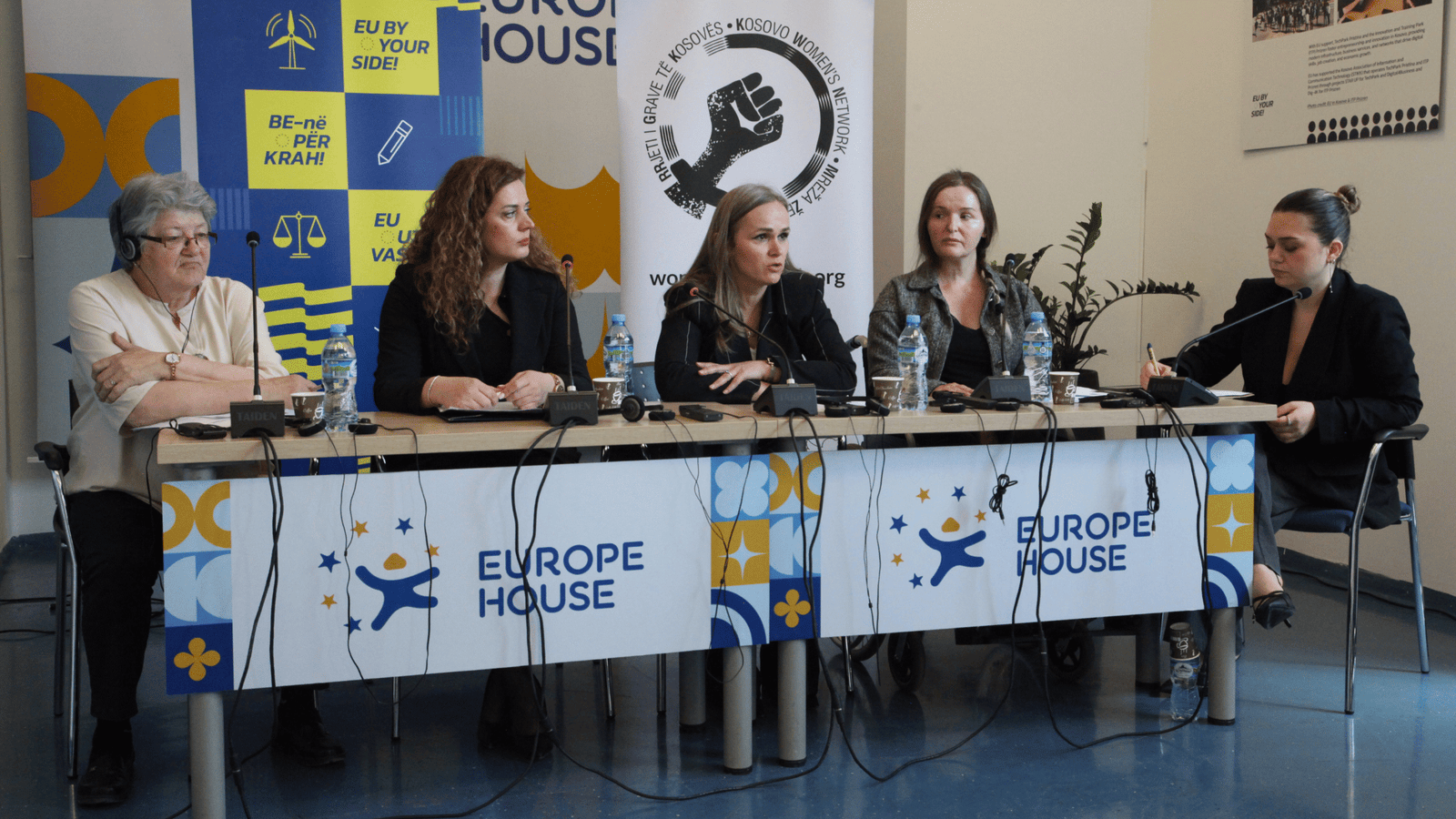
Vlora Nushi, Head of Office at UN Women; Hilmi Jashari, the Ombudsperson of Kosovo; and Deputy Minister of Justice Naim Qelaj, the National Coordinator against Domestic Violence also provided remarks at the grand opening. Several representatives of Kosovo institutions participated as well.

The exhibition will be open to visitors in five other municipalities in the upcoming months, specifically in Gjilan, Gjakova, Ferizaj, Peja and Mitrovica. It will also visit other municipalities in the future.

This exhibition was supported by the European Union (EU) through UN Women (#EVAW), the Austrian Development Agency (ADA), TOML, Night Design, and several volunteers and businesses.

For more pictures of the exhibition click HERE.

In THIS interview, Adelina Berisha, Advocacy and Research Coordinator on Gender Based Violence at KWN, explained the exhibition in more detail (available in Albanian only).

https://womensnetwork.org/gjilan-becomes-the-second-city-to-host-the-break-the-silence-ending-violence-behind-walls-exhibition/

“Freedom vs Shame” marks the 7th Edition of FemArt Festival 

For the seventh time, the Center for Art and Community – Artpolis, a member organization of Kosovo Women’s Network (KWN), hosted the FemArt Festival– a regional festival for artists and activists, held in Prishtina on June 10-16. 

This year the festival’s motto was “Freedom vs Shame” encouraging women to take ownership over their lives, promoting life and society free from prejudices. FemArt’s motto aimed to empower all women regardless of any possible difference. 

FemArt brought in the capital city around 200 female artists and activists from Kosovo, the region, Europe, America, Asia, and Africa, as well as engaged 30 young volunteers from all communities in Kosovo.

In addition to music and poetry, part of the Festival was also discussion panels as; “Female artist in the decision-making process”, “Young Peace Promoters from Region”, “Discussion between the Generations on Feminist Activism in the Former Yugoslavia”, et cetera. 

During these seven days, activists conveyed the message of the Festival that women and girls should be free, should live as they want and make decisions beyond from what is considered as “shame” from a patriarchal society. 

FemArt Festival was among the 20 activities of marking the 20th anniversary of Prishtina’s liberation, co-organized with the Municipality of Prishtina. 


KWN calls on MPs not to pass the current Labour Law in the Parliament

Dear deputies,

We are writing to you in regards to the draft Labor Law, currently in the parliament.

Kosovo Women’s Network considers that the current format of this draft Law, except all ways of regulating parental, leave, maternal leave and paternal leave, it also does not specify in any way discrimination in the employment context. This Draft-law as such leaves women in the labor market unprotected and has a significant absence of a gender perspective between women and men, specifically in the employment context.

Driven by this preoccupation and hoping that we can count on your collaboration, we ask you to take into account our recommendations listed below into amending the Labor Law in such a way, that it clarifies the dispositions regarding labor discrimination. Hence, cases of this sort will be able to be resolved based on the Labor law, apart from cases related to the Law nr. Nr. 05/L -021 on protection from discrimination.

Proposal

Consider establishing a more logical division of the legal framework, towards addressing the presently inharmonious legal framework’s overlapping and differing definitions and sanctions, which, at present, may contribute to confusion and legal uncertainty.

Consider amending the LL to specifically address discrimination in the employment context and the LPD to address discrimination in the non-employment context. This can be done by adding a paragraph such as the following:

Article xx , Types of Unequal treatment at work

  1. Types of unequal treatment of employees/employee candidates are:
    • Direct discrimination – shall be taken to have occurred where one employee or employee candidate is treated less favorably than another is, has been or would be treated in a comparable situation based on one or more grounds such as those stated in Article 1 of the Law on Protection against Discrimination;
    • Indirect discrimination – is considered when a provision, criterion or impartial practice in appearance, has or will put the employee or employee candidate in an unequal position compared with others, according to one or more of the grounds set out in Article 1 of the Law on Protection against Discrimination, unless the provision, criterion or practice can be objectively justified by a legitimate purpose and the means of achieving that purpose are appropriate and necessary;
    • Harassment – shall be deemed to be discrimination, when an unwanted conduct (including but not limited to unwanted conduct of sexual and/or psychological nature), which has the purpose or effect of violating the dignity of the employee or employee candidate, and of creating an intimidating, hostile, degrading, humiliating or offensive environment based on the grounds set out in Article 1 of the Law on Protection against Discrimination;
    • Incitement to discrimination – shall be prohibited when it amounts to promoting hatred towards the employee or employee candidate, based on one or more of the protected grounds listed in Article of the Law on Protection against Discrimination, and when done intentionally;


On article 5, On prohibiting all types of discrimination, to add a new paragraph that specifies the following:

  • Direct or indirect discrimination of men and women is prohibited during employment, promotion and capacity building, if that job may be performed adequately by

Justification

Addressing protection from discrimination specifically in the employment context, by mentioning, among others, types of discrimination such as harassment, sexual harassment, and incitement for discrimination; To differentiate direct discrimination from indirect discrimination and to add other listed justifications on discrimination.

The discrimination provisions of the LL can be described as minimalistic. These deficiencies are somewhat alleviated by Article 5.5, which provides that the Law Against Discrimination No. 2004/3 (now replaced by the Law on Protection from Discrimination No. 05/L-021) is directly applicable within employment relationships (dealt with separately below). However, more developed and detailed protection from discrimination specifically set out in the LL for the employment context would be preferable to this cross-reference. The only way direct and indirect discrimination is mentioned in the LL is against persons with disabilities.

The law does not address other necessary dispositions on causes of unequal treatment. Therefore, it is necessary to address and regulate protection from discrimination in the labor context.

We look forward to your good will and understanding, Sincerely,

Kosovo Women’s Network

Kosovo Women’s Network (KWN) is a network of more than 143 women organizations of all ethnic groups in Kosovo, advocating on behalf of Kosovar women at the national level, regional and international. KWN’s mission is focused on economic empowerment of women and in increasing their role in decision making.letter_Labour law_Reccomandations reagrding the Discrimination-converted

KWN calls on MPs not to pass the current Labour Law in the Parliament

Kosovo Women’s Network (KWN) on June 14 wrote a letter to the MPs of the Kosovo’s Parliament regarding the vurrent Labour Law.

Kosovo Women’s Network considers that the current format of this draft Law, except all ways of regulating parental, leave, maternal leave and paternal leave, it also does not specify in any way discrimination in the employment context. This Draft-law as such leaves women in the labor market unprotected and has a significant absence of a gender perspective between women and men, specifically in the employment context.

Through this letter KWN asked the MPS not to pass the current Labour Law in the Parliament.

Read HERE the full letter along with the KWN’s recommendations.

KWN Presents at EU Stakeholder Conference on Employment, Social policy

13 June 2019, Luxembourg – The Kosovo Women’s Network (KWN) participated in the stakeholder conference held in connection with the first ever EU-Western Balkans Ministerial meeting on employment and social affairs.

The EU Commission’s Directorate-General for Employment, Social Affairs and Inclusion (DG EMPL), responsible for EU policy on employment, social affairs, skills, labour mobility and the related EU funding programmes, today hosted a conference for stakeholders from civil society and social partners (e.g., trade unions) from the Western Balkans and EU to discuss their role, contribution and recommendations for the road forward for enhancing employment, developing social policies and furthering their implementation.

As a representative of women’s rights groups collaborating to address gender-based discrimination in labour in the Western Balkance, KWN’s Program Director / Lead Researcher, Nicole Farnsworth, said that “gender equality must be treated as part of the‘Fundamentals First’ Agenda of the EU”; gender equality is an essential part of reforms in all sectors, and not a separate issue to come after other reforms.  Specifically, in terms of social policy, the economic and social situation in the region cannot be improved without tackling gender inequalities. She noted that an interrelated social policy issue is the lack of accessible childcare and preschool education. Investing in these would create jobs, enable more women to work, improve children’s educational outcomes and thus future job prospects.

“Last but far from least, social policies need to better address gender-based violence,” she said. “Adequate state resources must be allocated for: temporary social housing; better social services; case management; trauma-sensitive vocational training and employment programs; and institutionalization of appropriate training for social service providers”.

The European Commission presented in February 2018 the Communication on “A credible enlargement perspective for and enhanced EU engagement with the Western Balkans”. The strategy calls for reinforcing the social dimension in the Western Balkans and increasing the focus on employment and social reforms, based on the principles of the European Pillar of Social Rights.

According to DG EMPL, social partners and civil society have a key role to play in the design and implementation of the policies affecting each and every citizen. This commitment was reiterated by representatives of the European Commission during the Stakeholder Conference.

“If we want to implement policies, we need people on the ground to implement these policies and take them forward,” stated Joost Korte, Director-General for Employment, Social Affairs and Inclusion at the European Commission, calling for the engagement of citizens in contributing to the EU Accession process.

This conference provided a space for an exchange between stakeholders, including participants of the Ministerial meeting, civil society and social partners regarding future cooperation. The senior level conference involved participants from the government administrations of the Western Balkans, social partners’ representatives from the Western Balkans and EU level organisations, government experts from EU Member States, civil society umbrella organisations from the Western Balkans and the EU, and regional and international organisations.

KWN utilized the opportunity to share some of the main findings from its research on gender-based discrimination and labour in the region, supported by the EU and Sida, and conducted together with its partners Gender Alliance for Development Center (GADC) in Albania, Helsinški parlament gradana Banja Luka in Bosnia and Herzegovina, Research in Action (Reactor) in North Macedonia, Centar za ženska prava / Women’s Rights Center in Montenegro and The Kvinna till Kvinna Foundation in Serbia.

KWN also used the opportunity raise issues that other partner women’s rights organizations in the region have emphasized previously as part of advocacy supported by the Kvinna till Kvinna Foundation.

Students from Amsterdam Appreciate the KWN’s Activism

On June 13 at the Faculty of Law building at  the University of Prishtina “Hasan Prishtina” a group of students from the Amsterdam University College, the Netherlands, met with the Kosova Women’s Network’s (KWN) Igballe Rogova and the Project Coordinator, Nertila Qarri-Gërguri. 

The students were introduced to the process of peace-building and activism in Kosovo during the ‘90s. 

During this interactive discussion, Rogova spoke about the “Motrat Qiriazi” Association, the history of the first movements on women’s rights in Kosovo, as well as the work done by KWN since its foundation. 

Qarri-Gërguri presented to the students an overview of the current work and strategy of KWN.

This was not the first year in which KWN met with students from this University, so the students expressed an interest in knowing more about women’s rights activists’ experiences in Kosovo, as well as recent developments and challenges in this area. 

The students appreciated the meeting, seeing it as a valuable experience and a good opportunity to closely understand the course of cultural and social processes throughout  various periods in Kosovo. 


Women Economic Forum addresses the MPs with Recommendations on the Labour Law

On June 12, the Women Economic Forum addressed a letter to the Kosovo Assembly MPs asking them not to pass the current draft Labour Law in parliament.

The Women Economic Forum considers that the current Labor law draft, which excludes all forms of regulating maternity leave, paternity leave, and parental leave, leaves women vulnerable to the labor market, and does not include a gender equality perspective.

This draft law in its current format is a serious threat to the well-being of women.

Given the urgent need to support 12% of women active in the labor market, in line with the National Development Strategy, the Women Economic Forum has presented the three following recommendations:

  • To include maternity leave, paternity leave and parental leave within the Labor Law
  • To include in the Labor Law the provision of breastfeeding hours in order to offer women protection to be breastfeeding infants during the first six months of childbirth, in accordance with EU directives
  • To transpose the concept of self-employment by adding a paragraph that would clarify the following:

“Self-employed parents who conduct economic activities for the purpose of profit, on their own account, are entitled to maternity leave and parental leave, same as employed parents.”

To read the full letter sent to MPs, click HERE.

Women’s Economic Forum is an independent body, which is comprehensive and unifying, which gathers around itself stakeholders, organizations and individualsof society that have an interest, play an active part and are engaged in the development of women in the economy. The Forum is jointly founded by eleven organizations throughout Kosovo that are actively involved in improving the position of women in Kosovo.

Members:

Kosovo Women’s Network (KWN)

Kosovo Women’s Network (KWN)

Riinvest Institute

Kosovar Gender Studies Center (KGSC)

Democracy for Development (D4D)

Shoqata e Grave “Medica Gjakova”

Center for the Protection and Rehabilitation of Women and Children “Liria”

Women for Women

The Network of Roma, Ashkali and Egyptian Women’s Organizations (RROGRAEK)

Women’s Business Association SHE-ERA.

Women Economic Forum addresses the MPs with recommendations on the Labour Law

Download File

Dear Deputies, 

We are writing to ask you not to pass the current draft of the Labor Law in parliament.

Women’s Economic Forum considers that the current Labor law draft, which excludes all forms of regulating maternity leave, paternity leave, and parental leave, leaves women vulnerable to the labor market, and does not include a gender equality perspective.

This draft law in its current format is a serious threat to the well-being of women.

Taking into account our concern, and hoping for your cooperation, we encourage you to support us in rejecting this draft law and in implementing its amendment with the following concrete recommendations that we have enlisted below, which are in accordance with the Kosovo Constitution, the Law on Equality Gender and relevant EU Directives.

Therefore, given the above-mentioned facts and the urgent need to support 12% of women active in the labor market, in line with the National Development Strategy, our recommendations are as follows:

  1. To include maternity leave, paternity leave and parental leave within the Labor Law

The current draft law does not recognize women as part of the working force. Instead, it excludes them from Labor law and treats them as a category that can’t contribute economically, but that can only reproduce. Workers should enjoy their rights in accordance with the Labor Law. The division of the provision of maternity leave from the entirety of articles of Labor Law is direct gender-based discrimination towards women.

Furthermore, national legislation that does not specifically refer to pregnancy and maternity as a form of gender discrimination makes discriminatory practices less visible and consequently more difficult to deal with. The current law discriminates against men by not offering them equal rights to be with their children, while simultaneously contributing to reducing the level of women’s participation in the domestic economy. According to the Law on Gender Equality, in order to achieve equilibrium between parents in their equal role, equal economic and social rights and responsibilities, policies should be established, the implementation of which would provide a basis for an equal parental role.

  1. To include in the Labor Law the provision of breastfeeding hours in order to offer women protection to be breastfeeding infants during the first six months of childbirth, in accordance with EU directives.

Law on Protection of Breastfeeding Nutrition, no. 05 / L-023, suggests that if the worker breastfeeding does not use maternity leave after the sixth month, then from the sixth to a year she has the right to leave for a period of two hours per day within working hours, not including regular working hours, to feed the suckling baby. After the first year, an employee breastfeeding a breastfeeding child is entitled to a one-hour rest period. But this law does not offer women protection to be breastfeeding infants during the first six months of childbirth.

By not providing such protection, the law relies on the assumption that women will not work these past few months, while paradoxically hinders women to work. Breastfeeding rest should be regulated in the framework of the Labor Law, given the direct connection to this Law. It is unacceptable that the Labor Law that deals with working conditions and the health protection of workers, leave out employees that gave birth or the breastfeeding ones.

  1. To transpose the concept of self-employment by adding a paragraph that would clarify the following:

“Self-employed parents who conduct economic activities for the purpose of profit, on their own account, are entitled to maternity leave and parental leave, same as employed parents.”

Justification

The concept of self-employment should be transposed into law, so that all self-employed persons who develop economic activities for the purpose of personal profit on their own account, under the conditions provided by national legislation and spouses or self-employed partners who participate in carrying out activities in the self-employed business, have access to the benefits of social and maternity protection, relying solely on this family relationship.

Reiterating that it is unacceptable to pass a labor law that does not treat women as a workforce, we inform you that we are ready for a meeting with you in order to jointly address these recommendations and introduce the model of re-prepared by us.


Sincerely,

Women’s Economic Forum

Women’s Economic Forum is an independent body, which is comprehensive and unifying, which gathers around itself stakeholders, organizations and individuals of society that have an interest, play an active part and are engaged in the development of women in the economy. The Forum is jointly founded by eleven organizations throughout Kosovo that are actively involved in improving the position of women in Kosovo.


Members:

Kosovo Women’s Network (KWN)

Riinvest Institute

Kosovar Gender Studies Center (KGSC)

Democracy for Development (D4D)

Shoqata e Grave “Medica Gjakova”

Center for the Protection and Rehabilitation of Women and Children “Liria”

Women for Women

The Network of Roma, Ashkali and Egyptian Women’s Organizations (RROGRAEK)

Women’s Business Association SHE-ERA.

Ruka Ruci Supports Women of Plemetin to Engage in Politics

On June 11, “Ruka Ruci” organization held an informative session with Serbian women in Plementin of Obiliq/Obilić to brief them on the initiative ‘Strengthening women’s participation in politics”.

This four-year-long initiative is implemented by Kosovo Women’s Network (KWN) together with Ruka Ruci, Organization of Persons with Muscular Dystrophy of Kosovo (OPMDK), and the European Women Lawyers Association (EWLA), whereas it is supported by the European Union (EU) Office in Kosovo. 

Nevenka Rikalo, Executive Director of Ruka Ruci, shared with the participants the objective and expectations from the implementation of this joint initiative. 

“We need to stay united to further increase women’s empowerment in decision-making. For any gender-related issues that you may have, you can count on KWN.  Because KWN is a place where you can address your problems regarding the issues that are bothering you,” she said.

Rikalo also familiarized women with two ongoing and very important collaborations of women, which function under the KWN’s umbrella, namely the Coalition for Equality (CfE) and the Lobby for Gender Equality (Lobby).  

Whereas, Zivadinka Radosavljevic, leader of the organization “Idemo Pravo” (Moving forward) expressed her concern over the women’s lack of access to information. 

Jelena Radosavljevic, a nurse, highlighted gender stereotypes that continuously discriminate against women. 

“For every imitative you take, no matter how good or skilled you are, you are still morally identified as a woman. It is very hard because society  stigmatizes you. Even in school if you go as a parent raising an issue, even in this case there are fingers pointing at you. Being a woman here means that you can do almost nothing at all, ” said Radosavlevic.  

The attendees agreed on the importance of increasing the number of women in politics and decision-making process. So far such meetings have been held in Gracanica, Novobërdë, Zubin Potok, Uglare and in North Mitrovica.

This initiative is supported by the European Union (EU) Office in Kosovo. 


KWN Held its Second Membership Meeting for 2019

Pristina– Kosovo Women’s Network (KWN) on 10 June held its second membership meeting for 2019, attended by approximately 60 representatives of KWN’s member organizations, the Kosovo Lobby for Gender Equality (Lobby), Kosovo institutions and other supporters of KWN’s work and cause.

Igballe Rogova, KWN’s Executive Director opened the session by recalling the recent launching of the activist Sevdije Ahmeti’s book, while she added that the monetary amount collected from the sales will be donated for Kosovar girls’ education.

Additionally Rogova talked about the 13th round of Kosovo Women’s Fund (KWF) of Kosovo Women’s Network (KWN), which is expected to open within a few weeks.

“Providing grants is not the sole purpose, but it is also to empower our member organizations and enhancing their capacities. It is fortunate that we started this process with Kvinna till Kvinna, and now the chance to have more grants to support our members is increased”, she said.

An important part of this meeting was also the discussion about the exhibition against domestic violence, organized by KWN on 14,15 and 16 June at the “Skendërbeu” square in the capital city.

Advocacy and Research Coordinator on Gender Based Violence at KWN, Adelina Berisha shared with the participants the aim of this exhibition.

“This exhibition comes as continuity of the activities and the fight against domestic violence that women face. The exhibition is in all municipalities of Kosovo, and you are invited to support the opening of the exhibition in Prishtina to show solidarity among women”, stated Berisha.


More about this exhibition read HERE.

Nicole Farnsworth, KWN’s Program Director and Lead Researcher spoke about the advocacy that KWN is doing in the amending process of the Labour Law, specifically the part which stipulated maternity leave.

“We are advocating against the new Labour Law, because it encourages women to stay at home and not to work. We must oppose this law, we are advocating for gender equality”, Farnsworth said.

Feride Rushiti, Executive Director of The Kosova Rehabilitation Centre for Torture Victims (KRCT), spoke about the International Festival of Female Artists and Activists- FemArt, held from 10 to 16 June in Prishtina.

“As part of FemArt we also have a conference. It is very important to continue with the spirit of solidarity, we have named this conference “Unbreakable”, where there will be three panels to discuss about the silence surrounding this crime [sexual violence] during these years”, she said.

Shpresa Agushi from the Network of Roma, Ashkali and Egyptian Women’s Organizations (NRAEWOK) has called for everyone’s support, recalling the attack on Roma woman which took place a few days ago.

Biljana Nastovska, Gender Advisor, Organization for Security and Co-operation in Europe- OSCE, stated that women’s movements are crucial in each state.

“Your work [Kosovo Women’s Network work] will give us “weapons” within our workplace, because no one wants to go against such a strong Network”, she said.

Members of KWN’s Assembly during this two-hour meeting shared information about the activities taking place in their municipalities/organizations. Also members were briefed with the activities by which FemArt Festival will be marked this year, as well as with the international conference “Women Deliver”, part of which is wartime sexual violence survivor Vasfije Krasniqi-Goodman.

This meeting was supported by the European Union (EU) Office in Kosovo and Austrian Development Agency (ADA).

READ ALSO: KWN Holds First Membership Meeting for 2019.