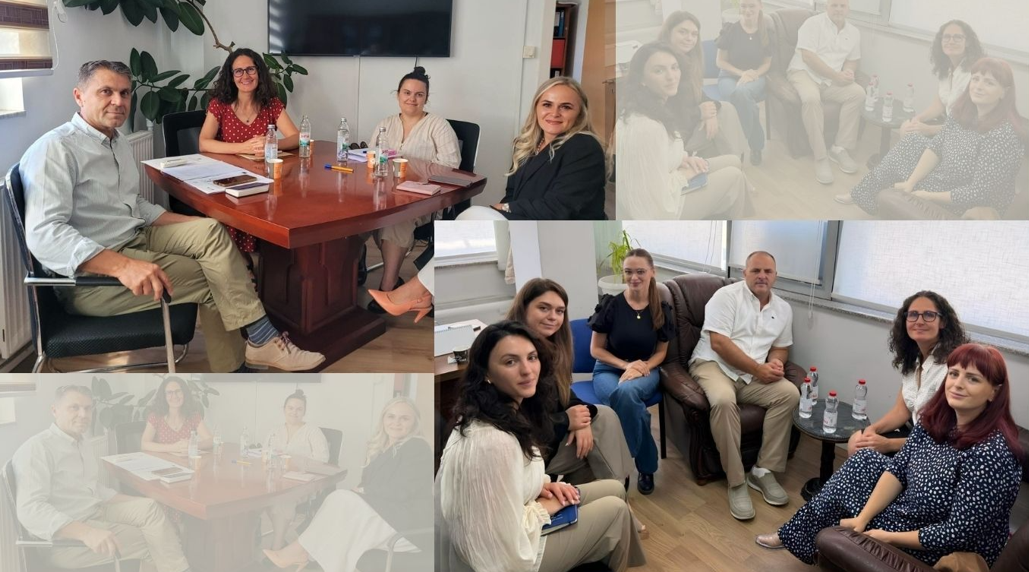
As part of its ongoing efforts to strengthen gender-responsive governance at the local level, this week the Kosovo Women’s Network (KWN) met with municipal representatives to support the integration of a gender perspective into planning, budgeting and service delivery.
On 28 July, KWN met with representatives of the Directorate of Agriculture and Rural Development, the Directorate of Finance and the Municipal Gender Equality Officer in the Municipality of Fushe Kosovo. Discussions focused on strengthening the implementation of gender-responsive budgeting across municipal sectors, including agriculture, by promoting equal access to municipal resources and ensuring that budget planning and allocations respond to the different needs of women and men. Participants also explored ways to enhance inter-institutional cooperation, improve local mechanisms for advancing gender equality and addressing gender-based violence, and strengthen the use of sex-disaggregated data to inform decision-making and municipal priorities.
The meetings continued on 31 July with representatives of the Directorate of Social Welfare in the Municipality of Pristina and the Centre for Social Work in Qafa, Pristina. The discussion with the Centre for Social Work focused on the need for an Emergency Fund, highlighted as essential for the effective and timely management of cases, as well as the need for additional staff to better manage its workload and provide adequate support to beneficiaries.
With the Directorate of Social Welfare, the discussion focused on the integration of Gender-responsive Budgeting into social welfare planning and budgeting, including the assessment of women’s and men’s needs for social services, the availability and use of disaggregated data, identified needs of women and girls, adequacy of current budget allocations, gaps in services and investment from a gender perspective, and cooperation between the Directorate, the Gender Equality Officer and the Directorate of Finance.
Furthermore, the discussion addressed the availability of sex-disaggregated data, particularly regarding women staying in shelters, including the number of days they remain there. The meeting also explored whether the Centre maintains a database and what types of data are collected and recorded. This information was considered important for supporting more accurate and evidence-based budgeting requests submitted by the Centre for Social Work to the Directorate of Social Welfare within the Municipality of Pristina.
These meetings were supported by the East-West Management Institute (EWMI), the European Union Office in Kosovo, International Partnerships Austria and Caritas Switzerland.