The Administrative Burden Reduction (ABR) Process, including government programmes for 2022–2027 and 2025–2028, have sought to modernise Kosovo’s public administration, simplifying procedures for people and strengthening efficiency, transparency and public trust.
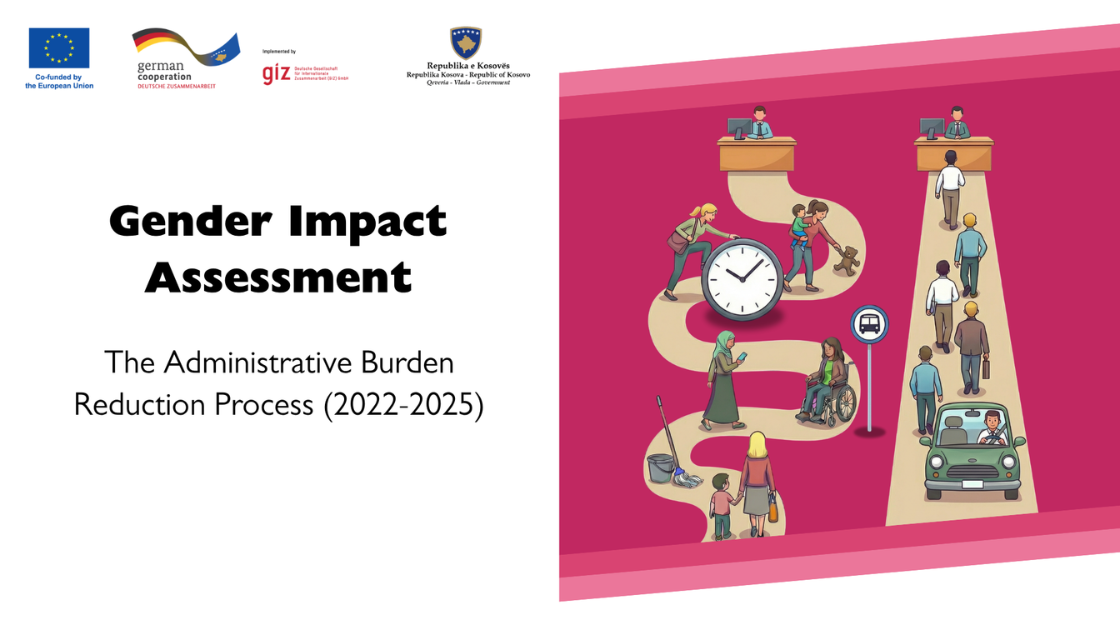
On 31 March, the Strategic Planning Office in the Office of the Prime Minister (OPM), supported by the Administrative Burden Reduction initiatives, co-financed by the European Union (EU) and Germany and implemented by GIZ Kosovo, officially launched the Gender Impact Assessment of Administrative Burden Prevention and Reduction Programs in Kosovo.
The Kosovo Women’s Network (KWN) was contracted to conduct the assessment, which aimed to learn from previous ABR programmes towards ensuring that gender equality is systematically integrated in future action plans, programmes and activities, making them more inclusive and responsive to the needs of all citizens.
The Assessment is among the first comprehensive ex-post gender impact assessments to be conducted for a government strategy or program, aside from those focused on gender equality, and the first-of-its-kind gender impact assessment of ABR in the Western Balkans. Thus, it also serves as an example for other ministries as to the importance of such analyses and how to conduct and use them to inform future programs across diverse sectors.
The launching event underscored the importance of gender analysis and gender-responsive tools for shaping more inclusive, accessible and equitable public services.
“This [European] Commission aims for a simpler and easier Europe, as well as a simpler and more efficient administration, which is essential. We can make public administration very simple, but at the same time we have to add value,” said Hubert Perr, Head of Cooperation at the EU Office in Kosovo. “This comprehensive part is really key: not only reducing burden, but also integrating gender equality as an element that adds value”, he emphasised.
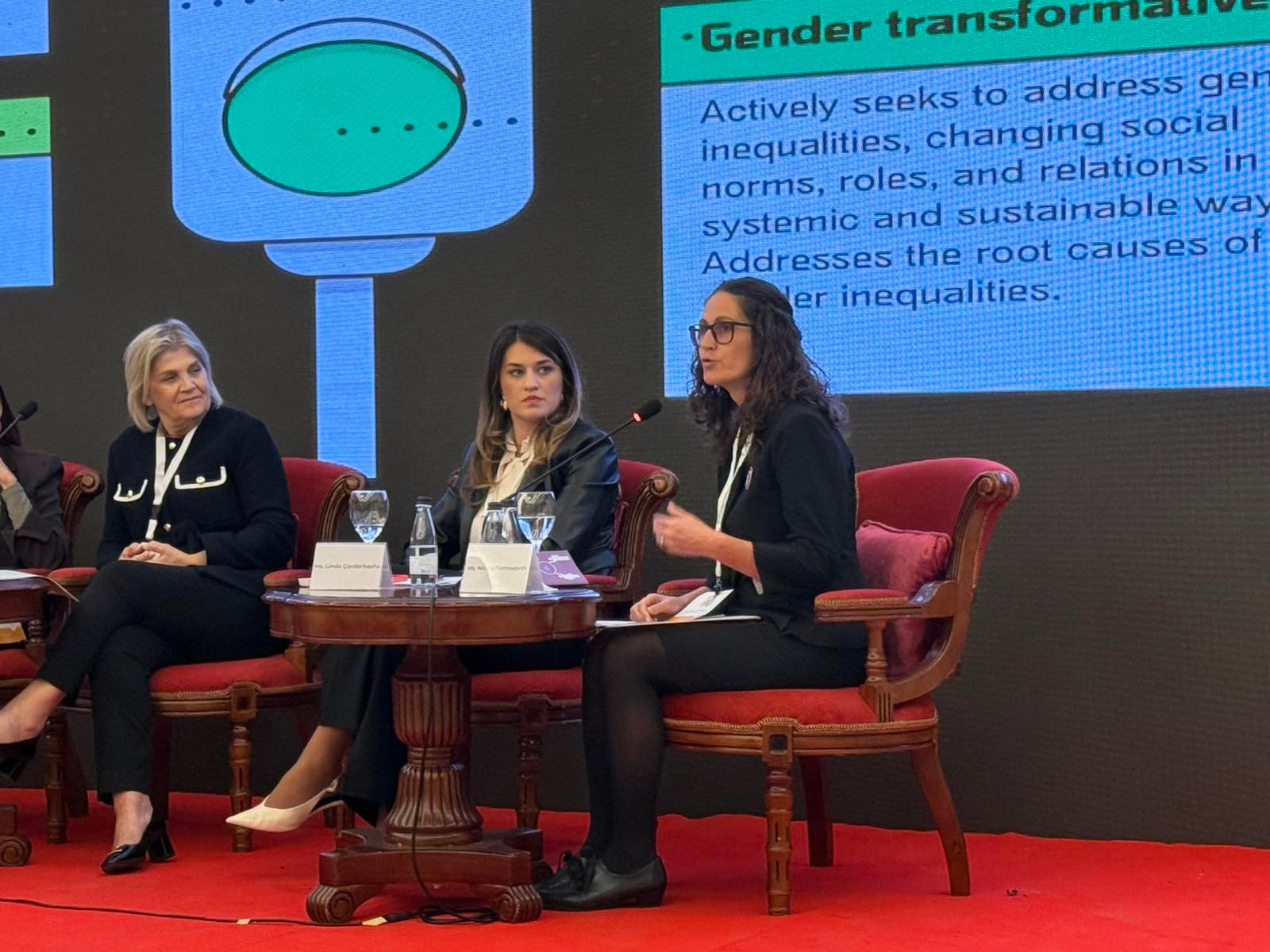
Nicole Farnsworth, KWN Deputy Director and Lead Researcher who led the assessment, in close cooperation with Ariana Qosaj-Mustafa and Donjeta Morina, echoed Mr. Perr’s remarks, emphasising that the Assessment shows how gender analysis does not necessarily create extra administrative burden (as sometimes suggested). Rather, through digitalising data collection, ensuring interoperable use of data and utilising gender analysis in planning and evaluation, the government can design more efficient and impactful programs.
The research included gender analysis of legal documents, a survey of 203 public officials (48% women) and 247 citizens (75% women), and 34 interviews with institutions, donors and civil society (65% women).
Findings show that the 2022-2027 Administrative Burden Prevention and Reduction Program did not include gender equality objectives and indicators to monitor the impact of reforms. Meanwhile, the 2025-2028 program recognised some issues, such as the lower participation of women in training (39% in 2023), which enabled actions to successfully increase women’s participation to 45% in 2024.
The analysis emphasises that digitalisation and simplification of procedures have brought significant benefits, reducing administrative barriers. Services such as eKosova have facilitated access for women with limited mobility or living in rural areas, reducing the need for physical visits and waiting in lines.
“Women have less time, so by digitalising processes, we are saving that little time that they have”, a research participant observed.
Mrika Berisha from the Strategic Planning Office provided several examples as to how ABR initiatives had reduced burden for women, such as life-event services, particularly those related to childbirth registration and linked benefits, which have streamlined administrative steps for new parents and reduced the need for multiple submissions of personal data. Also, Suhareka’s good practice of offering incentives for women to register property, potentially bringing broader impacts for women’s more equal access to property, is now being scaled up to other municipalities, to name a few, also emphasising that the Blueprint emerging from this report will serve as a foundation for systematically integrating a gender perspective into future ABR reforms.
Despite substantial progress, ABR benefits depend on internet access, digital skills and service design. Findings highlighted that only a fraction of procedures are fully digitalised, with many still requiring physical verification. Many users seek help from family members or others to apply for services. While these barriers affect everyone, they have a greater impact on women with care responsibilities, people with disabilities, residents of rural areas, minority groups (due to language), older people and those with lower levels of education.
“If you have a smart phone, you need to understand how to open eKosova with it”, a research participant said. “Maybe only 5% of persons with disabilities can do this; it’s especially harder for older persons.”
Meanwhile, the review of concept documents and policies found that policy and legal analyses rarely included the legally obligatory intersectional gender impact assessments, which could contribute to inadequate consideration of how different social factors affect diverse women and men’s access to public services.
The report recommends integrating obligatory gender impact assessment into programming documents and checklists, ensuring more structured cooperation with gender equality mechanisms, better informing diverse women and men how to use eKosova services and continuing to digitalise and simplify services citizens use most. For example, research participants said reforms should continue to focus on procedures related to life events, such as linking death registration with inheritance rights (towards safeguarding women’s equal access to inheritance); online or more accessible certification for persons with disabilities and the elderly; and easier access to social protection, health, employment and professional licensing services.
The Minister of Digitalization and Public Administration, Lulëzon Jagxhiu, emphasised that the Administrative Burden Reduction Process is a key reform of public administration and digitalisation. “The report recognises the progress we have made in advancing our inclusive approach to public administration reform and the delivery of public services through a life-event-based model”, he said, giving the example of integrated services related to childbirth, which were launched last year. These services “enable a reduction in administrative burden for new parents – in particular for pregnant women and new mothers”, Jagxhiu explained. “Furthermore, the design of these services has been based on a design-thinking process, involving parents from different population groups, including single mothers”. Jagxhiu concluded by stressing that the goal is for such good practices not to remain isolated cases; “Our aim is for the addressing of the specific needs of women and vulnerable groups to be systematically incorporated into all administrative reforms”, he said, emphasising that the blueprint emerging from this report will serve as a foundation for systematically integrating a gender perspective into future ABR reforms.
The SIGMA representative congratulated the government for this meaningful analysis and stated that the findings would be useful as part of its work with the government related to public administration reforms towards a simpler administration that is both impactful and has value to citizens.
The presentation brought together key stakeholders from the Government of Kosovo including the Agency for Gender Equality and Office of Good Governance, as well as the EU Office in Kosovo, the German Embassy, GIZ and civil society.