By Adelina Berisha, Director of the Programme for Addressing Gender-Based Violence at the Kosovo Women’s Network (KWN)
Yesterday’s killing in Gjilan once again highlights the urgent need for Kosovo to address femicide as a phenomenon rooted in gender inequality and unequal power relations.
Although Kosovo’s legislation recognises gender as an aggravating circumstance, this alone is not enough. Killings of women must also be investigated in the context of gender-based violence, taking into account the circumstances leading up to these killings.
Kosovo urgently needs a legal definition of femicide and a Femicide Watch mechanism to systematically monitor and analyse cases, identify institutional failures and help prevent future killings. These measures are consistent with the principles and obligations set out in the Istanbul Convention on preventing violence against women, protecting victims and prosecuting perpetrators.
A woman should not have to have reported violence to be taken seriously by the justice system. The absence of a prior report of violence does not mean that no violence occurred. Institutions must investigate the history of the relationship, including any threats, controlling behaviour and other possible forms of violence, to ensure that the woman’s experiences prior to her killing are taken into account both during the investigation and when determining criminal responsibility.
Justice cannot be limited to the killing itself. It must examine the full context of the violence and any institutional failures that may have contributed to the loss of life.
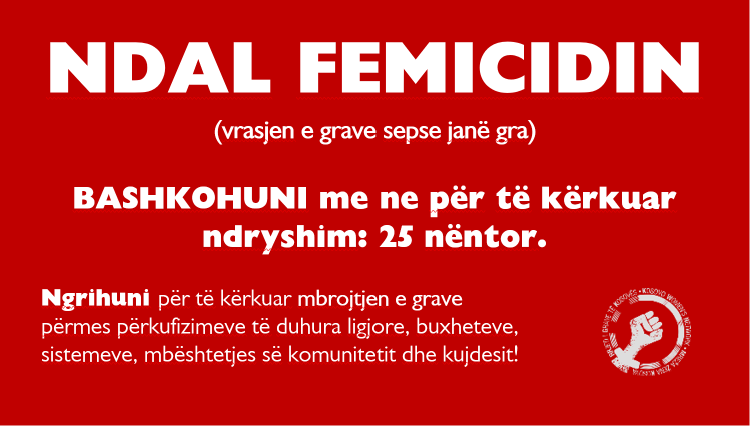
On 25 November, KWN calls on all citizens, organisations and institutions to join the nationwide protest against femicide and gender-based violence. Let us turn solidarity into action and demand justice, accountability and concrete measures to prevent femicides.
Not one woman less. No killing without justice.