KWN introduces psychology students to its programs and activities towards gender equality

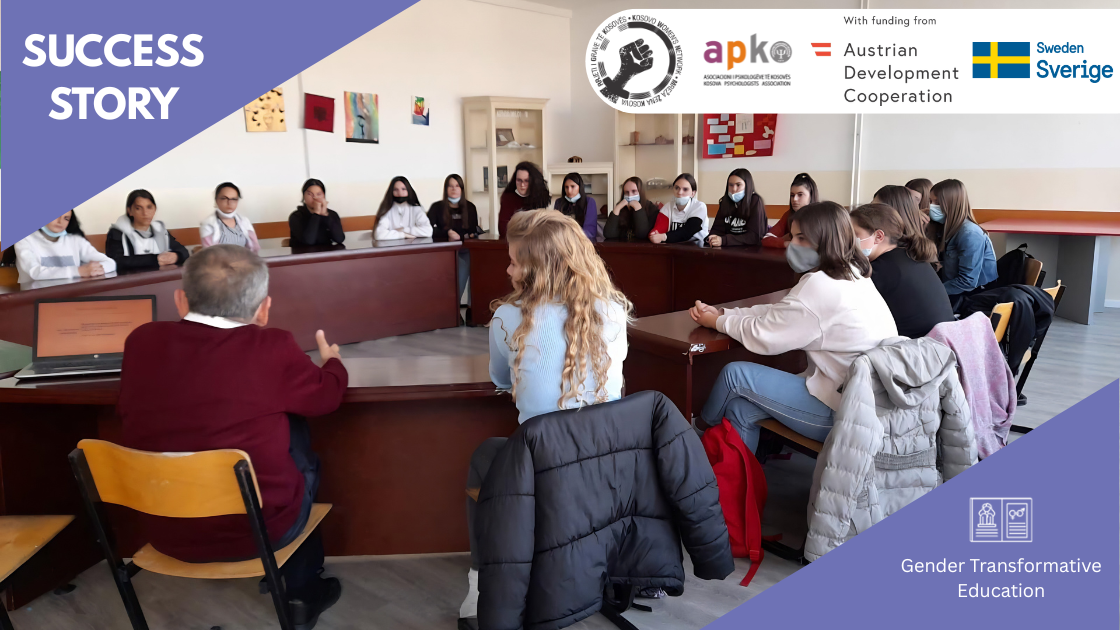
 On 24 May, at the invitation of Prof. Dr. Kaltrina Kelmendi, Adelina Berisha from Kosovo Women’s Network (KWN) held a presentation on KWN program and activities to the students of the Gender Psychology class, Department of Psychology, Hasan Prishtina University of Prishtina. The attending students were informed in detail of the program and strategy that KWN follows in order to reach to a society where women and men are equal and have equal opportunities to access education and employment, participate in politics and health care system, and live a violence-free life.

      In the framework of this presentation, the students were informed of the current gender equality situation in Kosovo. The attendees were informed of the conducted research and advocacy initiatives taken by KWN. “The Network is one of the sources that keeps us informed of the factual situation of the gender equality. KWN surveys have been conducted in a professional manner, and I have personally referred to them during my post-graduate studies”, Prof. Dr. Kaltrina Kelmendi said, thanking KWN for sharing information and for its contribution to achieving gender equality.

Activists, Donors Strategize for Better Funding for Feminist Movements

 The Count me IN! Consortium brought together 100 diverse activists and donors from around the world at a “Money and Movements” convening on 11-13 April 2018 in Naivasha, Kenya to discuss how, together, we can “create a future where feminist movements are strong, resilient and thriving”. Following our advocacy work related to funding for women’s organizing and the rather innovative approach of the Kosovo Women’s Fund, Nicole Farnsworth, Program Director and Lead Researcher at the Kosovo Women’s Network (KWN), was invited to attend.

 
The first day we “Got Oriented”, discussing expectations, as well as several challenges facing the feminist movement and individual activists, related to:
 
  • The human body: mental health for activists and activist burnout; autonomy over our own bodies, particularly for Lesbian, Bisexual, Gay, and Transgender, and Intersex persons; access for women with disabilities; physical safety for activists facing security threats.
  • Power and government, amid structural adjustment policies, deregulation of big business, growing influence of private actors on the State, and religious extremism – leading some governments and providing “justification” for the “war on terror” (and its subjective definitions) for other governments – contributing to increased spending on “security” and surveillance (including of activists).
  • People and demography, including in the context of migration.
  • Technology, which can be utilized to support, but also to undermine feminist organizing.
  • Planet, including how the accumulation of wealth contributes to inequality and how the current economic model involving extractive industries irreversibly harms the earth as well as communities.
 
The second day we “Got Disoriented”, entering three creatively crafted scenarios of what the world could look like in the year 2035, based on research related to real, current trends. In one scenario, we entered a room in which the planet was in crisis with oceans filled with plastic, cities submerged in water, and all government funding channeled to rebuilding infrastructure following one environmental emergency after another. What was the role of feminist activists amid such environmental catastrophe, and what is our role now in preventing such a scenario from happening?
 
In a second scenario, we entered a dark room, with Star Wars-like print running on the wall. It informed us that globalized technology and “The Company” owning it had taken over the world, replacing nation-states. Feminist activists could only organize an underground, primarily at the community level. They involved feminist hackers in using “acupuncture activism”: inserting activists into The Company, towards undoing the system. The scenario raised questions, such as how can small, localized organizing undo huge power hierarchies and hold global companies accountable? What do activists need to do now to prepare themselves for the changes that technology is bringing, including ever-growing surveillance? How can we use technology to support our cause?
 
In the third scenario, we entered a party scene: feminism had entered the UN system and pop culture with magnificent marketing, fancy award ceremonies, and parties to rally crowd funding for different feminist initiatives. Funding feminism was hip, and it seemed the most ideal potential scenario of the three. Yet, activists still competed for resources, and we knew nothing of the existing power structures in place. Also, who was in the room with their pocket books full of money, and where did they get their resources? How do we avoid grotesque competition for funds and/or the commodification of feminist organizing?
 
The third day, we “Got Creative and Committed”. AWID presented an initial model for a “Feminist Funding Ecosystem”, which would seek to reach diverse forms of feminist organizing and movement building, towards transformative feminist changes, both locally and globally. Such a model would include a holistic approach; interconnectedness among actors; reflectiveness of context and environment; complexity, reaching diverse actors; and be movement-driven. Then, funders entered one room while activists convened in another, strategizing and identifying concrete commitments for the future.
 
“We call upon donors to commit to tackling the power imbalances that exist in financing: shifting from resourcing that involves competition that divides feminist movements, to resourcing that supports solidarity that contributes to justice,” stated the call to action made by the activist group on “Influencing Donors” that KWN joined. Moreover, activists requested:
 
  • Political support from donors in advocating to other donors: 1) that feminist movements bring about real change; 2) for long-term grants that support activists’ own strategies; 3) for institutional support; and 4) for less time-consuming application and reporting procedures, as these draw time away from activism.
  • Support for continuous networking that links local, national, regional, and global feminist organizing (ensuring that its inclusive, bottom-up, not elitist), including support for spaces like this convening where feminist activists can develop a clearer strategy for organizing and identify allies.
  • Avoid knowledge extraction from activists (e.g., in programming, consultations), without compensation for their time and proper recognition of their expertise.
  • Support research and evidence to “Make the Case” for funding feminist movements, including a healthy ecosystem of different types of funding that reach diverse forms of feminist organizing.
 
The group also discussed what activists can do: undertake solidarity-based fundraising: supporting each other to access resources (rather than compete with each other), including through advocacy. Other activist working groups discussed integrating attention to activists’ health, including activist burnout, within funding mechanisms; and modalities for self-financing, among other themes.
 
Donors discussed:
 
  • How can they improve internal policy coherence, ensuring that their funding sources are not undermining feminist causes, and that they support the aims of feminist organizing in political and policy dialogues?
  • How can they influence other donors to fund feminist movements?
  • How can they prevent larger international organizations from taking over feminist activists’ space (and resources) for organizing?
  • How can they collaborate to use evidence to debunk myths that funding feminist activism is “too risky”?
  • How can they come together to jointly fund feminist movements in a better way?
 
Participants jotted down their commitments on postcards to be reminded, months later, of the commitments made.
 
Overall, the convening was an energizing and empowering experience. Organizers succeeded in deconstructing the power relations that often exist between donors and activists, providing a space to think and strategize together about future funding for feminist movements, as well as to build diverse allies for shared aims.
 
The Count Me IN! Coalition that organized the event includes MamaCash, CREA, the Association of Women’s Rights in Development (AWID), Urgent Action Fund Africa, the Red Umbrella Fund, Urgent Action Fund Latin American & the Caribbean and Just Associates (JASS).

The second regional meeting of feminists against femicide was held

 On April 4 and 5, in Belgrade, was held the second regional meeting of feminists against femicide. Femicide means killing women just because they are women. At this meeting, feminist activists from Kosovo, Albania, Macedonia, Serbia, Bosnia and Herzegovina, Croatia and Montenegro presented data from their respective countries on violence against women in general and more specifically on the murder of women or femicide. Adelina Berisha, advocacy coordinator and gender-based violence researcher in the Kosovo Women’s Network (KWN) participated in this meeting.

        The purpose of this meeting was to organize the same or similar activities and initiatives in all the aforementioned countries in order to create a common methodology for preventing and combating the killing of women as a region.
      Some of the key issues that were adopted at this meeting were: expansion of the feminist network in the region by including the representatives from Hungary, Slovenia and other countries of the region as well as seeking of opportunities for finding financial resources that would enable cooperation in combating femicide in the region.

Mind the GAP Report Findings Presented in Albania

 As a continuation of Kosovo Women’s Network’s advocacy work towards an improved implementation of the EU’s Gender Action Plan II, KWN presented the findings from its report ‘Mind the GAP’ to the EU Delegation and Women’s Civil Society Organizations in Albania. Among representatives from the latter, the discussion following the presentation focused mostly on how the GAP can be used as an instrument by women’s rights activists to advocate for improved performance of the EU and national governments on gender equality related issues. Officials from the EU Delegation in Albania welcomed the report and its findings, asking KWN specific questions related to how they themselves could improve their work towards furthering gender equality in its political and financial actions in Albania.


Increasing the Number of Employed Women by Amending the Law on Labour

 Already back in 2015, Kosovo Women’s Network (KWN) conducted a research on the effects of Kosovo’s current Law on Labour on women’s participation in the labour market. More specifically, this research looked more closely to maternity leave provisions within this law and the financial burden that these have on employers and the extent of discrimination against women in hiring or at work exists. After two years of forming partnerships with different organizations and together forming Women’s Economic Forum to advocate for leave provisions to change, Iliriana Banjska from KWN took part in a two day workshop organized by Democracy for Development (D4D) in which the joint comments provided on the first draft of the new Law on Labour were presented to the Ministry of Labour and Social Welfare (MLSW). 
            D4D presented the joint recommendations put together in part also by KWN and the research findings on which these are based on. The most important input which civil society with the support of the Union of Independent Trade Unions of Kosovo has put forward is a revised model for maternity, paternity and parental leave. The model proposed offers families a total of 13 months of leave. This includes eight months for the mother; four months of maternity leave paid at 70% of her monthly wage by the employer and 4 months of parental leave paid at 50% of the average wage in Kosovo paid by the government. For fathers, this model offers fathers a total of 5 months of leave, which includes one month of paternal leave paid at 70% of his monthly wage paid by the employer and four months of parental leave paid at 50% of the average wage in Kosovo paid by the government. 
            Arguments were made by civil society representatives that a model like this will contribute to gender equality in Kosovo as families will have a financial incentive to share child care responsibilities. This can shift traditional gender norms with regard to family and work and facilitate an increase in women’s employment rates. As research done by KWN, D4D and Institute Riinvest has shown, the current financial burden business owners currently face because of lengthy maternity leave provisions has resulted in employers preferring to hire men over women. This is also one of the key reasons why the proposed model seeks to relieve employers substantially from the current costs of maternity leave and create more balance in how much leave a woman and a men can take up. This will contribute to decreasing gender discrimination in hiring because both women and men will have equal leave rights, potentially costing an employer the exact same amount. 
          Minister of MLSW, Mr. Skender Reçica welcomed everybody and praised KWN and other representatives from civil society and the Union of Independent Trade Unions of Kosovo present at the workshop for the work done in this direction and entered in a dialogue with the participants on issues of maternity, paternity and parental leave. The discussion proved to be very heated as there seemed to be misunderstandings in relation to the aims of the proposed model among different officials. However, some common goals as finding ways in which to increase the number of employed women in Kosovo were identified and agreements were made to collaborate in this direction.


AUK Students Learn About Gender Mainstreaming

 Kosovo Women’s Network (KWN) has been advocating for an improved gender perspective in national laws, public policies, strategies and national and local budgets for several years now. This included working directly with relevant representatives of Kosovo’s institutions in training and mentoring them to gender mainstream these types of documents. However, how does one translate this somewhat technical language to students? 
            Sara Nicole Baxley, faculty staff at the American University of Kosovo (AUK), invited Iliriana Banjska, Gender Analyst at KWN, to hold a lecture on this topic on the 3rd of April of 2018. This was the second time KWN was invited to do so. During the fall semester in 2017, KWN’s Program Manager and Lead Researcher, Nicole Farnsworth, held a similar lecture for a group of AUK students. Because of its big success and student’s appreciation of it, AUK wanted to repeat it. 
        This time around students were informed about Kosovo’s legal framework pertaining to gender equality and provisions which oblige public institutions to implement gender mainstreaming in policy making and implementation. Iliriana proceeded by giving a practical explanation of the methodology KWN uses in its work related to gender mainstreaming. With very clear examples, students became familiarised with how to meaningfully integrate a gender perspective in public policies. 
            Finally, in order to really get a feel of what it means to amend policies in order for them to be more gender sensitive, students were split up in groups of five and were given an existing policy to review and comment on from a gender perspective. This practical exercise proved to be very effective as students discussed together and presented back to the group which, together with Iliriana, provided feed-back on their work. The creativity the students showed gave room for positive outlook on the future of gender mainstreaming, as this generation will potentially be the new policy makers of Kosovo who at a young age took a step towards understanding the importance and value of considering diverse women’s, men’s, girls’ and boy’s needs in policy making. 

Lawyer Bytyqi requests the recusal of Judge Shabani

Antigona Morina died six years ago due to constant bleeding, three days after her marriage. Her husband, Hilmi Zena, in addition to not providing medical assistance, has worsened her condition by continuing sexual intercourse with her.
      On 18 March 2018, the Koha media reported about the next scandal of the justice authorities regarding the treatment of cases of violence against women in Kosovo. The case was characterized by the disappearance of the official documents of the complaint by the Prosecutor for the case of Antigona Morina. If the media pressure of reporting did not exist, but also of the family, this victim would be forgotten by Kosovar justice.
      Following the reaction of the media, the Kosovo Women’s Network (KWN) on 23 March organized a protest # Justice For Antigona before the Court building in Rahovec urgently requesting an adequate response of justice, where it was suspected that the appeal made by the Prosecution was disappeared by the Court in Rahovec following the decision that found the main accused, Hilmi Zeka, innocent. The KWN also requested to address the flaws in this case as soon as possible as the destruction of official documents does not constitute only disciplinary responsibility but is a serious offense.
       The Court of Appeals further decided to remand the case for retrial. To ensure that the family of the deceased will be represented fairly, the KWN, with the support of the Austrian Development Agency, again engaged the lawyer Fehmije Gashi Bytyqi, as a representative of the injured family of Bislim Morina.
        As the next hearing was scheduled on 4 June, lawyer Bytyqi sent on 17 May to the Basic Court in Gjakova, the branch in Rahovec, the request for recusal of Judge Mizahir Shabani from the criminal case against Hilmi Zena. The Referral is based on reasonable doubts, if not the objectivity and impartiality that the Judge has caused in relation to the case.
        Establishing institutional responsibility when dealing with gender-based violence will increase the reporting of these cases by ensuring justice, protection and rehabilitation in cases of gender-based violence. By punishing violence through meritorious punishments for perpetrators of criminal offenses, the justice institutions give a proper message that there will be zero tolerance against domestic violence and that such macabre crimes will receive the deserved punishment.

       Therefore, through this article, the KWN again calls on justice institutions to take the right decisions so that the case can be fairly adjudicated and citizens’ confidence on these institutions increases. The KWN believes that only by fair decisions the justice authorities can influence the reduction of violence, namely the crime

Government Seeks to Improve Gender Mainstreaming in IPA Programming

 On Friday, May 4, the Ministry of European Integration held a workshop on “improving the process and practice of mainstreaming gender in IPA projects”, in which the Kosovo Women’s Network (KWN) presented on “how to better mainstream gender in IPA projects: methodology and practical examples”. The Instrument for Pre-Accession (IPA) is important because it provides financing from the European Union (EU) to support the government in Kosovo in making progress towards fulfilling the Stabilization and Association Agreement, and thus towards joining the EU.
     In accordance with Kosovo’s Law on Gender Equality, all laws, policies and programs should undergo review and reflect a gender perspective. Since IPA programming supports the implementation of existing laws and governmental strategies, it should support addressing needs that already have been identified within existing government strategies. However, some laws and strategies in Kosovo, particularly in relation to specific sectors, are “gender blind”: they have not sufficiently considered the different needs and interests of diverse women and men, girls and boys.
        Meanwhile, in 2015, the European Commission and European External Action Service adopted the Gender Action Plan II (GAP II). This document calls upon the EU to ensure that gender is mainstreamed in its external spending. Therefore, the EU Office needs to ensure that gender equality is considered in the programs it funds, particularly if the government has failed to sufficiently consider issues related to gender equality in its strategies. GAP II also calls for the inclusion of women’s civil society organizations (WCSOs) and national gender equality mechanisms (NGEMs), like gender equality officers, in planning IPA programs.
        Despite several attempts since 2015 and official instructions from the Prime Minister’s Office requesting involvement of NGEMs in all processes, WCSOs and NGEMs have been little involved in IPA programming, to date. An exception, KWN, as a WCSO, has reviewed and commented on all IPA programs from a gender perspective since IPA 2015, through a contract with the EU Office, and thus has contributed to supporting the inclusion of gender analysis and women’s civil society perspectives in programming. This good practice has been recognized by the EU in Brussels. However, despite requests to participate in programming earlier, KWN has been invited only to review the final IPA programming documents.
       “It’s a challenge to include gender late in the programming process,” noted Florim Canolli, Director of the Department of Development Assistance in the Ministry of European Integration.
         All relevant actors participating in the workshop agreed that it is problematic to try to include gender analysis and actions towards gender equality after the program has already been designed. Rather, gender analysis needs to be conducted in very beginning of the design phase and then used to inform the actual design of the program.
       This workshop convened representatives from ministries, including gender equality officers; the Agency for Gender Equality; the EU Office; and KWN to discuss how the IPA programming process could be improved to better incorporate a gender perspective. Participants identified several ways forward, including to:


  • Strengthen political will and enhance understanding among permanent secretaries and other government officials regarding the importance of gender analysis and the involvement of NGEMs in programming, starting this June for IPA 2019-2020;
  • Train NGEMs on Project Cycle Management and IPA, so that they can provide more informed contributions to programming;
  • Organize training and mentoring for government officials designing IPA programs, regarding gender analysis and gender mainstreaming, given their responsibilities under the Law on Gender Equality;
  • Ensure involvement of WCSOs in public consultations for IPA 2019-2020 programming early on, in June; and
  • Translate draft IPA documents into Albanian and Serbian languages so that government officials and WCSOs can better understand and contribute to them.
 
The Agency for Gender Equality, EU Office and KWN contributed to organizing the workshop, which funded by the EU through the Project Preparation Facility for the Ministry of European Integration, implemented by the International Services Deutsche Gesellschaft für Internationale Zusammenarbeit (GIZ) GmbH. 


"Marching, not celebrating " – Men and women took to the streets this year also for human rights

 This year, too, 8 March–the International Woman’s Day, was marked in Kosovo by a series of activities organized by civil society, activists, trade unions, academics, and students. Joined under the umbrella of Collective, they gathered under the moto “We March, we don’t celebrate”, which was used for the third time in events organized to mark the Women’s Day.

     This year, people took to the streets in Prishtina to demand economic and social rights as a precondition for a unified citizenry, exploitation-free employment, equality, freedom and social justice, paid employment for a life with dignity; they protested against sexism, homophobia, transphobia, and racism. In addition, they called for health insurance, security in work and employment without discrimination for everyone, regardless of their ethnicity, age, education, sexual orientation, or disability.
     Protest-march “We March, we don’t celebrate”, took to the streets at 12:00 a.m., where hundreds of citizens marched from Zahir Pajaziti Square, to the Central Bank of Kosovo, Municipality of Prishtina, Basic Court to go to the Parliament/Government of Kosovo.
     Cheerings became even more loud when the marchers passed by three billboards set near the Police Station at Luan Haradinaj Street; two of the first billboards read “Diana Kastrati” and “Zejnepe Bytyqi”, names of the women who were both killed by their husbands. The third billboard read: “How many missed calls more are needed?”, referring to the failure of relevant authorities to protect the victims. These billboards were designed by Haveit Group, inspired by the move titled Three Billboards Outside Ebbiing, Missouri.

KWN member organizations and LGE mark March 8th

 Apart from the already traditional march of 8 March – “We March, we don’t celebrate”, which takes place in Prishtina and a few other municipalities of Kosovo, KWN member organizations and members of the Lobby for Gender Equality (LGE) organized a series of activities. On that day, Bliri Association, supported by the Municipality of Drenas, organized a fair which gave 40 women the opportunity to promote and sell their products. In addition, Bliri organized yet another activity for the citizens of Drenas, to donate blood at Drenas Family Medicine Center.
      Meanwhile, Lobby for Gender Equality organized a meeting in Dragash attended by the main actors of this municipality; a few demands were brought forward by women, related to refunctionalization of the Daily Center in Dragash, employment of a gynecologist in Dragash, and inclusion of women in decision-making roles.
     “We will not stop until these demands are fulfilled; if we receive no response until April, then we will initiate a petition”, Xhejrane Lokal, member of the Lobby for Gender Equality said.
        Among others, Hendifer Organization decided to join the march "MARCHing, not celebrating" by organizing such march in Prishtina. The march covered the distance from the House of Culture to the Municipal Assembly building.
In the Municipality of Vushtrria, Ato Organization held a round table meeting to address matters related to domestic violence.