KWN held its regular Members meeting

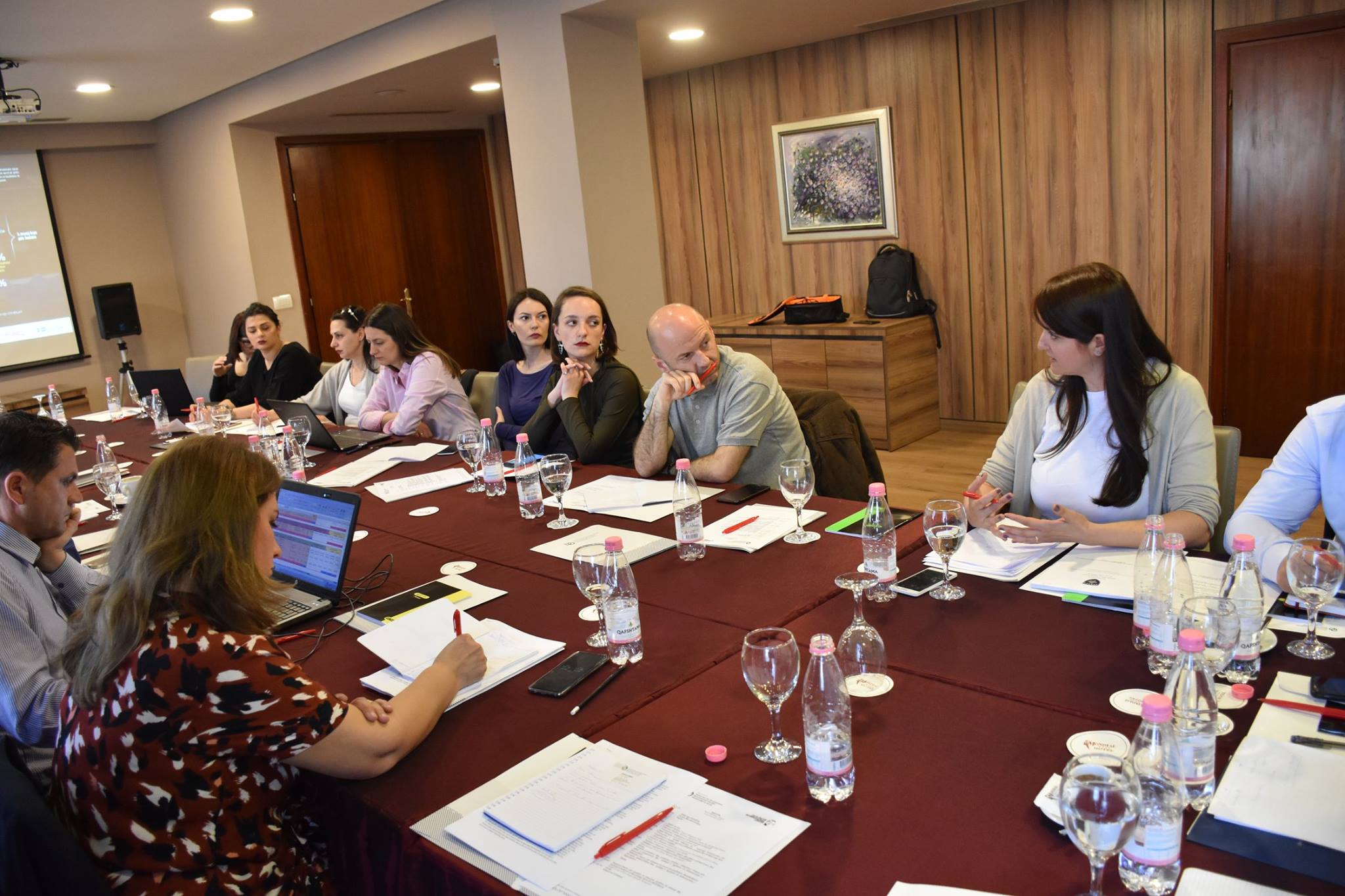
 On  March 5, 2018, at Hotel Sirius, Kosovo Women’s Network (KWN) held its regular members meeting, the first one for 2018, which was attended by the representatives of member organizations, members of the Lobby for Gender Equality, supporters and representatives of the institutions of the Republic of Kosovo.

Igballe Rogova, KWN Executive Director opened the meeting by welcoming the participants. She further reported on the agenda and presentations that would follow.
            Avis Benes, Head of the Public Information and Communication Unit and Silke Studzinsky, Head of Victims Participation Office from the Kosovo Specialist Chambers (KSC) made two presentations regarding the views, responsibilities and functioning of the Specialist Chambers and the victims’ participation scheme. Mrs. Benes explained in detail the history of the KSC, which are temporary judicial institutions that have jurisdiction over individuals only. Their mandate is to adjudicate allegations of crimes against humanity, war crimes and other crimes committed during the period from 1 January 1998 to 31 December 2000, related to the allegations mentioned in the report of 2011, of the Assembly of the Council of Europe.
            Further during the presentation, it was stated that the KSC intends to inform the public correctly in order to prevent false and inaccurate information. This is being done by focusing on presentations, panel discussions, lectures at universities, cooperation with non-governmental organizations and civil society organizations. After the discussions and a session of questions and answers, Mrs. Benes stated that “We will work hard and endeavour to prevent political interference in our justice processes.”
After the lunch, the time was reserved for the presentation of the EU-funded project “Moving Forward: Promoting Greater Efficiency and Effectiveness in the Fight against Trafficking in Human Beings in Kosovo”. This project is a joint effort of the Family and Childcare Center (KMOP), the European Public Law Organization (EPLO) and the Center for Protection of Victims and Prevention of Trafficking of Human Beings (PVPT), ”‹”‹which aims to further advance the general coordination of Anti-Trafficking in Kosovo, as well as the ways in which trafficking crimes are investigated and prosecuted, victims and witnesses are protected, and the provision of services is planned, managed and implemented in cooperation with the civil society sector. Sadete Kastrati, KMOP Grants Expert, informed about the announced Call for Project- Proposals.
            Further, Iliriana Banjska, KWN Gender Issues analyst, also co-author, presented the findings and recommendations resulting from the latest KWN report, “Mind the GAP”, which Ms. Banjska and Nicole Farnsworth during January have presented also to senior officials of the European Commission, in Brussels. This report illustrates the implementation of the European Union Gender Action Plan and the shortcomings of this process in the Western Balkans. You can read the full report on the KWN website.
            Later on, members shared information about their activities, whereupon Fazile Bungu from the Hendifer Association, Ferizaj, announced that also in Ferizaj they are marching to mark 8th of March. Fikrije Ferizi, from Women’s Association ATO, Vushtrri, informed that a roundtable will be organized in Vushtrri to mark the International Women’s Day. Gjejrane Lokaj from the Women’s Initiative Association, Dragash, announced that the 8th of March will be marked in Dragash by organizing, together with Lobby members, signature of a petition to open maternity units. Meanwhile, Nevenka Rikallo from the Association Ruka Ruci awarded certificates of appreciation to Igballe Rogova and Yllka Soba for their given support and contribution in the process of opening the shelter in Novoberde.
            Also, Mrs. Rogova announced that on 27-29 April, KWN supported by the Kvinna till Kvinna Foundation and with own participation, will organize members meeting in Durres, in order to work on the developing and drafting of the new KWN Strategy 2019-2022. Mrs. Rogova also added that the next regular members meeting will be in June. Since the World Blood Donation Day happens to be in June, KWN will try to organize blood donation during the meeting as a voluntary activity.
 Another issue discussed with members was proposing two names, a KWN member and an external expert, who will be a part of the Grants Review Committee of Kosovo Women’s Fund. The next round will be opened as soon as the KWN will sign the contracts with donors.
            Members were notified and invited to join the march that will be organized by the Collective We march, we don’t celebrate, at the Zahir Pajaziti Boulevardon 8 March starting at 12:00.
            This meeting was held by the partial support of the Kvinna till Kvinna Foundation as well as the Kosovo Specialist Chambers.

KWN Publishes Report: From Words to Action?

     On 12 March 2018, at Hotel Sirius in Prishtina, the Kosovo Women’s Network (KWN) published a new report: From Words to Action? Monitoring the Institutional Response to Gender-based Violence in Kosovo.
     “It was 2004 when we first protested publicly for protection from domestic violence; at that time, violence was a taboo and private topic,” said Igballe Rogova, KWN Executive Director during her opening remarks. “Since then, we have seen institutional progress, from the Law on Protection against Domestic Violence to strategies and action plans against domestic violence. However, the legal framework still is not sufficiently applied. As the title of our new report says, we don’t want any more words. We want action!”
     During the publication launching, KWN discussed the recommendations with key institutions responsible for implementing the legal framework. The co-author, Adelina Berisha presented the key findings and recommendations, some of which included:

  • The National Coordinator for Domestic Violence is a political position, namely that of the Deputy Minister of Justice; therefore, without a functioning government, Kosovo has lacked this key coordinating body for more than a year. Perhaps due in part to this, only an estimated 19% of the second National Strategy for protection from domestic violence and action plan for 2016-2020 has been implemented.
  • Inter-institutional cooperation remains weak, including a lack of comprehensive data and case management systems.
  • Shelters struggle to stay open and to provide consistent, quality services.
  • Rehabilitation and reintegration programs remain nearly non-existent for both perpetrators and victims.
  • Several institutions continue to blame victims for the violence perpetrated against them, which contributes also to light sentencing or to no penalties whatsoever. This can lead to recidivism.

    “The main challenge is the mentality,” said Sevdije Morina, Deputy State Prosecutor. Violence is not a private issue, she said. “It should be treated as violation of law regardless of the victim’s declaration. We have worked to tell prosecutors that they must build a case regardless of the victim’s statements, as victims may change their statements.”
     “While the persons holding the position of National Coordinator have changed, the challenges have remained,” observed Naim Qelaj, the Deputy Minister of Justice and recently appointed National Coordinator on Domestic Violence from the Ministry of Justice. “I learned a lot from this report, and I believe that all of the recommendations are in line with the National Strategy. I promise that I will address all recommendations.” He said that he would soon call an inter-ministerial meeting to ensure that all institutions also will be aware of the recommendations and that they will work to implement them.
     “Everything that the Kosovo Women’s Network initiates is positive,” said Biljana Rexhiq, a judge representing the Kosovo Judicial Council. “I also highly value the research journalists from BIRN. I was also monitored by them. The findings and recommendations by BIRN and KWN are thoroughly analysed and we should use them as a guide for preventing violence against women, particularly domestic violence.” Moreover, she stated that the Head of the Kosovo Judicial Council, “agrees with all of this … and he will take all measures by law to address gender-based violence.”
      “The research is making us talk and improve ourselves,” agreed Adile Shaqiri, Senior Officer for Protection of Victims of Trafficking, Sexual Crimes and Domestic Violence from the Department of Social and Family Policy in the Ministry of Labour and Social Welfare.
      In December 2016, Kosovo adopted its second National Strategy on Protection from Domestic Violence and Action Plan 2016 – 2020 (NSPDV). Since then, several initiatives have sought to build the capacity of public institutions to implement this and other legal responsibilities pertaining to domestic violence. While sexual harassment has been discussed more in public fora in recent years, other forms of gender-based violence, particularly sexual violence, remain largely invisible and under-researched.
     Between August and November 2017, KWN and the Balkan Investigative Reporting Network (BIRN) monitored the extent to which institutions that have a legal responsibility to protect persons who have suffered gender-based violence are implementing the relevant legal framework. Monitoring also aimed to examine any changes since KWN’s 2015 research on attitudes, awareness and performance of institutions working with cases of gender-based violence; and to assess implementation of the NSPDV to date. The final report draws from findings from case monitoring, interviews with 84 representatives of relevant institutions and a review of quantitative data.
     In addition to the aforementioned panellists, representatives from several institutions, media outlets, international organizations, UN agencies, and civil society also participated in the launching event.
     This research was made possible with support from the Austrian Development Agency. As Arsim Aziri, Head of Administration, Advisor Private Sector from the Austrian Development Agency stated during the presentation, Austrian Development Cooperation seeks to include women’s empowerment in all of their work. He announced that they look forward to continuing their long-term cooperation and support to KWN, considering that the “results are there”.

Students from the University of Vienna learn about KWN

 During January, students from the University of Vienna and European Inter-University Centre for Human Rights and Democratisation conducted a study visit in Kosovo. In the framework of this visit, on January 20, the students also met with Igballe Rogova, Executive Director of the Kosovo Women’s Network (KWN)  at the Hotel Sirius in Prishtina.

They showed interest in learning more about the experiences of women’s rights activists in Kosovo, recent developments, human rights challenges, peace and security, as well as obstacles and opportunities in the future.
Ms. Rogova initially spoke about activism during the 1990s in Kosovo, for the ‘Sisters Qiriazi’ Association, as well as for the war period in Kosovo, when this association did not cease at all its activity to help Kosovars who were placed in camps as refugees. Attendees also had the opportunity to be informed about the history of the women’s movement in Kosovo, how the first women’s rights organizations in Kosovo were founded, and the history and work of KWN since its founding in 2000 as an informal network. Among other things Rogova also mentioned investigative reports on gender-based violence and sexual harassment in Kosovo; Establishment of the Council for Survivors of Sexual Violence in Kosovo; As well as for initiatives and researches with regard to the monitoring of United Nations Security Council Resolution 1325 in Kosovo, Resolution on Women, Peace and Security.
            By expressing their gratitude for the meeting, the students said that this was one of the most informative lecture they had during their stay in Kosovo.

Mind the GAP: KWN Advocates for an improved implementation of the EU’s Staff Working Document in the Western Balkans

After two weeks of intense field research on the implementation of GAP II in the Western Balkans, more specifically in Kosovo, Albania, Bosnia and Herzegovina, Serbia, the Former Republic of Macedonia and Montenegro, Kosovo Women’s Network (KWN) presented its report ‘Mind the GAP’ in Brussels on the 22nd of January 2018. The European Commission (EC) and the European External Action Service (EEAS) published this Staff Working Document titled ‘Gender Equality and Women’s Empowerment: Transforming the Lives of Girls and Women through EU External Relations 2016-2020’ in 2016. Participants included officials from Directorate-General for Neighbourhood and Enlargement Negotiations, Directorate-General for International Cooperation and Development, Country Desks and others from the European Commission.
            “This report is like a list you make for cleaning your house, you don’t like it, but it is good because you needed to clean the house”, said Charlotte Isaksson, Senior Gender Advisor to the European External Action Service. Other participants present welcomed KWN’s report with great pleasure, praising its detailed findings and clear and practical recommendations.
            Besides the report being presented, KWN used its time in Brussels to meet up bilaterally with specific officials to discuss specific recommendations from the report. All in all, this advocacy trip proved to be rather successful and fruitful as it resulted in KWN expanding its network in Brussels and put some important point related to the implementation of GAP II on the agenda in the region and in Brussels. 

Feminism, solidarity and women’s resistance in Kosovo

 Hosted by the Kosovo Center for Gender Studies (KCGS), a discussion panel meeting on “Feminism, solidarity, and women’s resistance in Kosovo” was held on 25 January at Kadare Bar & Books cafeteria, Prishtina. The panel was composed of Linda Gusia, feminist and lecturer at the Department of Sociology, Hasan Prishtina University, and Blert Morina, feminist and activist of LGBT community rights and director of the Center for Equality and Freedom (CEF). Luljeta Demolli, KCGS Executive Director, facilitated the panel. 

Feminist movement has been recently embraced by girls, women, boys, and men all over the world, and Kosovo is no exception for this trend. Today in Kosovo, we see more and more young people being identified with the feminist movement and engaged in their daily lives in working towards gender equality. However, feminist movement in Kosovo started earlier. Women and girls in Kosovo have given their contribution to gender equality – a main cause of feminism. The women and girls’ role in various processes of social and political developments has been important but recognized little.
In this regard, Linda Gusia mentioned in her speech the role of women’s movement since 70s and 80s of the last century. In addition, she talked about various types of feminism that exist today in the world, and stressed the importance of cooperation among different activists towards achieving the common goal–gender equality and respect for human rights.
Blert Morina, on the other hand, emphasize the role of activism as a tool for achieving gender equality and respect for human rights. He also mentioned the role that solidarity and cooperation among activities plays as a good way to achieving equality, but also as a means to influence citizens’ mobilization. Among others, he mentioned the organization of “Parade of Pride”, which because of solidarity and cooperation among activists, achieved success mentioned as a success story by various media around the world.
The panel participants agreed that it was only through solidarity and cooperation of activists representing various groups that the cause of gender equality will go further. Women from rural and urban areas, women with formal and informal education, women coming from various ethnic, cultural, and religious backgrounds, women with a different sexual orientation, and any person that feels himself or herself feminist, were invited by the participants to join the feminist movement and activism in order to achieve the gender equality.
Ms. Demolli from KCGS informed the participants that this is the first panel of this kind, and the second panel meeting, in which another topic will be discussed, is planned to be held in the months that follow. In addition, Ms. Gusia emphasized that it is important that such discussions take place in the premises of the public university, where the next meeting was decided to be held. These panel discussions have been supported by Kvinna till Kvinna Foundation. 

Regional Feminists meet to discuss Femicid

 Hosted by Autonomous Women’s Centre, feminist activists from Bosnia and Herzegovina, Croatia, Kosovo, Montenegro and Serbia gathered from 1 to 2 February 2018 to discuss and exchange knowledge and experience with regard to monitoring femicide in these countries. In this meeting Kosovo was represented by Kosovo Women’s Network. 
        Representatives from each country shared the general situation of their respective countries, focusing on violence against women and femicide and the work they do to prevent and fight these phenomena. Feminist activists agreed that the situation with regard to violence against women remains a common societal concern in all these countries. 
       “We sit here together as a result of the legacy of the feminist that worked together across borders in the 90s, we should continue our cooperation as a continuation of this”, said Aleksandra Nestorov from Autonomous Women’s Center. 
         In order to increase joint efforts to prevent femicide, representatives had a chance to gain experience from the Centre for Women’s Rights in Bosnia and Hercegovina who for eight years have been monitoring cases of violence against women and femicide in their country. The idea behind this was to create a similar methodology for the region to track and monitor cases of femicide. 
        This meeting was a starting point of a joint initiative to be taken by activists from the region in this regard. Participants agreed to draft a concept document which will include a problem analysis and the joint advocacy initiatives that will be undertaken by the activists from the region to combat the issue of violence against women and femicide. 

Kosovo again part of One Billion Rising Campaign

Although the 14th of February is celebrated worldwide as the day of lovers, activists for women and girls rights for several years now are manifesting differently on this date. This is thanks to the One Billion Rising global campaign – an initiative which started since February 2012. It all started as a call for action based on disturbing statistics which show that 1 in 3 women in the world is physically assaulted or raped during their lifetime. With a global population reaching 7 billion, this means that more than 1 billion women and girls experience different forms of violence.
Kosovo has become part of this initiative by organizing every year the One Billion Rising event, since the first campaign at the global level. On this day, feminist activists, women and girls rights activists, individuals and organizations in Kosovo have joined the march, singing and dancing, thus becoming part of events taking place all over the world.
      With the moto “RIDE! RESIS! UNITE!”, Kosovo is part of the One Billion Rising this year as well, calling to express the anger against violence  against women and girls through solidarity and dance.
In Prishtina performance and the traditional dance under the sound of Break the Chain, which also is the anthem of the One Billion Rising campaign, was organized. One Billion Rising was organized by the Center for Art and Community ARTPOLIS supported by the Kosovo Women’s Network (KWN), Gender Studies Program, Kosovo Youth Council, Center for Equality and Liberty for the LGBT (CEL), Kosovar Gender Studies Center, Peer Educators Network, ECMI Kosovo and ORCA.

A More Gender Sensitive National Programme for Implementation of the Stabilization and Association Agreement

 The Ministry of European Integration (MEI), with the support from the Deutsche Gesellschaft für Internationale Zusammenarbeit (GIZ), on the 5th of February organized a public consultation on the Draft National Programme for Implementation of the Stabilization and Association Agreement (NPISAA) 2018 – 2022. This came after the draft of this Accession document was circulated among civil society to provide comments directly on the draft. The event was moreover organized to launch the Guideline for Consultations with CSOs and other Stakeholders within the EU-Kosovo Stabilization and Association Bodies. 
            With the support from Kvinna till Kvinna Foundation, Kosovo Women’s Network has been providing comments for the NPISAA since 2016, including this last round for the 2018-2022 one. During the meeting, officials form the MEI made public that plans for the future include the establishment of a Gender Equality Index by the Agency for Gender Equality (AGE), the collection of gender disaggregated data by each institution and continuing the implementation of affirmative measures in the form of administrative instructions for joint registration of property by partners. Thanks to the successful work of AGE, these important steps towards more gender sensitive policy making have now been taken. Moreover, KWN has been pushing for these reforms in various ways, including in written form directly on Kosovo’s Accession documents. Moreover, an official from GIZ congratulated KWN’s input on the economic sections of the NIPSAA, saying that these have been very useful and needed. 
            Next steps to be taken by KWN is signing up to the coming consultation rounds to be organized by the MEI on different sectors within the NIPSAA. 

KWN and Kosovo Midwife Association hold a round-table meeting regarding the maternity hospitals being closed in Kosovo

Kosovo Women’s Network (KWN), in cooperation with the Kosovo Midwife Association, organized on 7 February at Prishtina Hotel a round-table meeting concerning the maternity hospitals being closed in Kosovo, causes and the options for avoiding this situation and putting them to function again.
This meeting was attended by representatives from the Ministry of Health, Trade Union Health Federation, Parliamentary Committee on Health, Main Family Medicine Centers, and representatives of KWN staff and Kosovo Midwife Association. 
      Magbule Elezi, Executive Director of Kosovo Midwife Association, opened the meeting stating once again that in Kosovo there are 14 maternity hospitals in total, but some of them are, unfortunately, out of order.
 Edona Hajrullahu, vice Ombudsperson, committed that the Ombudsperson Institution is a mechanism of equality and as such is responsible for receiving and investigating the complaints of any citizen and inform the public institutions and provide the latter with recommendations. For this reason, Hajrullahu expressed, on behalf of the Ombudsperson Office, the willingness to cooperation with all the actors beyond this meeting, so that all women and girls be provided with an equal access to healthcare.
During the meeting, the participants discussed about maternity hospitals that are open but out of order, and the lack of gynecologists working in them, and how women and girls in rural areas have to go to the nearest city to carry out gynecological visits even if such visits are regular.
Afterwards, Xhejrane Lokaj, said that she has worked since 1978 as a midwife both at the hospital and in education institutions. In the recent years, she has been working in the emergency sector because the maternity hospital is no longer functional. “Dragash maternity hospital is not closed. I have the key with me today, and I can open it whenever I go to work but doing so won’t change anything. The women in our region are not equally treated like the ones in other regions, particularly those in urban areas”, Lokaj said. Furthermore, she said that women of 36 villages of Dragash Municipality should travel at least 60 kilometers to even receive a hormonal treatment.
“I do not understand, then, why we have a midwifery secondary school? Why does the faculty offer midwifery studies in the first place? If there is no job for midwives, then why are we preparing professionals in this field?”, she added.
On the other hand, Igballe Rogova, Executive Director of KWN, said that women’s health is one of the items of KWN strategy, and KWN has worked a lot over the years towards this goal, by sending notes to the media, providing recommendations concerning laws, and publishing research reports.
       They also discussed about functional maternity hospitals which must be taken as an example, and the one of Podujeva was mentioned as being one of them.
In addition, the participants shared other information concerning the situation of other maternity hospitals, such as the one of Kaçanik, Istog, and their challenges. The meeting included discussions and debates until it came to an end.
As a result, three main recommendations were provided:
  • Kosovo Midwife Association should be included in all working groups discussing and rendering decisions for all legal acts and by-laws concerning midwives and their profession;
  • Gynecologists being sent by the Ministry of Health to all maternity hospitals lacking gynecologists would make it possible that such maternity hospitals be operationalized as soon as possible, along with the midwives’ job description and competencies on the basis of health levels.


Kosovo Program for Gender Equality working group meets for the second workshop

Kosovo Women’s Network (KWN) attended the second workshop on drafting the Kosovo Program for Gender Equality, organized by the Agency for Gender Equality. The second round of workshop discusses the women’s rights, access to justice, and security. While the drafting process started in October 2017, the third workshop is expected to be organized this March.
       Agency for Gender Equality (AGE), based on Article 11 of Law on Gender Equality, was obliged to start drafting the Kosovo Program for Gender Equality (KPGE) – a strategical document of the Government of Kosovo, which sets forth the goals, measures, and main actors bearing the responsibility for the achievement of gender equality in all domains of social, economic, political, education, health, and cultural spheres for both women and men in Kosovo during the period from 2017 until 2021.
       In its first workshop, the working group drafting this document, which includes KWN members, discussed, over the span of six days, the meeting, analysis, and provision of necessary information during and until the end of the finalization process of the Kosovo Program for Gender Equality and Action Plan. The Document is divided into three pillars: Economic empowerment and social welfare; human development; decisionmaking and representation, women, peace and security. The workshops are supported by the Swedish Government, Swedish International and Development Agency (SIDA).