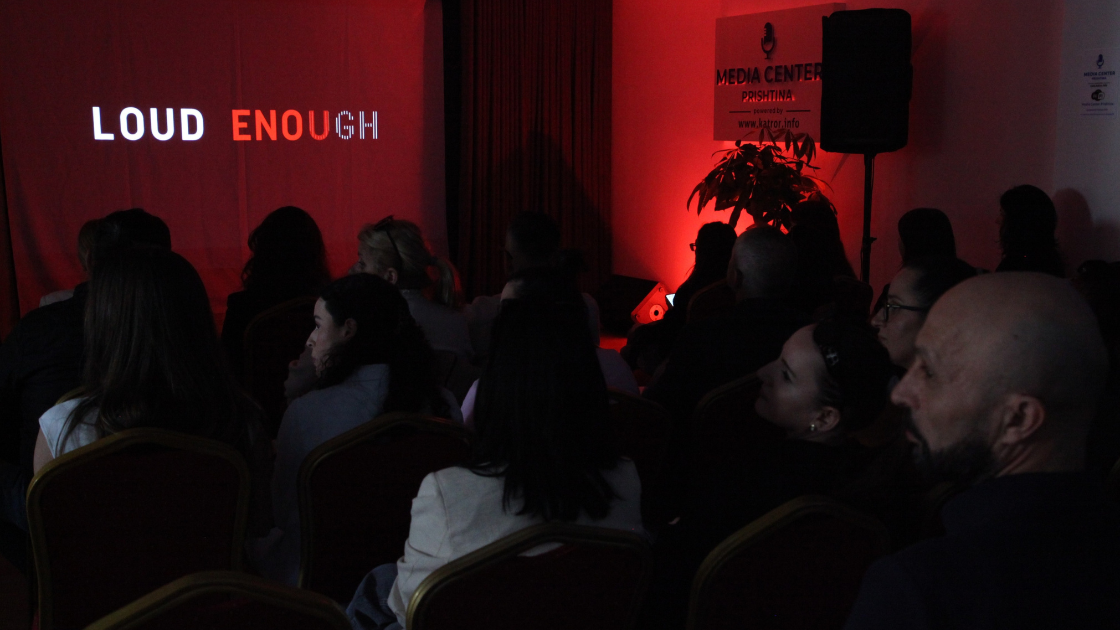
During the play "Take care of the one you love"

Artpolis raises awareness among youth through Forum-Theatre

 Hundreds of young people assembled at the Dodona theatre to witness the performance titled “Take care of the one you love”. The performance was directed by Dardana Mehmeti, and actors included: Aulona Prokshi, Edon Shileku, Gresa Xhema, Veton Gjinaj, Nitë Makolli dhe Skënder Podvorica.
    This performance dealt with the topic of early marriages and gender based violence, and depicted a 17 year old teenager, victim of early marriage and unwanted pregnancy.  As a result of this, she was also faced with physical violence from her husband of a same age. 
  The actors very emotionally and professionally performed many moments that are experienced by women and girls in abusive relationships, such as her friends’ attempts to help her, and her fear that her family will not support her if she decides to leave her abusive husband. The genre of this performance was forum-theatre, and its objective was to increase awareness among youth on early marriage, abusive relationships, and unwanted pregnancy
     “It is very important for young people to witness reality and deal with the consequences of their actions,” said the director of the performance, Dardana Mehmeti. “We use theater as a medium for raising awareness and tackle topics that are faced by youth. This medium is much more attractive than lectures, which are frequently seen as boring. Through theatre, on the other hand, they learn lessons that stick to their memory”.    At the end of the performance, the viewers had the opportunity to ask questions to the characters. Artpolis attempts to perform this performance as much as possible so that awareness can be raised among youth on these negative occurrences.  This initiative was supported by the American Embassy in Kosovo.


Young Activists learn about Integrated Security

On 29 January-1February, a workshop titled “Integrated Security for Young Activists” as organized by the NGO Artpolis, member of KWN. Participants of the workshop included young activists on women’s rights from various organizations, including three KWN representatives.
    During the workshop, a safe space was created to reflect on the welfare and personal safety of the activists, stress management, trauma management, time planning, and other topics related to activists’ welfare and their safety and security. 
The workshop was facilitated by Zana Hoxha Krasniqi, Artpolis, and Svjetlana Markovič, Helsinki Citizens’ Assembly, BeH. During the workshop, activists discussed different topics and shared intimate stories with one another. All those stories will remain confidential, as explicitly stated.
  “We had the opportunity to discuss issues that concern us, in a safe space where we were not judged by anyone,” said one participant. “We really needed this workshop”.  
   Participants had the opportunity to learn more on bio-energy, and to reflect on their future plans, to think more about themselves, and to put themselves first.  

MEST, KWN Initiate Gender Responsive Budgeting

 On Jan. 30, KWN Executive Director Igballe Rogova, Program Manager/Lead Researcher Nicole Farnsworth and Coordinator Donjeta Morina met Prof. Dr. Arsim Bajrami, Minister of Education, Science and Technology (MEST) to discuss collaborating towards institutionalizing gender responsive budgeting (GRB) in MEST. During the meeting, Minister Bajrami expressed his interest in this cooperation and emphasized his willingness to make the work of MEST as transparent and efficient as possible. 
     “I am very happy that we will cooperate in integrating gender responsive budgeting in MEST. You will have my full support throughout this process,” stated Minister Bajrami, highlighting his long-term commitment towards issues concerning gender equality.
     Minister Bajrami agreed that MEST, as a very important Ministry, can help increase or decrease gender inequalities through budget allocations and distributions. Minister Bajrami also mentioned his strong commitment towards increasing the quality of education related services, stating that this will be his top priority.
     In 2014, KWN cooperated with Deutsche Gesellschaft für Internationale Zusammenarbeit GmbH (GIZ), in assisting the Ministry of Labour and Social Welfare (MLSW) in integrating gender responsive budgeting in budget processes. After this successful experience, KWN will continue offering assistance to the Ministry of Education, Science and Technology in 2015. This will be supported by the Austrian Development Agency (ADA).
     GRB introduces an approach through which a gender perspective can be integrated into budgetary processes. GRB involves a process through which strategic objectives towards enhancing gender equality can be introduced into the budget. It can help increase transparency, increase effectiveness of public expenditures, and facilitate monitoring of implementation. The process of GRB analysis can help identify whether public spending reaches different groups of women and men; how effective resource allocations are in meeting the potentially diverse needs of women and men; how effective the implementation of policies and budgets is in achieving overall gender goals; and how gender (in)equalities may impact the achievement of overall goals. Further, budget officers, budget departments, and institutions at municipal and national levels can use GRB to better communicate and substantiate the needs of their departments to other institutions and actors, including the Ministry of Finance.


Letter to Prime Minister of the Republic of Kosovo Isa Mustafa 29 January 2015

 
29 January 2015
 
Dear Prime Minister of the Republic of Kosovo Isa Mustafa:
 
On 24 and 27 Jan., Kosovo Women’s Network (KWN) staff members participated in the protests with the slogan “Jablanovic Out; Trepca is Ours”. KWN took part in these protests for the following reasons. First, although he is a minister in the government of the Republic of Kosovo, Mr. Aleksandar Jablanovic denied the independent statehood of the Republic of Kosovo by referring to Kosovo as “Kosovo and Metohija”. Second, while in Gjakova, Mr. Jablanovic called the mothers of missing persons “beasts”. Third, we wanted to join fellow citizens in demanding that the government bring into discussion the law that would make Trepca a public enterprise.
Thousands of Kosovo citizens entered the streets twice to 1) express their concerns regarding Mr. Jablanovic’s statements; 2) demand that the Government of Kosovo dismiss Mr. Jablanovic from his position as a Minister; and 3) to call upon the Parliament of the Republic of Kosovo to decide upon the future of Trepca.
 
KWN continues to support the citizens of Kosovo who are using their rights, guaranteed by law, to express their dissatisfaction through peaceful protest. In accordance with our Statute, we entered into these protests as citizens, without any political affiliation with any political party, because we, as citizens, wanted to make these demands.
 
KWN condemns the violence used in these protests. The first reaction of the Kosovo Police against peaceful protestors on 27 Jan., as shown on media and as we witnessed with our own eyes, was disproportional.
We call upon you, as the Prime Minister of the Republic of Kosovo to immediately dismiss Mr. Jablanovic from any official position in the Republic of Kosovo, not only due to his denial of Kosovo’s existence as an independent state, but more importantly because of his insults against Kosovo mothers who for 16 years continue to await information about their loved ones who went missing during the war. KWN has continuously stood behind the mothers of missing persons in their demands to learn the fate of their loved ones and will continue to do so.
Sincerely,
 
Igballe Rogova


Thousands of citizens took to the streets with the slogan “Jabllanoviq out – Trepça belongs to us”

 On 27 Jan. thousands of citizens gathered in Zahir Pajaziti Square in Prishtina to make two requests for Government of Republic of Kosovo; discharging Minister Alexander Jabllanovic, who through a declaration denied the independence of the Republic of Kosovo and simultaneously referred to the mothers of missing persons from Gjakova as ‘savages’, also for the government to bring the law that transforms Trepça in a public enterprise. 
    Even though the right for peaceful protest is a guaranteed right by the Constitution of the Republic of Kosovo, many citizens from different cities were obstructed by the police to come to Prishtina. Allegedly, the police had stopped their buses, therefore certain citizens decided to go to Prishtina from Peja by foot. 
The march in Prishtina started from the square ‘Zahir Pajaziti’ and halted at square ‘Skenderbeg’, where speeches were held by various political and non-political actors. However, many of the protesters present, were there to raise their voice about those to requests, without supporting or being affiliated to any of the political parties. 
    Many of the protesters expressed their concern that media in Kosovo did not show all sides of the protest. 
“Our media does not inform us on the reality of what is happening. As peaceful protesters, we sat down on our knees a few times during the protest, to show that our objective was to protest peacefully,” said one of the protesters. “While discussing the issue with people who only watched the protest through television, I understood that practically no media outlet showed the times where we sat down, nor the times when the organizers pleaded to the protesters to stop.” 
    After a while the protesters started to run from the teargas that was being thrown at them by the police. The citizens resisted the police for five hours. At some point the situation escalated and protesters grabbed whatever was in their way, in order to express their revolt, and in order to protect themselves from the rubber bullets that the police was throwing at them. 
“I was shocked when I went home and my family members told me what they had seen on TV, and when I told them what really happened, they wouldn’t believe me ,” stated one protester. “My friends and I went to the protest without being affiliated with any party; we simply wanted to peacefully protest, as worried citizens, to make use of our rights to express our support for the miners of Trepca, we did not go out to cause damage to public property.” 
    As a non-governmental organization, and without being affiliated to any political party, KWN staff; solely as citizens of the Republic of Kosovo. The Government of the Republic of Kosovo did not take any measure to counter the offenses uttered by Jabllanoviq towards the mothers of missing persons, who continue not knowing anything about the fate of missing persons, 16 years after the war in Kosovo. Hence, KWN staff took part in the protest to protect the dignity of mothers and citizens who referred to as “savages” by Jabllanoviq.


Council for Survivors of Sexual Violence Organizes Workshop on Exchanging Experiences between Bosnia and Hercegovina and Kosovo

 With support from the Legal Office at the Prime Minister’s office and UN Women, the National Council on Survivors of Sexual Violence during the war, under the leadership of Atifete Jahjaga, President of the Republic of Kosovo, organized a two day workshop in Tirana. This workshop, which was held on 15-18 January 2015, gathered a delegation from Bosnia and Hercegovina, members of the National Council on Survivors of Sexual Violence during the war in Kosovo, and other participants.
    The objective of the workshop was to exchange experiences between Bosnia and Hercegovina and Kosovo regarding sexual violence during the war. Participants exchanged experiences on rehabilitation, reintegration, and empowerment of survivors. One of the main issues of discussion during the exchange, was the recognition of the statute of survivors in Bosnia and Hercegovina.
    Igballe Rogova, KWN Executive Director, is a member of the National Council for Survivors of Sexual Violence during the war in Kosovo. With support from UN Women, OHCHR and the Legal Office at the Prime Minister’s office, the Council has begun drafting different articles of utmost importance for the implementation of the law on recognizing the statute of  martyrs  invalids, veterans, KLA members, persons raped during the war, civil victims of the war and their family was approved in March 20 2014.
This law recognizes the status of women raped during the war in 1998-1999 in Kosovo, in an attempt to prevent social stigmatization and to restore their dignity. The approval of this law is the result of a two year long advocacy process by women, civil society, and political institutions.
    Kosovo Women’s Network (KWN) and its member assisted throughout this process. KWN attracted attention towards the situation of women who have suffered sexual violence during the war through its protest organized on March 9 2012, with the slogan: “We don’t want flowers, we want justice for women raped during the war,”


KWN participates in High-Level Budget Transparency Conference

 KWN has been involved in conducting gender analyses of Kosovo budget processes since 2012. Therefore, on 22 Jan., KWN was invited to a High-Level conference on Budget Transparency in Kosovo, organized by the GIZ project, “Reform of Public Finance Systems”. The conference was chaired by David Nguyen-Thanh, Head of Competence Center, Public Finance and Public Administration Reform at GIZ.

 
Ms. Angelika Viets, Ambassador of the Federal Republic of Germany, and Avdullah Hoti, Minister of Finance in the Republic of Kosovo made the opening remarks to the conference.
     “The Ministry of Finance will be very transparent regarding the expenditure of every cent of the budget of,” said Mr. Hoti. “We need to give our maximum that every cent is spent in the right way”.
Three panels took place in the course of the conference:
  • Panel I:  Why Budget Transparency Matters 
  • Panel II: The Role and Importance of Transparency in Budget Development.
  • Panel III: The Role and Importance of Transparency in Budget Execution and Control.
 
During the first panel, Mark Hallenberg,  Director of the Fiscal Governance Centre at the Hertie School of Governance in Berlin, discussed the importance of the reliability of data, mentioning that transparency cannot be achieved only through the availability of data. True budget transparency can only be achieved when the available data is completely reliable. Professor Hallenberg also discussed the benefits budget transparency can provide to a country. He cited many studies that correlate transparency with higher levels of trust (by citizens and investors), with higher investments, and lower levels of corruption.
 
During the second Panel, Mr. Klaus Feiler, State Secretary, Senate Administration for Finance, State of Berlin narrated how the Berlin budget is planned and executed; and demonstrated how truly transparent this process is. He also informed the participants on Gender Responsive Budgeting, something that Berlin has been integrating in its budget processes in the last 12 years. Mr. Agron Demi, Ekzekutive Director of the GAP institute, also spoke in the second panel, and heavily criticized the lack of transparency of the Kosovo government. He gave numerous examples of instances when the GAP institute was denied requested information and data from the government.
According to Bettina Hagedorn,  Chairwoman of the Public Accounts Committee in the German Parliament, the planning process for the budget in Germany begins in March of a given year; in July it is sent to the MPs, who can analyze it until September; budget discussions begin in September and last until November. On the other hand, according to Besnik Bislimi, chairman of the Committee for the Oversight of Public Finances in the Republic of Kosovo stated that Kosovo MPs had one day available to read and discuss the draft budget for the 2015 fiscal year.
After the many issues that were discussed in the conference, and the many comparisons that were made between Kosovo and Germany, the following conclusion can be made: If Kosovo fiscal processes are to become more transparent, the timeframe given to MPs to read the draft budget, and the intensity of budget consultations must be increased.
 

KWN Comments on UNSCR 1325 Implementation at EU Task Force Meeting

 On 20 Jan., a representative from the Kosova Women’s Network (KWN) Nicole Farnwsorth, attended the European Union (EU) Task Force on United Nations Security Council Resolution (UNSCR) 1325 on Women, Peace and Security meeting in Brussels. The EU consultation was organized to correspond with a visit by Radhika Coomaraswamy and her team, which is leading the UN Global Study on the Implementation of Security Council Resolution 1325. The Task Force kindly created space for comments by civil society representatives attending the meeting, including KWN. The consultation focused on national and regional 1) priorities and progress relating to the women, peace and security agenda; 2) obstacles, gaps and emerging concerns; and 3) missing data and recommendations for the Global Study. The issues raised by the KWN representative included:

  • Women’s Security: there is insufficient attention to the overall wellbeing and security of women in conflict and post-conflict situations, which can contribute to insecurity and conflict. This should be addressed in programming around UNSCR 1325 as a protection, prevention and recovery measure (e.g., better programming on health and economic security).
  • Coordination among UN agencies as well as with other actors such as international organizations has been poor. This has involved competition and “turf wars”, which contributes to inefficiency and ineffectiveness in programming. We’d be more effective and efficient with better coordination.
  • Justice and reparations for crimes committed against women, particularly sexual violence, remain largely unaddressed. In Kosovo, this is due to failures by the UN and their loss of evidence, which makes justice difficult 15 years later. Women still demand justice and reparations.
  • Women’s participation in peace talks (e.g., between Kosovo and Serbia) does not necessarily mean representation of issues important to women. Beyond women diplomats involved in peace processes, women in the country must also be consulted and the issues they raise should be better addressed in negotiations (e.g., in the case of Kosovo issues raised by women such as missing persons and justice for gender-based violence perpetrated during the war have not been adequately addressed).
  • An adequate budget must be allocated for work relating to the implementation of UNSCR 1325.
  • The indicators used by the EU and UN respectively should have clearer targets and timeframes for better monitoring implementation. 
     Achievements and best practices mentioned by the 12 EU Member States present included: progress in women’s and men’s more equal participation in civilian and military operations; training for them; gender coaching for high level/central authorities; the international summit on sexual violence and International Protocol on the documentation and Investigation of Sexual Violence; initial work towards Women’s Economic Empowerment; and “stories from the field” from peacekeepers regarding how gender training helped them better interact with and protect women in conflict situations.
     Challenges noted included ensuring adequate funding for implementing National Action Plans (NAPs); measuring long-term impact; insufficiently clear indicators (without targets and timeframes); bringing women into peace processes and negotiations; considering and addressing via programming the diversity among women (intersectionality); increasing women’s participation in peace operations; addressing impunity; ensuring relief and redress for persons who suffered sexual violence; insufficient support from high level officials, which is necessary for implementation; documenting the impact of women’s involvement in peace processes, as few examples exist (e.g., only in the Philippines and Colombia offer examples of women’s significant involvement); and that EU Member States are not solely responsible for achieving results because this depends also on others.
     Among the recommendations made to the UN were: UNSCR 1325 implementation should be adequately budgeted for by the UN, and gender should be mainstreamed in all budgeting; and conflict analysis and power analysis, including in early warning, are important to ensure women are part of peace processes and their design from the beginning. Some of the recommendations for the EU included:
  • The EU should adopt the International Protocol on the documentation and Investigation of Sexual Violence in conflict.
  • Male mediators should receive more training on gender and inclusion.
  • Train and better involve the media considering their important role in reporting on peace and security issues. Use modern technology to raise awareness about UNSCR 1325.
  • Countries need to consult more with women in conflict regions when creating their NAPs.
  • Attention needs to be paid to men and masculinities. 
     Moving forward, several participants noted the usefulness in linking work around UNSCR 1325 with other similarly aimed agendas (e.g., Beijing +20, the post-2015 development agenda, and the forthcoming new EU Gender Action Plan). While there is interest in linking the various indicators related to these agendas towards efficient reporting, emphasis was placed on not diluting the original intention and purpose of UNSCR 1325. While important, gender mainstreaming alone was considered insufficient; specific actions towards furthering gender equality are necessary as well.
     The UN High Level review, taking place in 2015, will “assess progress at the global, regional and national levels in implementing UNSCR 1325”. KWN Executive Director Igballe Rogova is a member of the High-level Advisory Group for the study. The methodology will involve consultations, including with diverse stakeholders in conflict-affected areas; commissioned studies on issues of interest; input from UN states; and a survey of civil society by the Global Network of Women Peace-builders. The report will not involve “naming and shaming”, but rather best practices. While the authors will discuss areas in need of improvement, they intend for the report to be forward looking. More information about the Study is available here

KWN Consults on EU Women, Peace, Security Indicators

 On 21 Jan., a representative of the Kosova Women’s Network (KWN) Nicole Farnsworth, participated in an Expert Policy Workshop on “Refreshing Indicators for the EU’s Women, Peace and Security Policy” in Brussels. The workshop provided a space for prominent experts on United Nations Security Council Resolution (UNSCR) 1325 to review the European Union’s (EU) 17 indicators for monitoring and evaluating implementation of its Women, Peace and Security policy.
    While some people may consider indicators bureaucratic and/or potentially useless, indicators are crucial for holding the EU accountable to its commitments under the Comprehensive Approach to the EU Implementation of UNSCR 1325 and 1820 on women, peace and security (2008). Indicators can facilitate the measuring of progress, identification of shortcomings and lessons learned.
     Thus, a corresponding document exists to the Comprehensive Approach specifying indicators for EU implementation of UNSCRs on Women, Peace and Security(2010), focusing on Common Security and Defence Policy (CSDP) missions and operations. It is in accordance with UNSCR 1889, which calls on UN bodies and Member States to collect data, analyse and assess the specific needs of women in post-conflict situations. EU bodies (including European External Action Service headquarters, CSDP missions, EU delegations and EU special representatives, like those in Kosovo), as well as Member States should report on the EU’s 17 indicators every two years.
     KWN’s representative took part in one of four working groups, which focused on women’s participation in conflict and post-conflict situations. She emphasized the importance of establishing indicators at the outcome and impact levels, particularly qualitative indicators. For example, the number of women who participate in negotiations with EU-support can show that women were present. However, this indicator (#8) does not provide evidence whether women’s input was taken into consideration and/or addressed during negotiations. She provided the example that in Kosovo women have consistently raised issues of justice for gender-based violence perpetrated against women during the war, reparations and missing persons. However, none of these have been adequately addressed in the prior negotiations or current EU-brokered dialogue with Serbia. She proposed adding indicators that would demonstrate outcomes of women’s involvement in negotiations qualitatively and quantitatively, such as: “the number and types of issues raised by women that were taken up and addressed in mediation, dialogue and negotiations.” Here examples would be important for showing how issues raised by women in civil society (not only diplomats) are considered and acted upon.
     A similar recommendation was made regarding outcomes of consultations with EU officials, CSDP missions, delegations, headquarters and Member States’ ambassadors. While the current indicator 10 measures the number of meetings between EU officials and Member States’ embassies and women, it does not call for reporting on the outcomes of meetings: how do EU officials act on and/or address issues raised by women? A proposed reformulation was: “number and type of specific actions taken by the EU in follow-up to address issues raised by women in civil society.”
     Some officials expressed concern that this could be difficult to monitor and collect data about, particularly considering the number of meetings that their embassy representatives have with women. They also noted that some women may raise issues that are irrelevant and perhaps should not be addressed.
     While several recommendations were put forth during the day, a few other key recommendations included:   

  • The EU does not have targets and therefore it is difficult to measure progress. Clear, time specific goals and outcomes, including targets, should be elaborated.
  • The indicators now are very convoluted with several measures put together; these need to be separated out into sub-indicators for clear, accurate measurement.
  • Indicators relating to Relief, Recovery, and Rehabilitation, including from sexual and gender-based violence are largely overlooked by current indicators and should be added. These could be drawn from UN indicators.
  • The EU should not only measure the amount of funding it distributes (indicator 5), but the results of that funding (outcomes and impact).
  • Add to indicator 11, so it includes: Proportion of women in all EU top positions, including the European External Action Service (EEAS) headquarters and delegations, CSDPs, EU Special Representatives, headquarters (senior and middle management), police, diplomatic corps, military (including civilian experts), seconded experts, relevant decision-making bodies (e.g., committees) and Member State ambassadors.
  • Indicator 13 should be clarified. All planning documents must refer to gender. However, these documents are not necessarily understood or followed. Review documents should be compared with planning documents to ensure gender issues were adequately addressed in implementation. Gender advisors should be part of review teams.
  • Regarding indicator 14, gender advisors are not enough. Heads of missions and other decision-makers should have responsibilities relating to furthering gender equality within their terms of reference.
  • The EU should adopt an additional indicator: “to what extent was there a gender perspective incorporated in the early warning, conflict analysis, peace process design and peace process outcome document?” This could be important for ensuring women’s specific needs are considered and reflected from the beginning of peace processes and not added later. If women’s perspectives are considered from the very beginning it can significantly change the entire design of the peace process.
  • The EU and Member States need to set aside adequate resources and time for collecting, analysing, and reporting on indicators.
 
All recommendations will be considered further and a final proposal for revising the existing indicators will be put forth to the EU’s Political and Security Committee later this year. 
     This review was organized by the EU and the European Peacebuilding Liaison Office (EPLO) via a Civil Society Dialogue Network meeting, which involved approximately 40 experts from the EU, EU Member States, international organizations and civil society, including KWN. It was organized in the context of the upcoming 15th Anniversary of UNSCR 1325.      
 At present, 17 of the 28 EU Member States have their own national action plans (NAPs) and strategies for the implementation of UNSCR 1325 and related resolutions, on which many also report within their countries.
Overall, the EU provides an estimated €200 million per year to the women, peace and security agenda.
     For more information, see EPLO’s report Lessons Learnt in Monitoring the Implementation of EU Women, Peace and Security Policy.Additional reports about EU implementation of these policies have been published by the Folke Bernadotte Academy.
     

KWN Supports “Thirrjet e Nënave” (Mothers’ Calls) and Joins the Protest

Kosova Women’s Network (KWN) supports the association “Thirrjet e Nënave” (Mothers’ Calls) and joins the national protest on 24 Jan. in front of the National Library in Prishtina starting from 14:00.

 
Even after 16 years, “Thirrjet e Nënave” continue to seek information regarding their loved ones who are still missing since the war ended. The hate speech used by Mr. Alexander Jabllanovic and the denial of the Republic of Kosovo as an independent country, has tremendously concerned KWN and Kosovo citizens. Therefore KWN will join this protest with the request that Mr. Jabllanovic is discharged from his position.