KWN Appeals: Vote for More Women in Parliament

Kosovo Women’s Network (KWN), is calling on citizens to vote more women onto the electoral lists in the early elections for the Assembly of the Republic of Kosovo. This will be held on Sunday, February 14th 2021.

The campaign started shortly after KWN urged political entities to respect the Law on Gender Equality (LGE) in the lists of candidates which are submitted to the Central Election Commission (CEC). Given that neither the parties nor the CEC implemented this law, it is up to the citizens to elect as many women as possible in parliament.

KWN has campaigned on the ground for this issue in previous years’ elections, and will continue to support, protect and promote the rights and interests of women and young women, regardless of their political background, religious, ethnic or sexual orientation. Supporting women’s participation in politics and decision-making also is part of KWN’s 2019-2022 Strategy.

KWN values ​​elections as a fundamental element of a democratic state and gender equality as a vital right for all people, so we consider it more than necessary that citizens be given equal opportunities. Lack of democratization and low participation of women within most parties unjustly deprives women of participation and contribution in decision-making.

Thus, on February 14, whichever list you choose, vote for more women in parliament!

KWN Holds Its First Membership Meeting for 2021

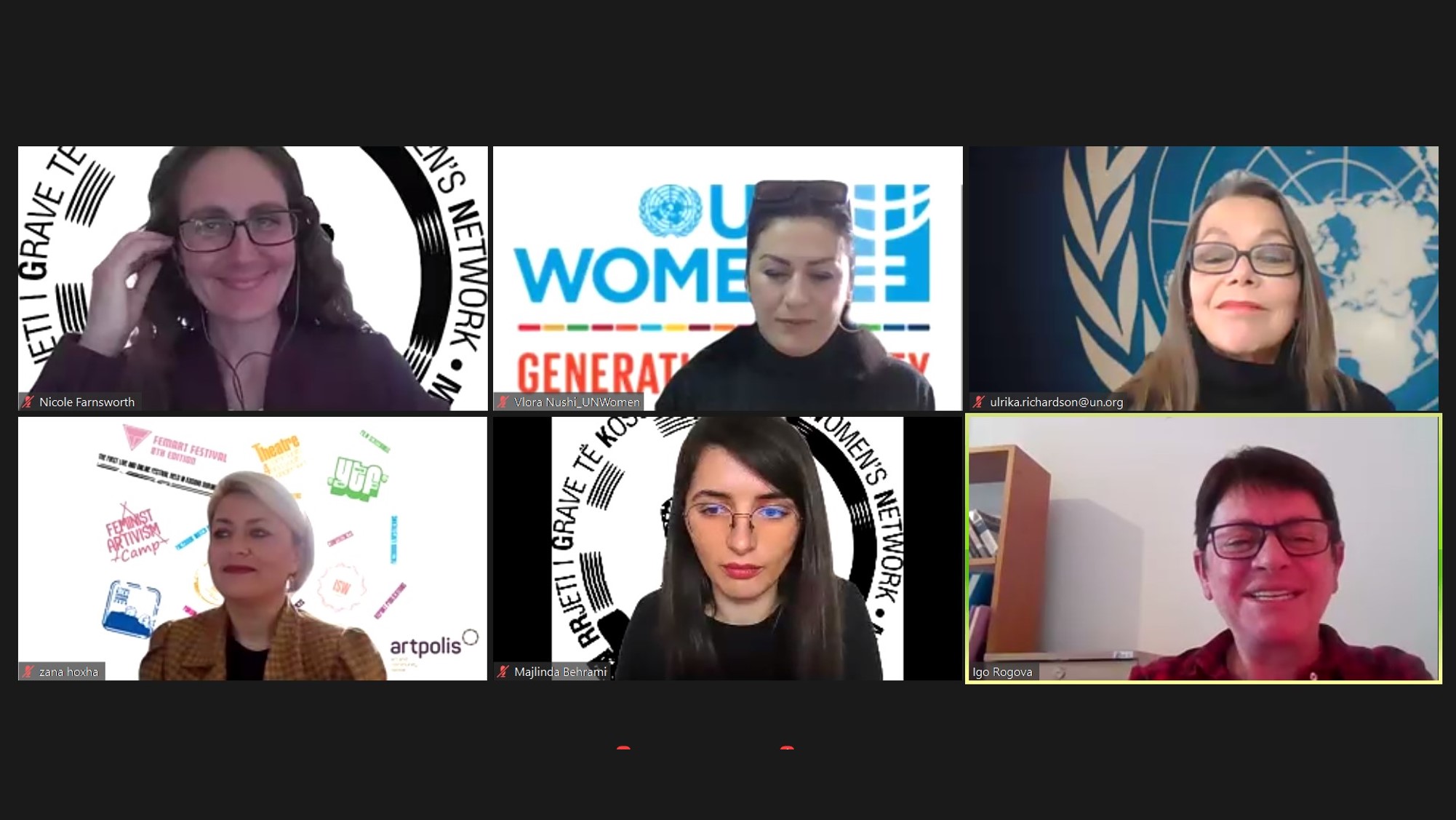
On February 8, Kosovo Women’s Network’s (KWN) held its first membership meeting for 2021. The meeting, was held through the ZOOM platform and was attended by about 60 representatives from KWN member organizations, the Kosovo Lobby for Gender Equality (Lobby), institutions, and supporters of KWN’s work and activism.

KWN Executive Director, Igballe Rogova started the meeting by mentioning the importance of respecting pandemic measures and hoping to hold future meetings physically. Rogova also mentioned the current campaign for women’s empowerment in politics “Vote for Equality”.

This image has an empty alt attribute; its file name is 00-IGO-2-1024x533.jpg

“The public relations team is doing a great job of spreading the message to get more women voted for the parliamentary elections expected to be held on February 14, 2021,” she said, adding “due to the situation caused by the COVID-19 pandemic, the campaign is focused on social networks, where public figures call upon citizens to vote for more women in government, because more women in politics means a more equal and democratic society.”

In addition, Gentiana Murati, Grant Manager, KWN, informed the participants about some of the proposed changes to the Kosovo Women’s Fund (KWF) Grant Manual.

“As it is known, this manual was drafted in cooperation with the members of the Network in 2012 and it precisely defines the mechanisms for the functioning of the Fund. “The change we are proposing has to do with the Grants Evaluation Commission,” she said.

This image has an empty alt attribute; its file name is 00-Genta-1024x498.jpg

“We propose that there be no Board members in this commission, but to have a member representative from the staff, two representatives of member organizations and two or three external representatives depending on the number of members in the commission. While the donor should be only as an advisory member “, added Murati.

Then, Valmira Rashiti, Project Coordinator, KWN, spoke to the participants about the activities of the two projects: Gender mainstreaming in the EU accession process, funded by the European Union; as well as Gender Based Discrimination in the Labor Market, funded by the European Union and co-funded by the Swedish International Development Cooperation Agency.

This image has an empty alt attribute; its file name is 00-Valmira-1024x535.jpg

“We encourage you to report your cases or those of someone you know who has experienced discrimination on the basis of gender on the number of Kosovo Law Institute (KLI): 0800 22 222”, added Rashiti.

During this meeting members and attendees had the opportunity to share information about the activities they had recently conducted as well as the activities they have planned for 2021. This meeting was supported by the European Union Office in Kosovo (EU), the Austrian Development Agency (ADA) and UN Women

KWN Supports the Protest in Prizren: Justice for Every Woman Murdered!

Despite the changes in the Criminal Code of Kosovo and the amending of the Istanbul Convention into the Constitution, murder and violence against women still are not receiving the punishment they deserve from our justice institutions.

On February 3, 2021, the Basic Court of Prizren sentenced Ilir Haxhiaj to 15 years in prison for beating and killing his wife, Hatije Dina. He was convicted with criminal offence of “serious bodily injury”.

To oppose this decision, and to ‘remind’ the Basic Court of Prizren that this “bodily injury” took the life of Hatije Dina, dozens of activists protested today starting at 12:00, in front of the Basic Court of Prizren. The protest was organized by Collective for Feminist Thought and Action.

Kosovo Women’s Network (KWN) supports this protest and denounces the lenient sentencing of Ilir Haxhiaj for the criminal offence “Serious Bodily Injury” as contradictory to the country’s legal framework.

We expect the voice of these activists, who protested today, to reach the Court of Appeals, so that it can declare this sentence, issued by the Basic Court in Prizren, as invalid.

Through this press release, KWN also announces that it will closely monitor the further course of this case.

Justice for murdered women! Justice for every woman murdered!

Thanks to the Support of KWF, Members of ShVPD Learn Brajell Alphabet

24 blind and visually impaired men and women attended basic Braille training.

The Association of the Blind and Visually Impaired (SHVPD) conducted 20 trainings within the initiative “Supporting the Blind and Visually Impaired for Leading an Independent Life” as a beneficiary of the 14th round of the Kosovo Women’s Fund of (KWF) in order to eradicate illiteracy and independence for the life of blind and visually impaired people.

From February to September, the SHVPD held trainings for the members of the association from Rahovec and villages such as Gexhe, Hoqa e Vogël, Bellacërkë and Zatriq. A total of 24 participants, 13 men and 11 women, were certified in Braille alphabet.

Xhylferije Bytyqi lead the training and spoke about the lack of education for this category of people in Kosovo and highlighted the importance of such initiatives.

“The blind, as a highly marginalized group in our society, are neglected in every sphere of life, especially when it comes to education.Knowing the difficulties that persist for the visiually impaired, such initiatives are more than necessary”, said Bytyqi.

SHVPD also held meetings with the Employment Center to discuss about easier access of blind and visually impaired people to employment, as well as with the Directorate of Education of the Municipality of Rahovec on the issue of education classification for blind students.

This meeting and this initiative is supported by the Kosovo Women’s Fund (KWF), funded by the Austrian Development Agency (ADA) and co-funded by UNWomen.

Read more about this initiative:
Braille Literacy Training For The Blind And Visually Impaired
ShVPD Returns with the Braille Literacy Training

Six Organizations Benefit from Sub-grants on GRB

Kosovo Women’s Network (KWN) has a long history advocating for Gender Responsive Budgeting (GRB) to be included in all budgeting processes by public institutions in Kosovo, as stipulated by the Law on Gender Equality (LGE).

Continuing this effort, KWN Member organizations and other CSOs who expressed interest attended a training on GRB. After successful completion of this training, they were eligible to apply for grants to implement their GRB ideas within their municipalities. They submitted their concepts for these grants to the regional initiative Gender Budget Watchdog Network (GBWN), a network operating in Western Balkans (WB) and the Republic of Moldova.

KWN, as partner organization of this network, supported the following six organisations, among them a few member organisations; Kosovo Woman Initiative, Udruženje Poslovnih Žena (WBA), EcoKos Women, Organization for Local Reform (EULOC), Mitrovica Women Association for Human Rights (MWAHR), as well as Youth Association for Human Rights (YAHR) to implement an initiative of their own choice related to GRB.

Below is a summary of the initiatives that are expected to continue for 18 months, starting from January 2021:

Kosovo Woman Initiative will implement the activity titled “Gender budgeting towards gender balanced economic development”. This initiative aims to raise the level of awareness of municipal officials in implementing of gender responsive budgeting in the Municipality of Gjakova, through advocacy tools such as proper reporting on findings informing advocacy, as well as advocacy meetings with directorates giving subsidies/grants in their municipality.

WBA with their initiative “Empowering women through local policy analysis and participation in gender budgeting in northern Kosovo”. This project aims to empower and raise capacities of women from formal and informal groups in Northern Mitrovica through a series of practical activities, and it targets women members of formal and informal women’s groups in four municipalities in northern Kosovo.

EcoKos Women has won the grant with the initiative “Menstrual hygiene management, clean life for women and girls”. They aim to influence the menstrual hygiene management (MHM) of women and girls, given that menstruation and associated activities are surrounded by silence, shame and social taboos, further manifested in social practices that restrict movement, freedom and access to everyday activities. That will be achieved through advocacy and raising awareness about MHM, as well as reducing the monthly expenditures of the gender budget. This mitigation will happen through the reduction of the value-added tax -VAT on sanitary pads, a step which will reduce their price in the market.

EULOC will implement the activity “Monitoring and mentoring the gender responsive implementation of local policies in the Municipality of Viti”. Through this, EULOC intends to identify gender perspective practices and gender budgeting practices in decision-making institutions at the municipality of Viti. Through direct advocacy interventions they aim to promote the use of best practices of gender mainstreaming in the budget planning process and throughout the gender budgeting cycle.

YAHR has won with their idea on “Monitoring and analysis in the creation of local policies from a gender perspective”. Through this, YAHR intends to influence budget processes, planning, and policies in the municipality of Lipjan to better reflect the needs of women and men from the community. By the end they hope to create a Memorandum of Understanding between YAHR and Municipality of Lipjan for gender equality, an increase of women in policy making and decision-making processes, and a research and analytical report using GRB tools..

MWAHR with their initiative “Gender perspective for sustainable economic planning” aims to include a gender lens in all the budgeting processes, making government budgeting, programming and planning more responsible from a gender perspective in Mitrovica. They hope to achieve this through monitoring efforts, meetings with municipal officials to discuss findings, as well as using media tools for advocacy, like TV Debates.

These KWN member organizations have been previously trained on GRB and their initiatives are financed by the Austrian Development Agency (ADA) and Swedish International Development Cooperation (Sida) , through GBWN.

The Activism of Besnik Leka During 2020: Challenging, yet Possible

2020 has been a challenging year, not only in terms of endangerment to the public health by COVID-19 pandemic, but also beyond – in how this pandemic has only highlighted and deepened existing social inequalities. 

Women’s rights activists in the Kosovo society faced difficulties, too! 

Many-years-long activist Besnik Leka, who was also a member of the Kosovo Women’s Network (KWN) Board, during the 2017-2020 period, speaks about the activities undertaken during the past year, initially saying that 2020 has highlighted patriarchal societies even further, including here Kosovo, as well. 

“The previous year has been very challenging for many organizations and individuals from civil society, including myself. “This is because it has limited our scope of action and contribution for challenging social norms, which are slowing down our social development.” 

However, Leka considers that the contribution was not completely impossible. 

“We simply just had to adapt to the situation and find the best possible approach”, he said. 

As a human rights activist, these were the activities whereby Leka has made his contribution

March 2020  

Leka was part of a virtual roundtable with youngsters from Kosovo, Lebanon, Austria, and Germany to discuss regarding the video project “Can I Kiss You”, which speaks more on the importance of giving consent during the relationship. This was done with aim to raise the awareness among adolescents on the topic of consent, the difference between gender and sex, as well as power in relationships. 

You may click HERE to see the video of this event.  

May 2020  

Whereas, during May in a discussion held within the campaign “Housework has no Gender!”, Leka discussed about the way how the cycle of unhealthy masculinity can be broken, the crises of this masculinity, what are the disadvantages for boys and men having  this mindset and what are their benefits after changing these behaviours. 

June 2020 

Leka joined the #Close in Distance campaign to call upon equality at home – not violence. He has stressed that many boys and men today live in a state of internal conflict, since on the one hand they are being challenged by patriarchal expectations, which require boys to be violent, stoic and aggressive, while on the other hand there exists their will to be loving, equal and at peace. 

“To be equal in our homes”, was his message.  

August 2020 

With the initiative “Men in the Kitchen”, Leka aimed to involve men in the kitchen and thus break the gender stereotypes about professions. Six men were part of this initiative, where different recipes were cooked, and the amount won was distributed to the families in need.  

October 2020 

Leka was one of the speakers invited by the “Transformational Journalism” program to discuss the techniques of written journalism and the gender perspective in journalism. 

The program was concluded by a three-day conference during which participants have had discussions with members of civil society organizations and of media who have experience and expertise in the field of human rights work.  

November and December 2020  

In November, Leka has moderated the “Future4Youth” virtual conference, which brought together different voices from civil society, citizens’ informal groups, parents, teachers and other stakeholders around the same goal – to address and advocate for prevention of violence, gender equality, life skills and health education in schools across the Balkans. 

Whereas, during December, in a discussion held with YMCA, Leka spoke on the importance of “Life Skills Education”, how society works and the way how to make it better. 

*With this article KWN starts a series of publications on the work and contribution of human rights activists in Kosovo. 

KWN Continues its Campaign to Strengthen Women’s Participation in Politics: Vote for Equality

As with previous elections, the Kosovo Women’s Network (KWN) is continuing its campaign to strengthen women’s participation in politics and decision-making processes, for the parliamentary elections expected to be held on February 14, 2021. 

Due to the situation caused by the COVID-19 pandemic, a part of the campaign will be focused on awareness-raising through social media, which will highlight public figures from different backgrounds. They will call upon citizens to vote for more women in government, because more women in politics means a more equal and democratic society.

Supporting women’s participation in politics and decision-making is part of the KWN Strategy 2019-2022. KWN also campaigned for this issue in the previous elections held in 2017 and 2019 and will continue to support, protect and promote the rights and interests of women and girls throughout Kosovo, regardless of their political, religious, ethnic, age, education, sexual orientation and ability.

KWN considers elections as an essential element of a democratic state, and gender equality as a fundamental human right, so we appeal to people to vote more women into parliament, as a necessary condition to combat the institutional tradition that has unjustly deprived women of their participation in politics and decision-making. 

Whichever party list you choose, vote for more women in parliament!

This campaign is part of the Action “Strengthening Women’s Participation in Politics,” which is supported by the European Union (EU) Office in Kosovo.

READ ALSO:  KWN Appeals: Vote for More Women in Parliament

Success story from Montenegro: AYDM Advocates for the rights of women with disabilities

Since April 2020, the Association of Youth with Disabilities of Montenegro (AYDM) has been working on providing free legal aid to all women with disabilities who have suffered from discrimination in the field of work and employment. By the end of November, 40 women with disabilities had approached AYDM which provided 89 sessions of legal advice, and represented the parties before the competent courts and institutions.

There has been an increase in the number of women with disabilities who have sought help, support and counseling in the field of labor relations. Most irregularities occurred during employment of persons with disabilities (PWDs).

One positive example from this initiative was the drafting of a contract for service user S.C.; in whose name AYDM contacted their employers with a request to review working conditions and eliminate irregularities. Originally, S.C. worked from home because their workplace, where they were an intern, was completely inaccessible to PWD due to architectural barriers. After the application was sent by AYDM, both the employer and competent local self-government bodies allowed SC to continue working from home, in an accessible working environment. Soon after the expiration of the initial employment contract, AYDM was informed that the S.C. was offered anothercontract.

“I am satisfied with the working conditions; my office is now accessible, and I can successfully perform my work tasks. Since I signed a fixed-term contract, I will try to acquire as many skills as possible and to progress in the business. Immediately after the end of the internship, I decided to take the professional exam for work in state bodies, because I believe that it will help me in mastering work activities. “

Another example was the service user B.A. who was discriminated against due to her disability.  B.A. is employed in a public preschool institution as a cook, although she is a doctor by profession. Her employer was originally unaware of her disability, but B.A. believes that the reasons why she was not hired twice as a nurse / technician were because the information was made known. After that, the director of the school began to persistently discriminate “indirectly”. After two attempts at applying for the position, the employer rejected her applications and hired seven people without disabilities. There was never a detailed explanation for rejecting her application. “I was very hurt when my employer told me orally that because of my disability he could not allow me to work as a nurse. Working with children requires a lot of effort and responsibility. I don’t want to have unpleasant situations with parents in case “something” happens!”  B.A. did not give up, on the contrary, she decided to initiate an investigation with help from the legal team of AYDM, as well as initiate a complaint to the Protector of Human Rights and Freedoms. Proceedings before the competent authorities are currently ongoing.

Women with disabilities are now feeling empowered to report discrimination in the field of work and employment, after hearing the stories of their peers. In the past two months, a growing amount of women with disabilities have applied to AYDM for legal assistance. Most complaints stem from the irregularities of job applications for state institutions. Some of the job ads were eventually taken down, while the selection process for others is still ongoing.

AYDM also began a campaign against violence against women, for “16 days of Activism”. During that period they implemented the campaign on social media platforms and directly spoke with their constituents. On the International Day for the Elimination of Violence against Women, ADYM highlighted that women and girls with disabilities are not “spared” from violence, but can suffer more than able-bodied women.

The organisation called on the state to take an active role in fighiting the discrimination of women with different abilities, and for competent institutions and individuals to raise awareness and strengthen their mechanisms of protection and support for victims of violence.

We believe that through campaigns of this type, women with disabilities will be further empowered to report discrimination and violence and will be active when it comes to exercising their rights.

This activity is part of sub-grantee’s action ”Empowered, Employed, Involved“, supported by the Kosovo Women’s Network, Center for Women’s Rights and their partners through the Action “Furthering Women’s Labour Rights”. This Action is financed by the European Union and co-funded by Swedish International Development Cooperation (Sida). The content of this activity/post is solely the responsibility of Association of Youth with Disabilities of Montenegro and does not necessarily reflect the views of the European Union or Sida. 

ShMAKS Advocates for Institutional Support to Strengthen the Role of Midwives

“Promoting maternal and child health through strengthening the role of midwifery”, is the initiative of the Kosovo Midwives Association (ShMAKS), a member organization of Kosovo Women’s Network (KWN), which was implemented in order to increase awareness of the tireless work of midwives.

On September 9, Magbule Elezi, President of SHMAKS, met with the Minister of Health to discuss the importance of including the role and interests of Kosovo midwives in the Health Act.

This image has an empty alt attribute; its file name is 119159851_3379200785473581_3181447079929567377_n.jpg

SHMAKS has advocated for institutional support to strengthen the role of midwives in Kosovo in the past thanks to the support received from the Kosovo Women’s Fund (KWF).

“Over 930 midwives in Kosovo do not enjoy a special status compared to other health professionals and their role is not defined at all levels of health services.” said Elezi.

“Strengthening the role of midwives in Kosovo and re-functionalizing maternity hospitals in Kosovo are our two ongoing requests to policy makers and the health committee in the Kosovo Parliament.” she added.

During the period of implementation of activities, SHMAKS drafted requests to address to the Ministry of Health to organize working group regarding the drafting of the profession, role, responsibilities and duties of midwife. SHMAKS also held meetings with women and girls in Kaçanik, Podujeva and Istog, with groups of 7-10 participants, in order to provide advice and information relevant to their health.

This image has an empty alt attribute; its file name is IMG_5178-1024x683.jpg

On October, SHMAKS held a roundtable on promoting maternal and child health by strengthening the role of Midwife. Participants in the roundtable were Mr. Milazim Gjocaj Official Leader, responsible for the law on Health, Ms. Suna Zajmi, Director of Health and Social Welfare in Kamenica, Mr. Fitim Uka, Member of the Parliamentary Committee on Health, Mr. Zaim Thaqi, Director of Health and Social Welfare in Podujeva and Mr. Jusuf Korenica, Director of Family Medicine in Rahovec. At this roundtable, recommendations for the Health Law Commission were also gathered.

Some of the recommendations are as follows:

• Involvement of midwives in the process of drafting guidelines and clinical protocols in obstetrics;
• Description of job duties, depending on the institution where midwives work;
• Continuing professional education for midwives;
• Representation of midwives in decision-making processes within institutions;
• Increasing and strengthening teamwork;
• SHMAKS to be included in all working groups where debates and decisions are made in all laws and bylaws for midwives and her profession;
• Delegation of gynecologists from the Ministry of Health in all maternity hospitals where gynecologists are missing, which enables faster re-functioning of maternity hospitals;
• Description of work tasks and competencies.

This initiative is supported by the Kosovo Women’s Fund (KWF) and funded by the Austrian Development Agency (ADA) and UN Women.

“Raba Voca” Starts “Break The Silence” Campaign

Center for Protection of Women and Children “Raba Voca” – Mitrovica, organized an advocacy campaign on raising awareness of women about their rights. Respecting the physical distance, with masks on and a limited number of participants, Raba Voca has raised its voice against gender based violence in Kosovo.

The “Break the Silence” campaign started its activities in February and continued until the end of September, as a beneficiary of the 14th round of the Kosovo Women’s Fund (KWF) in order to raise awareness of institutions and the community on women’s rights and importance of combating gender-based violence.

Representatives from the municipalities of Mitrovica, Skenderaj and Vushtrri, assembly members as well as representatives from civil society, women entrepreneurs and students participated in this advocacy campaign. A total of 205 participants, respectively 160 women and 30 men, of different ethnicities such as: Albanian, Bosniak, Serb, Turk, Egyptian, Ashkali and Roma from 13 villages of the Municipality of Vushtrri, Mitrovica and Skenderaj.

During the information sessions held in the three above-mentioned municipalities, the citizens were also informed about the importance of reporting violence in order to strengthen women’s rights.

“Break the Silence” highlighted one of the main obstacles to combating violence against women.

“Most women consider domestic violence as a private matter and very few women who have experienced violence talk about it, and very few of them report violence,” said Fidane Hyseni, Executive Director of Center “Raba Voca”.

This initiative was welcomed by the participants, where the participants were informed more about the current situation and the work that needs to be done to achieve more positive results for women, and consequently for society as a whole.

“We knew that violence is not good, but we did not know where to go”, are the words of one of the participants, who assessed this initiative as very beneficial for the community.

This initiative is supported by the Kosovo Women’s Fund (KWF) and funded by the Austrian Development Agency (ADA) and co-financed by UN Women.