After years of advocacy, KGSC pushes the adoption of the Policy against Sexual Harassment in Public Administration in Kosovo

On 25 November, within the 16 Days of Activism against Gender based Violence, the Policy against Sexual Harassment in Public Administration was signed by the Prime Minister of the Republic of Kosovo, Mr. Avdullah Hoti.  Kosovar Gender Studies Center (KGSC), in cooperation with the Office for Good Governance (OGG), with the purpose of implementing the Law no. 05 / L-021 on Protection from Discrimination and Law no. 05 / L-020 on Gender Equality, has prepared the Policy against Sexual Harassment in Public Administration in Kosovo.

The aim of the Policy against Sexual Harassment in Public Administration in Kosovo is to serve as an instrument and strategic orientation in creating a workplace environment where every form of sexual harassment is prevented and sanctioned.

The Policy, the first of this nature, was welcomed by feminists, WCSOs, Institutions, and International organizations working in Kosovo, and was considered as a big step in furthering women’s rights in the workplace. 

“The policy contributes fundamentally to the protection of and promotion of gender equality as a fundamental value of the democratic development of the society and the Republic of Kosovo, with the aim of preventing any form of action that leads to violation of the personal dignity of each employee in public administration. This is a necessity in the implementation of the directives of the European Union that require from our institutions the fulfillment of these criteria in the process of European integration.” said Luljeta Demolli, Executive Director in KGSC

“This policy protects gender equality as a fundamental value of the democratic development of Kosovo society (…) and the Government remains committed to implementing active policies in the field of human rights, protection against discrimination and creating equal opportunities for all citizens in the Republic of Kosovo” Prime Minister Hoti stated.

Also, the Head of Office for Good Governance, Mr. Habit Hajredini added that they are “committed to implement and monitor this Policy and to protect employees from discrimination”. 

This Policy was initiated by KGSC in cooperation with OGG in 2008 with financial support of USAID. However, throughout the years KGSC continued working in updating the Policy in accordance to the applicable law and continued its advocacy with every establishment to push it in the Governmental agenda.

This story is part of Preventing Discrimination of all forms in the Workplace action, supported by the Kosovo Women’s Network and their partners through the Action “Furthering Women’s Labour Rights”. This Action is financed by the European Union and co-funded by Swedish International Development Cooperation (Sida). The content of this story is solely the responsibility of Kosovar Gender Studies Center and does not necessarily reflect the views of the European Union or Sida.

KWN Demands the Dismissal of Selmanaj, Kumnova Joins in Support

The Kosovo Women’s Network (KWN), on 23 November, sent a letter to Prime Minister Avdullah Hoti, demanding the dismissal of Deputy Prime Minister Driton Selmanaj, following his statement on the issue of missing persons.

Following this demand, for five consecutive days (23-27 November), the Executive Director of KWN, Igballe Rogova, stood in silence in front of the building of the Government of Kosovo, demanding the dismissal of Deputy Prime Minister Selmanaj.

On the fifth day, Rogova was accompanied by Nesrete Kumnova, Head of the Organization “Mothers’ Cry”, who for two decades now is calling for justice for the missing persons. She joined in support of the call of the KWN and citizens who have already signed an online petition, calling for immediate dismissal of Selmanaj.

If this topic is consumed for Selmanaj, for me it is not! This is the greatest sin that Selmanaj has committed, hence we are demanding his removal”, Kumnova said.

In the KWN’s letter sent to Prime Minister Hoti for the dismissal of Selmanaj is stated that for the KWN and its members, the issue of missing persons is a human rights issue. Moreover, as the KWN’s upcoming research “Where is my seat at the table” shows, the issue of missing persons is one of the most important issues that the citizens of Kosovo want to be addressed by the Government towards achieving a lasting peace in Kosovo and the region. 

As rallies and mass protests are not allowed under the COVID-19 pandemic fighting measures, every day of this protest has been held in compliance with the applicable measures.

HERE you can read the full letter that the KWN addressed to Prime Minister Hoti regarding the dismissal of Selmanaj.

MEP Von Cramon-Taubadel Addresses EU Special Representative Lajcak on Women, Peace and Security, following KWN Advocacy

On 25 Nov., MEP Viola Von Cramon-Taubadel, EP Rapporteur for Kosovo, wrote a letter EU Special Representative for the Belgrade-Pristina Dialogue Miroslav Lajčák to ask why he had not met with women’s rights organisations in Kosovo on his recent visit with civil society in Kosovo pertaining to the Dialogue between Kosovo and Serbia.  

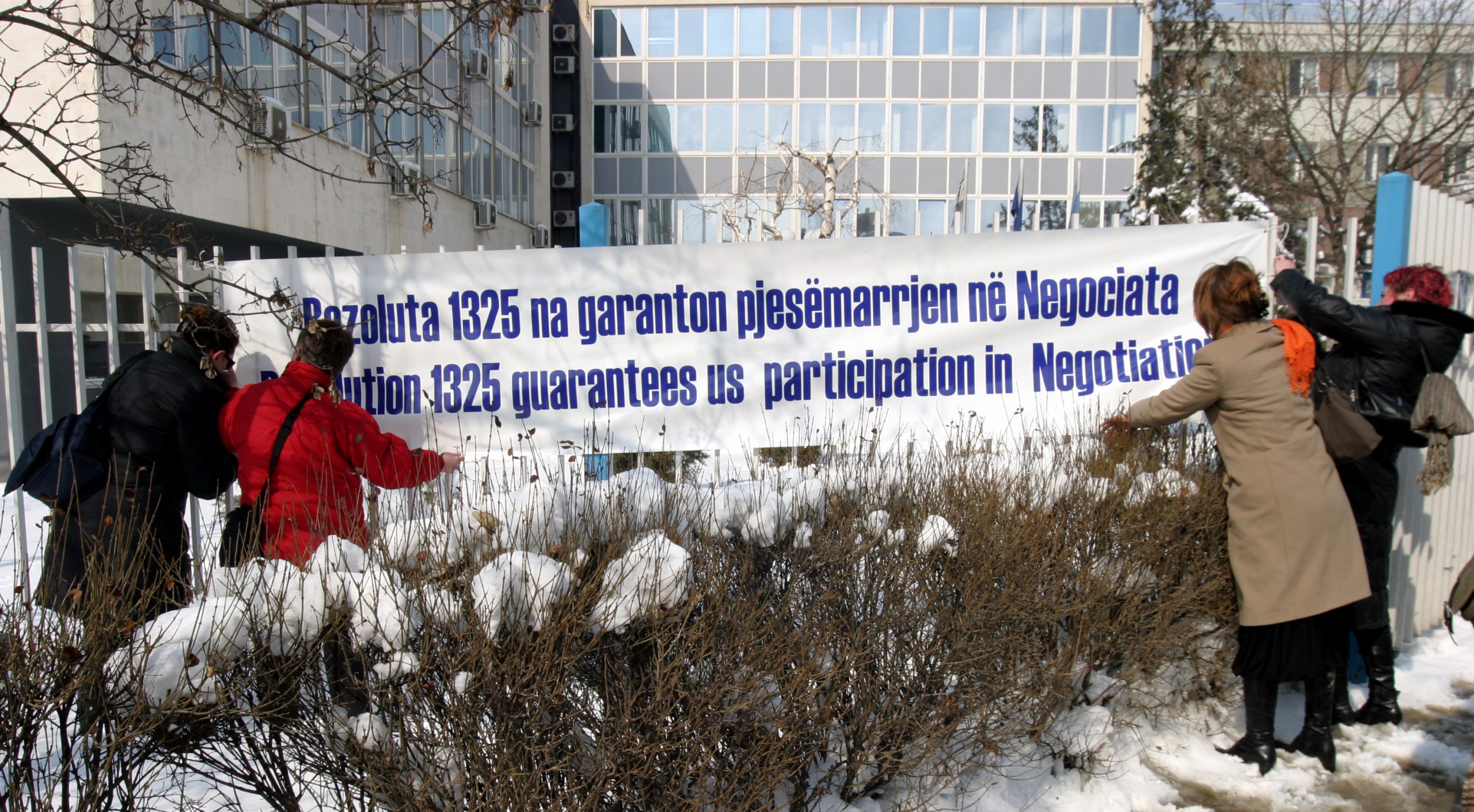
In accordance with United Nations Security Council Resolution (UNSCR) 1325 on Women, Peace and Security, actors engaged in supporting and mediating peace processes should ensure women’s engagement in these processes, including women’s rights organisations.  

MEP Von Cramon-Taubadel’s letter followed her meeting with the Kosovo Women’s Network (KWN), Kosovar Gender Studies Centre and Mitrovica Women’s Association for Human Rights last week, supported by the Kvinna till Kvinna Foundation. During the meeting, activists from these organisations expressed their concerns regarding women’s underrepresentation in peace processes, as per the UNSCR 1325 on Women Peace and Security. More specifically, they observed that the EU Special Representative for the Belgrade-Pristina Dialogue Miroslav Lajčák had not met with leading women’s rights activists or organisations during his consultations with civil society organisations in Pristina a few weeks prior. 

Following this conversation, the MEP Von Cramon-Taubadel addressed Mr. Lajčák with the following letter: 

 “Dear Mr. Lajčák, 

I would like to call your attention to an important aspect of the Belgrade-Pristina Dialogue. 

Although United Nations Security Council Resolution 1325 on Women, Peace and Security 

calls for the inclusion of women in all peace processes, and the EU has committed to 

implementing this Resolution in its EU Strategic Approach to Women, Peace and Security 

(https://www.consilium.europa.eu/media/37412/st15086-en18.pdf), women have not been 

sufficiently included in the Kosovo-Serbia Dialogue. 

While this resolution and its sister resolutions point to the important role of women’s rights 

organisations in peace processes, I have been informed that you have not met with these 

organisations or women’s rights activists in your most recent visit to Kosovo. I would like to 

underline the need for a gender-sensitive EU foreign policy, which should be applied in any 

dialogue and on any issue. Could you therefore please clarify why you have not included 

women’s rights organisations in the meeting that you held with civil society? 

Furthermore, what will you do to fulfil the EU’s commitments to including more women in 

peace processes, including in both track one and track two diplomacy, related to the 

Kosovo-Serbia Dialogue in the future? It has been brought to my attention that the 

negotiating team of Pristina does not include any women. Have you raised this issue with? 

the leaders of the negotiating team or at any other forum? “ 

KWN highly appreciates MEP Von Cramon-Taubadel’s support and commitment to advancing gender equality and the women, peace and security agenda in Kosovo. KWN has also sent a letter on this issue to Mr. Lajčák previously, available here: 

The aforementioned meeting between women’s rights organisations and MEP Von Cramon-Taubadel took place as part of the annual EU Advocacy Week, supported by the Kvinna till Kvinna Foundation. Through this initiative, every year, women’s rights organizations from the region have the opportunity to meet and share their concerns related to gender equality in the Western Balkans with relevant persons at the European Parliament, EU Commission, and European External Action Service, among others.  

https://womensnetwork.org/wp-content/uploads/2020/11/Letter-Miroslav-Lajčák.pdf

KWN Demands Institutional Response Regarding the Incest Case in Mitrovica

This past Friday, on the RTK show “Udhëve”, the case of a 17-year-old minor who was raped by her father in the Mitrovica region became public.

The Basic Court in Mitrovica found the defendant not guilty, acquitting him of all charges. The main reason for his release, although there was convincing evidence, including the 17-year-old’s statement, was that the prosecution failed to provide sufficient evidence to convince the trial panel of his guilt. This has led the prosecution to exercise its right to appeal by referring the case to the Court of Appeals.

Incest remains a taboo in both society and institutions. How seriously is incest dealt with; this case proves it best. 

In fact, years ago, the victim’s mother reported the violence she was suffering from her husband. Years ago, the latter banned the minor to go to school. In addition, the victim’s mother reporting to police regarding domestic violence seemed to fall on deaf ears. Should the reporting to the police initially treated according to the legal framework, the most horrible experience of the minor would have been prevented; an experience that will have long-term consequences on her mental health. Making the situation even more difficult, after he was acquitted, the suspect returned to live in the same house as his victims, the woman he physically abused and the girl he sexually abused. The Centre for Social Work, as a body responsible for minors’ care, has  distanced itself from any responsibility on the grounds that they had nothing else to do.

Since the case is submitted to the Court of Appeals, we call on the Prosecution to prepare the evidence in cooperation with the appropriate experts, so that there is no room for the perpetrator of incest to live in freedom. We also expect the prosecution to seek protection for the victim.

KWN raises its concern that living in the same environment as the perpetrator of the violence, in addition to harming her psychological well-being, may also affect intimidation and the threat to report again, now that the case is on retrial. We call on the Centre for Social Work to take the case seriously, requesting them to cooperate with shelters so that the minor could be provided with shelter, as well as psychological assistance in case of need. We also call on the Kosovo Police to respond in accordance with legal obligations in cases of violence reporting. We expect the Victims’ Advocates to assist the prosecution in bringing perpetrators to justice.

Incest, although a taboo occurs in every society, including our own, so we seek justice and proper treatment for victims of incest.

We also inform you that KWN will monitor this case treatment and will be on alert and willing to help justice prevail.

Rikotta and “ATO” with meetings on economic empowerment and capacity building of women

Bosnian, Albanian and Gorani women from Prevalla and the surrounding villages such as Mushnikova, Gornosella, Recani, Grnqare and Lubinje had the opportunity to be trained on economic empowerment and capacity building. 

Organization “Rikotta” and Women’s Center “ATO”, member organisation of the Kosovo Women’s Network (KWN), organized 12 advocacy trainings during the 11 months of their initiative “Economic empowerment and capacity building of women in Prevalla and surrounding villages”. 

Thanks to these meetings, 150 women were informed about future employment opportunities, and 90 women were trained on various topics such as advocacy and the methods of advocating to the relevant institutions. 10 of the women participating in the trainings were employed through the Employment Office. 

This image has an empty alt attribute; its file name is viber_image_2020-08-22_13-10-43-1024x768.jpg

On August 22, Rikotta and “ATO” held a meeting on pandemic conditions with 30 Bosnian and Gorani women from Prevalla and surrounding villages.During this meeting the lecturer, Fikrije Ferizi, expressed that such initiatives are imperative for this region. 

“While a large number of the population suffers from unemployment and a lack of professional development, women, especially those living in rural areas, are most affected by these factors.” said Ferizi. 

In addition to the beneficiaries of the project, officials from the Employment Office in the Municipality of Prizren and a representative of the Directorate of Economy, Agriculture, Forestry and Rural Development were also present and announced opportunities for employment for these women in their projects. 

“Apart from living in difficult conditions, the women of this region also experience isolation and marginalization from their families and society overall,” added the project coordinator and Director of Organization “Rikotta”, Pranvera Hajzeri-Bullaku. 

This initiative and these meetings were supported by the Kosovo Women’s Fund (KWF) and funded by the Austrian Development Agency (ADA). 

KWN sends a letter to the Prime Minister Hoti demanding the dismissal of deputy Prime Minister Selmanaj

23 November 2020

Dear Prime Minister Hoti:

The issue of missing persons is a human rights issue. Moreover, as research has shown, including the Kosovo Women’s Network’s forthcoming research Where’s My Seat at the Table?, the issue of missing persons is among the most important issues that Kosovo citizens want to see the government address, towards sustainable peace in Kosovo and the region. Therefore, it is an issue important to the Kosovo Women’s Network (KWN) and its members.

Since the war ended, the people of Kosovo and especially the families of missing persons, have continuously requested that the government, and international actors mediating peacekeeping processes, address the issue of missing persons. Without addressing this key issue, there can be no real peace for the hundreds of families still missing their loved ones.

Never have the families of missing persons been silent on this issue. Since the end of the war, they have regularly protested, demonstrated, and raised their voices, calling for a government response. We have stood with them, hearing their stories and their cry for truth.

Never has the Government of Kosovo appropriately prioritized this issue. Rather, for two decades, we have heard is a cascade of empty promises that hold little truth.

In 2009, Mother’s Cry, an organization representing the mothers of Gjakova still missing their loved ones, even went on a hunger strike because they were tired of the government’s empty promises. They sought truth. Even then, after the government promised a response, this issue has not been resolved.

Among our political leaders, Saranda Bogujevci has served as one of the few strong voices that we have had, herself a survivor of several atrocities. Since the moment she was elected to the Assembly of Kosovo, she has represented the interests of Kosovo citizens by raising the important issue of missing persons. She has fulfilled her duty, as a deputy, to represent our interests and to address this serious human rights violation.

In contrast, we have a government official, Deputy Prime Minister Driton Selmanaj, who not only is utterly failing to represent the interests of Kosovo citizens, but is directly offending citizens and political leaders like Saranda Bogujevci, who has represented our voices. As Deputy Prime Minister, his statements do not merely represent himself as an individual, but rather they represent the Government of Kosovo. Thus, through him, the government is offending its own citizens.

In 2015, then Minister of Local Governance Jabllanovic, as a representative of the government, offended the families of missing persons. The people of Kosovo rose up and requested his dismissal. Then Prime Minister Mustafa dismissed him. This is the second time that such an offence comes from the government, and the result should be no different.

Therefore, we join the thousands of other citizens, including those who have already signed the online petition, in calling for Selmanaj’s immediate dismissal. This is the right of the people: to demand accountability from our political leaders to represent our interests.

As people are not allowed to gather for a massive protest amid social distancing protocols, I have taken the personal decision to stand in front of the government for one hour every working day, starting today from 12:00, until he is dismissed. After years of supporting the voices of missing persons, I cannot be true to myself and my beliefs as a human rights activist if I sit idly by and watch silently while Kosovar citizens are directly offended by the very people who have been elected to represent our interests. I will stand in silence, in solidarity with the families of missing persons, as well as with the many people of Kosovo who support their search for truth and their demands for action by our government, until our voices are heard.

Sincerely,

Igballe Rogova

Executive Director

Kosovo Women’s Network

Public Letter to the Mayor of Skenderaj: Zero Tolerance for Denigrating Language Toward Women

Dear Mayor of Skenderaj, Mr. Bekim Jashari, 

Multiple media outlets reported yesterday on the insulting and denigrating language that the Director of Property, Cadastre Geodesyi in the Municipality of Skenderaj, Ramiz Shala, has publicly used against the assembly member Vjollca Ramadani. 

Shala used the offensive terms “crow” (Alb “sorrë”) and “slumdog” (Alb “zagaricë”)d when addressing Ramadani through a post on the social media platform, Facebook. This language is indicator of an unacceptable mentality in the representatives of our institutions. 

Through this letter we call on you to dismiss Mr. Shala, believing that such language should never have a place in public institutions, and should be condemned without any compromise. 

We remind you that our commitment to empower women’s participation in politics, both locally and nationally, is closely linked to the daily effort to build a society where women and girls are not discriminated against and enjoy equal treatment by society and institutions. Therefore, we ask you not to tolerate this misogyny, which is denigrating for women and their position in society. 

The mission of the Kosovo Women’s Network (KWN), a network of 158 organizations, is to support, protect and promote the rights and the interests of women and girls throughout Kosovo, regardless of their political beliefs, religion, age, level of education, sexual orientation and ability. KWN fulfills its mission through the exchange of experience and information, partnership and networking, research and advocacy. 

Sincerely, 

Igballe Rogova 

Executive director 

Kosovo Women’s Network 

OPDMK Holds Training on Communication Capacity Building

 On November 18, The Organization of Persons with Muscular Dystrophy of Kosovo (OPDMK), member organization of the Kosovo Women’s Network (KWN), held a one-day training “Communication capacity building for women who want to be involved in politics. “Ten participating women discussed their public appearances, the importance of participation in political and decision-making processes, and the importance of using social networks as a means of communication. 

The Executive Director of OPDMK, Antigona Shestan, spoke about the importance of this training for women and girls and disabilities. 

“Online training is much more accessible for people with disabilities, due to their physical condition, as well as because people with disabilities differ in needs due to different categories. In this way, our participants are more secure and independent when they do not need assistance,” she said. 

Meanwhile, Resmije Rrahmani, Project Coordinator, says that trainings like this are essential to enable these women and girls to get the deserved place in society. 

“Online trainings, events, conferences and meetings certainly facilitate the participation of women with disabilities. “I think that internet access is a good tool for the future because of the greater inclusion for women with disabilities who should be part of an equal society,” said Rrahmani. 

“Trainings like this are very important for us and for our member organizations. Together we discussed the experiences and challenges faced by women and girls who want to be part of the political process. Above all, we shared ideas on how we can overcome these challenges through the best ways of communicating with the public “, said Gresë Sermaxhaj, Public Relations Coordinator, KWN. 

This activity was held in the framework of the initiative “Strengthening Women’s Participation in Politics”, supported by the European Union (EU) Office in Kosovo. 

You can read more about this initiative HERE

KWN Welcomes ADA Representatives

On November 16, Sandra Horina, Counsellor & Head of Austrian Development Cooperation for Kosovo, visited Kosovo Women’s Network (KWN)’s office.   

Igballe Rogova, KWN Executive Director and Nicole Farnsworth, Program Director/Lead Researcher introduced her to KWN’s work, activities and advocacies, looking forward to continuing cooperation with ADA.  

For many years now, ADA remains one of KWN’s closest partners on the path to strengthening feminist movement in Kosovo.  Throughout implementation of prior ADA support, KWN has had some great achievements.  

Read also: KWN and ADA Organize Workshop on Gender Mainstreaming Programming  

Naš Dom and QGZHR advocate to encourage women’s economic development

The Women’s Association (UDZ Naš Dom) together with Women’s Centre for Rural Development (QGZHR), from November 2019 to September 2020, held meetings in five municipalities ( Novo Brdo, Ranilug, Gračanica, Partesh, Kllokot) in order to finalize Action Plan and exchange of views on the potential of women entrepreneurs.

These meetings were held in the framework of the initiative “Partnership for Development (of women’s entrepreneurship development-friendly environment)”, supported by the Kosovo Women’s Fund (KWF) and funded by the Austrian Development Agency (ADA).

This image has an empty alt attribute; its file name is viber_image_2020-09-30_18-32-56-4-1024x1024.jpg

Women gathered to create mechanisms and adapt tools to support and create favorable conditions for the development of women entrepreneurs at the local level. From these activities, the two member organizations of the Kosovo Women’s Network (KWN) found that none of these municipalities included a gender component in budget planning.

At a roundtable organized by UDZ Naš Dom, in Upper Makresh on 30 September, representatives from these municipalities gathered to discuss the problems faced by women, recommendations for local institutions, as well as initiatives to support women’s entrepreneurship in the above-mentioned municipalities.

“Of the total number of businesses registered in the name of women, only 3% are actually owned by women (this percentage change from 2.5% to 5%, depending on the municipality),” said Vesna Stajic, Director of UDZ Naš Dom, adding that “none of the five municipalities has incentives intended to encourage the development of women’s entrepreneurship”.

This image has an empty alt attribute; its file name is IMG_1238-1024x683.jpg

During the ten months of project implementation, UDZ Naš Dom and QGZHR also advocated to local institutions with recommendations gathered from meetings with women.

The recommendations are as follows:

1. Through regulations to encourage and motivate the participation of women in the identification of the mechanisms and drafting priorities for proposal (local village councils, working groups, professional commissions) of the percentage provided by the Law on Gender Equality (50%).
2. Introduce of the gender component in the budgeting for upcoming year.
3. Introduce of facilitation in tax registration and payment for women start-up businesses, plan subventions for the development of women businesses.
4. Planning social services (kindergartens, nurseries, assistance and home care for the elderly and sick) for the communities that respond to the needs of vulnerable groups, their greater social inclusion and quality improvement of life.
5. Find a solution for creating local transport within municipalities together with stakeholders – local businesses and citizens.
6. Appoint a team of experts from the relevant directorates to work on the preparation of local economic development, which would include projects that would involve women.
7. To appoint a team of experts from the relevant directorates for capacity building of women interested in the labor market in the field of employment and self-employment.
8. Provide space for opening a Business Incubator for start-up businesses, which would mobilize and encourage women to participate in the economy.

Meanwhile, Shefkije Mehmeti, Director of QGZHR among others presented the recommendations collected for local women’s NGOs, women’s CSOs and women’s groups:

1. Inform women about the advantages of registration in the labor market.
2. To inform the citizens about the current laws and their right to work and employment, education (as well as other rights regulated by law), as well as about the mechanisms and means by which they can fight for their rights.
3. Focus advocacy activities / campaigns on the introduction of gender responsive budgeting (GRB) in local budgets, which would promote the development of women’s entrepreneurship, the opening of social enterprises, women’s leadership and participation. Also, to inform consumers about the benefits of producing organic products.
4. Focus activities on increasing the number of women in decision-making positions.
5. Monitor planning and spending of local budget; The analyzes should be submitted to the relevant institutions and made public.
6. To approve the action plans for Networking of three sectors (public, civil and economic) in order to create a favorable environment for the development of women’s entrepreneurship
7. To work on the motivation of individuals or legal entities (business associations, CSOs, groups) for networking, which emphasizes the role of women entrepreneurship in the community, joint market entry and the start of social enterprises.
8. Increase the visibility of women entrepreneurship through organized events.