Improving Women’s Access to Health Care in Rural Rahovec

In Kosovo, particularly in rural areas, access to basic and reproductive health services remains limited. Chronic underfunding has resulted in shortages of medical equipment and specialists, poor-quality care and unreliable maternity and emergency services. Women from minority communities often face additional obstacles.

Recognising these challenges, the NGO Gruaja Fermere launched a local initiative aimed at improving women’s access to high-quality health care. A total of 291 participants, predominantly women and girls from 11 villages in the rural municipality of Rahovec, took part. Through a combination of awareness activities, education and advocacy, Gruaja Fermere empowered women to understand their rights and report violations, while also engaging with health institutions for meaningful systemic improvements.

Raising Awareness Through Education

Gruaja Fermere conducted 11 informal meetings to raise awareness about quality health care among women and girls, including from minority communities. These sessions focused on educating participants about their rights, with a special emphasis on reproductive and maternal health, and providing guidance on how to report violations. Women were also encouraged to actively advocate for their rights to local institutions. During the meetings, 20 cases of health rights violations were documented by Gruaja Fermere and later presented to the Family Medicine Centre in Rahovec. The participating women also highlighted their key priorities, including more, permanent doctors and nursing staff in rural areas, access to local specialist services, and expanded health education on topics such as family planning and non-communicable diseases.

Gruaja Fermere organised 11 lectures targeting Albanian, Roma and Serbian women. Led by a female doctor, the lectures covered topics such as breast and cervical cancer prevention, proper self-examination techniques and when to seek medical care, as well as the management of non-communicable diseases, in accordance with priorities expressed during the village meetings.

Strengthening Local Health Services

The initiative also included field visits to village clinics to assess the functionality of patient rights mechanisms. During the visits, Gruaja Fermere’s team checked for the presence of patient rights cards, complaint forms, complaint boxes and complaint reviewing committees. Several issues were identified: In some clinics, complaint boxes were missing entirely; where boxes were present, doctors informed that most patients were unaware of the reporting process; and in certain villages, doctors were rarely available, forcing residents to travel to Rahovec centre for care.

Discussions with local women revealed additional challenges, including lack of information from doctors, inadequate hygiene routines and missing follow-up appointments. While women expressed willingness to report issues towards improving the health care system, they often lacked confidence that institutions would handle complaints fairly.

Advocating for Institutional Change

Based on these findings, Gruaja Fermere prepared recommendations for improving complaint-handling mechanisms, which were shared with the Family Medicine Centre Directorate. A roundtable brought together eight municipal health officials, during which Gruaja Fermere advocated for the specific problems women had raised to be addressed. The discussions focused on improving access to health care and ensuring functional complaint mechanisms, as well as women’s most pressing health needs. Officials committed to implementing the recommendations wherever possible, setting the stage for tangible improvements.

Lasting Impact

Thanks to Gruaja Fermere’s advocacy efforts, Family Medicine Clinics were established in the villages of Brestovc, Zoqisht and Denjë, with doctors working from 07:00 to 15:00. Elderly people can now receive assistance at the clinics to open online accounts in E-Kosova, where they can choose a health care provider. The institutional system for managing patient complaints was strengthened. Patient rights cards are displayed, complaint boxes are functional, and a review committee ensures written responses within ten days. Women and men in Rahovec now have a clear, accountable path to raise concerns and receive responses guaranteed to them by law. Additionally, a doctor and nurse conduct home visits to provide care to those unable to reach the clinic.

Gruaja Fermere’s experience shows that real change comes from empowering communities while also strengthening institutions. By providing women with knowledge of their rights and creating reliable mechanisms to enforce them, tangible improvements in access and quality of health care were achieved. The initiative proves that when patients are informed and institutions are held accountable, even the most underserved communities can experience meaningful and lasting transformation.

Gruaja Fermere initiative “Promotion of primary health care for Rahovec’s women” was carried out with support from the Kosovo Women’s Network’s (KWN) Kosovo Women’s Fund (KWF), financed by the Austrian Development Agency (ADA) and co-financed by the Swedish International Development Cooperation Agency (Sida), in the amount of €9,930, from January to December 2024. The initiative contributed directly to KWN’s Programme “Right to Health”.

“We Finally Felt Seen” – Empowering Minority Women in Lipjan to Speak Up about Mental and Sexual Health

In many communities across Kosovo, conversations about mental and sexual health are still surrounded by silence, especially for women and girls from non-majority groups. For Roma, Ashkali and Egyptian communities in Lipjan, access to essential information and support on these issues has long been lacking. Stigma, economic hardship and limited access to healthcare have only deepened barriers.

More than 236 women and girls from Lipjan’s non-majority communities, including Roma, Ashkali, Egyptian, Bosniak, Croatian and Serbian women, came together in spaces where they could finally speak freely, ask questions and begin healing. Organised by the Women’s Alliance for Integration (WAI), these spaces were part of a broader initiative to raise awareness about the importance of mental and sexual health.

The Pain Behind the Silence

For many women, simply attending the sessions was a radical act. The initiative offered 12 workshops covering topics that many participants had never discussed before: postpartum depression, anxiety, antenatal stress, hygienic practices, sexual health rights and how to access local services. But more than just information, the sessions created emotional release. During one of the first meditation exercises, over 50 women began to cry.

“I never knew what I was feeling had a name,” said one participant, a young Ashkali mother from Gadime. “When I heard the psychologist talk about depression after childbirth, I realized: that’s what I went through. And no one had told me it was real, or that it could be treated.”

Another woman added:

“This was the first time someone sat with us, listened to us and told us our feelings matter.”

Facing Challenges, Demanding Better

Throughout the sessions, women shared deeply personal stories of discrimination and neglect in public health institutions, from being denied services unless they paid under the table, to enduring unsanitary conditions and stigma from healthcare workers. WAI documented five formal complaints and worked with local health authorities, including Lipjan’s Family Medicine Centre and the Council for Patient Care, to ensure these issues were heard.

Alongside the in-person sessions, WAI organised an awareness campaign reaching over 33,000 people online and 300 families door-to-door, offering brochures in diverse languages with accessible information about mental and reproductive health.

WAI also met with senior health officials from the Ministry of Health, advocating for concrete improvements: free access to sanitary products in clinics, tax removal on hygiene items, and increased mobile health services in rural areas. These conversations, backed by the voices of dozens of local women, began opening long-closed doors.

A Step Toward Lasting Change

While the initiative lasted only three months, the change it sparked continues to ripple. For many women, it was the first time they learned how to access health care, understood their rights, or had someone to speak to about their struggles. For others, it marked the beginning of their role as advocates, not just for themselves, but for their daughters, neighbours and communities.

“Before, we thought being sick was just our fate,” said an elderly Roma woman from Medvec. “Now we know we can speak up and that someone is finally listening.”

WAI’s initiative “Mobilising Roma, Ashkali and Egyptian women and girls for their mental and sexual health rights” was carried out with support from the Kosovo Women’s Network’s (KWN) Kosovo Women’s Fund (KWF), financed by the Austrian Development Agency (ADA) and co-financed by the Swedish International Development Cooperation Agency (Sida), in the amount of €5,000, from June to August 2023. The initiative contributed directly to KWN’s Programme “Right to Health”.

European Union in Kosovo, Kosovo Women’s Network Launch Groundbreaking Gender Analysis on Peace and Security in Kosovo

On 31 October, the European Union in Kosovo, together with the Kosovo Women’s Network (KWN), marked the 25th Anniversary of United Nations Security Council Resolution 1325 on Women, Peace and Security (WPS) at the Europe House in Pristina and launched an EU-funded and KWN-prepared report entitled “Peace and Security in Kosovo: A Gender Analysis”.

“The aim of the gender analysis of peace and security in Kosovo is to inform present and future EU programming that will further and better support the implementation of the Women, Peace, and Security Agenda in Kosovo, in cooperation with institutions, civil society, women’s rights organisations and international partners,” said Aivo Orav, the EU Ambassador in Kosovo.

In marking this Anniversary, Orav was joined by Igballe Rogova, Executive Director of KWN, a multiethnic network of 102 diverse women’s rights organisations. “Without the inclusion of women, there is no lasting peace. Without women, there is no justice, and the absence of justice undermines the achievement of sustained peace,” Rogova emphasised.

Photo: Samir Karahoda – European Union in Kosovo

Presenting the new Gender Analysis’ key findings and recommendations, the KWN Deputy Director and Lead Researcher Nicole Farnsworth highlighted that Kosovo has committed to the WPS Agenda but that several laws and policies require amending and adopting to ensure its implementation, particularly related to women’s participation and protection, including electoral laws, the law on the status and rights of war victims and the Law on the Kosovo Security Force.

“The new Kosovo Program on Gender Equality should attend to several unimplemented aspects of the WPS Agenda so it can serve as Kosovo’s National Action Plan on WPS,” said Farnsworth.

Photo: Samir Karahoda – European Union in Kosovo

The report further notes that the root causes of past, present and potential future tensions include segregated education and media that reinforce gender norms underpinning violence; insufficient inclusive and gender-responsive interethnic communication and interactions; economic instability and inadequate transitional justice.

The report recommends strengthening gender-responsive transitional justice, improving access to social and health services and implementing gender-responsive education, economic and environmental programs that address gendered structural inequalities and bring diverse women and men together to address issues of shared interest.

In addition, the report highlights the need to better engage diverse women, men and women’s rights organisations in consultations and in transitional justice, security, and peace processes, ensuring inclusive participation, leadership and gender-responsive decision-making.

The full report is available here in English, Albanian, and Serbian.

Kosovo Women’s Network in October: Strengthening Capacities, Institutional Cooperation and Community Awareness

During October, the Kosovo Women’s Network (KWN) carried out a series of important activities aimed at strengthening institutions, increasing awareness, and improving responses to gender-based violence in Kosovo.

In collaboration with the Ministry of Justice, the Department for Social and Family Policy, and the Professional Council for Social and Family Policy, KWN organised two rounds of two-day trainings on the curriculum “Working with Victims of Domestic Violence: Treatment and Referral” in the Prizren region. The trainings brought together social service professionals to share experiences, deepen legal knowledge and strengthen a victim-centred approach.

On 14 October, QIKA launched the newspaper “No Means No – Also Online,” which presents findings from research on sexual harassment and online violence against women and girls in Kosovo. Among the panelists was Adelina Berisha, Programme Director for Addressing Gender-Based Violence, who shared experiences and advocacy efforts that KWN has undertaken to tackle online violence.

Furthermore, KWN continued monitoring cases of gender-based violence in courts, as well as providing support and counselling for victims of gender-based violence.

In addition to these efforts, KWN participated in the President of Kosovo’s conference “Women, Peace and Security: Addressing New Threats through Regional Cooperation.”

As part of the “Door to Door” campaign, in collaboration with RROGRAEK, ZEC, and OPDMK, KWN contributed to organising informational meetings with citizens from the Roma, Ashkali and Egyptian communities, the Serbian community, and people with disabilities, distributing educational materials and raising awareness about various forms of gender-based violence.

Through its partnership with Artpolis, KWN also supported the premiere of the forum theatre play “Behind the Screen,” held at the “Xhevdet Doda” school in Prishtina and at Cinema “Jusuf Gërvalla” in Peja.

Through these initiatives, KWN continues to play a key role in institutional empowerment, victim protection and building an equal and safe society for all.

All these activities were supported by the Austrian Development Agency (ADA), with the support of the Austrian Development Cooperation and the East-West Management Institute (EWMI).

Beyond Obstacles: Women with Disabilities Leading Change

Women and girls with disabilities often face two layers of marginalisation: gender-based discrimination and the barriers created by ableism. These intersecting inequalities limit their access to basic rights, especially in the field of health care and reproductive health. Physical inaccessibility of medical facilities, lack of tailored information and prevailing stereotypes leave many without the knowledge or means to make informed decisions about their own bodies.

For adolescent girls, these challenges are compounded by the persistence of taboos around menstruation and sexuality. Many avoid discussing health concerns or lack access to essential products and information, resulting in both health risks and social exclusion.

To close these gaps, the NGO Handikos Mitrovica launched an initiative designed to break barriers and build confidence, equipping women and girls with disabilities with the knowledge, support and tools to claim their right to healthcare.

Strengthening Awareness and Confidence

Handikos Mitrovica engaged women and girls with disabilities in Mitrovica through an integrated set of trainings, information sessions, guided visits and advocacy actions aimed at strengthening their knowledge, agency and access to reproductive health care. Two three-day training groups in early July 2023 equipped 20 participants with essential information on reproductive health, sexuality, sexually transmitted infections, early pregnancy risks and institutional complaint mechanisms. In August, a follow-up session with women and mothers of children with disabilities deepened participants understanding of patient rights, while also documenting ten cases of alleged violations, laying the groundwork for future advocacy.

Simultaneously, Handikos Mitrovica provided a dedicated training for mothers to strengthen parent-child communication on sensitive topics such as puberty, menstrual health and healthy relationships, enabling them to better support their daughters.

An expert-led session with the head nurse of the Main Family Medicine Centre gave participants direct insight into how to file and follow up on complaints. 24 women asked practical questions about the steps involved, the expected timeline for responses and the kinds of issues that fall within the Centre’s responsibilities. As a result, participants began to see complaint mechanisms not as bureaucratic obstacles, but as useful tools to claim their rights.

From Awareness to Engagement

Through guided visits to the Main Family Medicine Centre’s counselling services, participants had the opportunity to see first-hand the spaces and professionals available to them. Over the course of these visits, 22 women learned about services for family planning, pregnancy, childbirth and postnatal care, and could discuss with staff the adaptations available for women with mobility or sensory impairments. Many participants noted that simply knowing what the facilities looked like, where to go, and who to speak to would make them more confident in seeking services in the future.

The trainings did not only provide participants with knowledge but also offered a safe space where they could share personal experiences, fostering solidarity and mutual support. Following the trainings, participants reported a significant boost in confidence. They felt more prepared to attend medical appointments independently, ask questions, and insist on their rights. Some even began sharing their new knowledge with peers in their communities, multiplying the initiative’s impact beyond its direct participants.

Handikos Mitrovica also engaged with local stakeholders to raise awareness about the specific barriers faced by women with disabilities. This dialogue opened pathways for future cooperation with municipal authorities on improving service accessibility, both in terms of physical infrastructure and provider sensitivity.

Lasting Change for Dignity and Equality

By focusing on an often-overlooked group, the initiative broke silences and challenged stereotypes, proving that disability inclusion is an essential dimension of gender equality. It showed that when women with disabilities are informed and empowered, they can take control of their health and demand the respect they deserve. Handikos Mitrovica’s initiative represents a step towards a society where all women, regardless of ability, can live with dignity, equality and autonomy.

Handikos Mitrovica’s initiative “Empowerment of women and girls with disabilities: A comprehensive approach to reproductive health” was carried out with support from the Kosovo Women’s Network’s Kosovo Women’s Fund (KWF), financed by the Austrian Development Agency (ADA) and co-financed by the Swedish International Development Cooperation Agency (Sida), in the amount of €5,000, from June to August 2023. The initiative contributed directly to KWN’s Programme “Right to Health”.

Reflecting on Security and Defense Spending in the EU’s Multiannual Financial Framework from a Gender Equality and Gender Budgeting Perspective

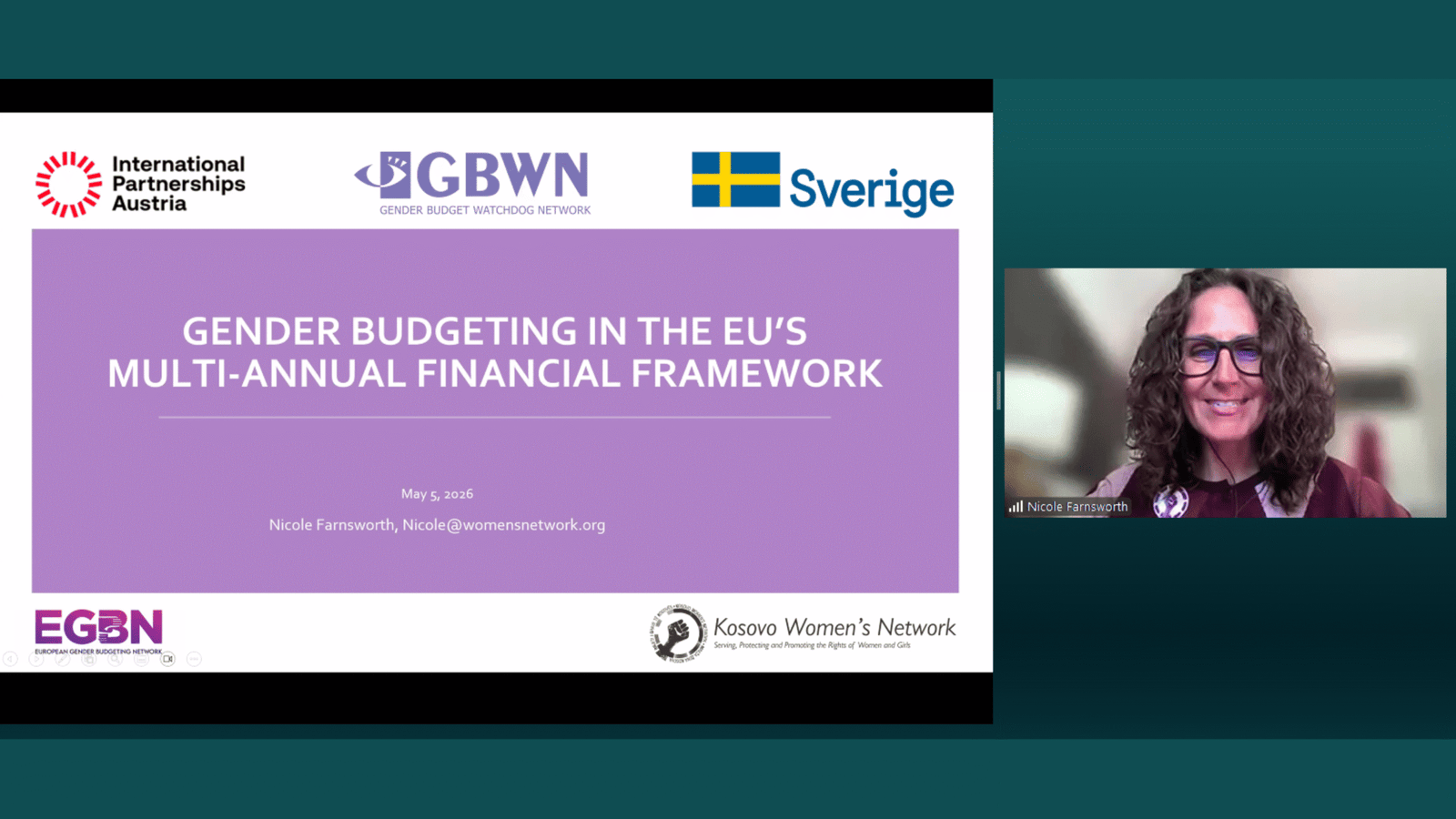
The Gender Budget Watchdog Network (GBWN), together with the European Women’s Lobby (EWL) and the European Gender Budget Network (EGBN), organized the webinar “Security for Whom?” to reflect on the EU’s shifting priorities in its new Multiannual Financial Framework (MFF). Moderated by Nicole Farnsworth, Deputy Director and Lead Researcher at the Kosovo Women’s Network (KWN), the event gathered feminist academics, policy experts, and civil society actors to explore whether gender equality and gender budgeting can be meaningfully integrated into the EU’s growing defense and security expenditures.

Speakers raised alarm that the proposed MFF lacks gender equality objectives in most program regulations. As Elisabeth Klatzer (EGBN) warned, “The new MFF introduces flexibility and performance tracking, yet omits clear gender equality objectives leaving gender at high risk of being sidelined in funding.” Similarly, Anna Elomäki (Tampere University) emphasized that “Earmarked defense and security spending is set to surge to roughly €235 billion five times current levels while funds for people and social objectives shrink.”

The discussion revealed widespread concern that EU funding priorities are reinforcing traditional, male-dominated sectors while neglecting social and human security. Aurelie Buytaert (European Peacebuilding Liaison Office) cautioned that “If the EU deepens its role in defense, it must also strengthen governance aligning spending with arms-export criteria and gender strategies so we don’t undermine peacebuilding and the official development assistance” Hanna L. Mühlenhoff (University of Amsterdam) added that “In a climate of war-readiness, technical gender mainstreaming risks becoming a fig leaf; feminists should challenge the broader agenda of militarization itself.”

From an institutional perspective, Sari Kouvo (Gothenburg University) underlined that “Mainstreaming gender and human rights in EU security policy requires strategic hooks clear language, objectives and indicators that actually become actionable.” Meanwhile, Anastasia Mondeser (Gender Associations) reminded that “Defence is not a gender-free space; gender budgeting can be applied through annexes, targets and oversight if institutions commit to accountability.”

Addressing external financing, Laura Guthrie (CONCORD) warned that “Without binding targets like the 85% gender marker in external action, gender equality becomes optional and easily pushed aside by short-term interests.” Nela Porobić Isaković (Women’s International League for Peace and Freedom) argued that “Moving money into militarization crowds out social infrastructure and care; our priority must be human security, not arming a system that trades in death.” Concluding the discussion, Mary Collins (EWL) reminded participants that “Security must mean freedom from violence, equal participation and trust in public institutions budgets should reflect those values, and women must be at the table.”

Closing the event, Nicole Farnsworth emphasized the importance of building a joint feminist coalition to advocate collectively for peace, equality, and accountability across EU budgeting processes.

During the webinar, EGBN and GBWN announced a new policy brief, “Putting Gender Equality and Women’s Rights at the Core of the Next EU Budget (MFF 2028–2034),” which can be used by a diverse, multifaceted coalition to advocate jointly for a more gender-responsive MFF. You can read the policy brief here.

This webinar was supported by the Austrian Development Agency and Sweden through GBWN.

Watch the webinar here.

KWN Calls for Effective Implementation of Laws Addressing Gender-based Violence at President’s “Women, Peace, and Security” Conference

Today, the Kosovo Women’s Network (KWN) participated in the conference “Women, Peace, and Security: Addressing New Threats through Regional Cooperation”, organised by the Regional Center of Excellence for Women, Peace and Security in Kosovo, established by the Office of the President of the Republic of Kosovo, H.E. Vjosa Osmani.

Besarta Breznica, Program Officer for Addressing Gender-based Violence, took part in the panel “Regional Approaches to Preventing Gender-based Violence in Southeast Europe”. She presented the challenges institutions face in implementing legislation, including insufficient budget, staff and institutional infrastructure.

Further, she stated that justice institutions still struggle to enforce laws due to patriarchal and traditional mindsets.

“Justice institutions often fail to adequately assess risks in domestic violence cases, produce weak indictments and judges continue to issue very lenient sentences for offenders.”

The drafting process of the State Protocol for the Treatment of Cases of Sexual Violence was mentioned as a positive example of cooperation between local organisations, international partners and state institutions. Other positive examples included numerous awareness campaigns continuously organised by women’s rights organisations and the provision of free legal aid for all victims of gender-based violence.

Finally, long-standing cooperation with organisations from the Western Balkans was commended, particularly their joint efforts in conducting research and providing free legal aid.

Equality from the Start: KWN Advocates Gender-transformative Early Childhood Education at University of Pristina Conference

On 16 October, Sara Nicole Baxley, Lecturer at RIT Kosovo (AUK) and Gender Expert with the Kosovo Women’s Network (KWN), presented KWN’s recent policy paper “Integrating Gender-transformative Approaches in Early Education Curricula and Pedagogy” at the conference “Gender Equality and Institutions” organised by the Faculty of Economy, University of Pristina.

In her presentation, Baxley highlighted how investing in early childhood education can foster gender equality and inclusion from the very beginning, as these formative years play a critical role in shaping identities, norms and opportunities. She emphasised the importance of gender-transformative curricula that go beyond merely avoiding the reinforcement of inequalities to actively challenging them and reshaping social norms and roles. Additionally, the increased availability and affordability of early education services would enable women’s equal participation in political, economic and social areas of life.

Baxley shared insights from a gender-transformative assessment tool and called for stronger institutional accountability and interinstitutional collaboration, while also highlighting the importance of teacher training. Provided with opportunities to reflect on their own gender biases, habits and interactions with children, teachers can become “agents of equality” in their everyday work.

Aside from the role of institutions in advancing gender equality, the conference also covered women’s economic empowerment and related policies, as well as gender equality and representation.

“The conference showcased a wide range of presentations, from academic research to reports on CSO interventions, spanning diverse European contexts and multiple sectors. This breadth of perspectives fosters a systems-based approach to tackling gender inequality, demonstrating that meaningful change requires collaboration across disciplines and borders. Together, we can turn knowledge into action and build institutions that truly uphold gender equality,” says Baxley.

Key recommendations from KWN’s policy paper “Integrating Gender-transformative Approaches in Early Education Curricula and Pedagogy” include:

  • Striving for legislation that make Early Childhood Education (ECE) accessible and affordable for lower income earning families and those with children with diverse learning needs.
  • Increasing funding for ECE, building and expanding facilities and conditions to increase the number of diverse girls and boys enrolled in ECE.
  • Implementing awareness-raising campaigns on the benefits of ECE.
  • Reviewing and ensuring curricula are gender transformative and consider gender biases.
  • Including in the curriculum framework specific pedagogical practices teachers are expected to use in the classroom to ensure they apply gender-responsive approaches in their delivery of curricula.
  • Using GRB to allocate specific budgets in legislation and policies for gender-transformative teacher training.

You can read the full paper here.

This research is part of KWN’s ongoing efforts to advance Gender Transformative Education, supported by the Austrian Development Agency (ADA) and co-financed by the Swedish International Development Cooperation Agency (Sida).

KWN Presents Research at Gender Equality Workshop

On 15 October 2025, education expert Arbresha Meha participated on behalf of the Kosovo Women’s Network (KWN) in the “Sustainable Higher Education and Research in Kosovo” (SHER) Workshop on Gender Equality. Meha shared key findings from KWN’s forthcoming research on sexual education and gender equality in pre-University education in Kosovo.

Meha stated that schools continue to reinforce gender stereotypes through language and schoolbook illustrations, noting that stereotypes present in higher education stem from and are visible already at an early education level. While many teachers express their interest in utilising gender-responsive teaching practices, they have had insufficient training to strengthen their capacities to do so. Emphasising the importance of the individual teacher, Meha stated that while policies come from a higher level, “individuals make the difference”. She stressed the need for more teacher training, stronger institutional support, and clear guidelines on implementing specific parts of curricula.

Particularly challenging topics that are insufficiently addressed in many schools include bullying and harassment, as well as sexual education, which remains largely taboo. While sexual education is partially included in subjects such as biology, these lessons often focus mainly on physical aspects, neglecting psychological and social dimensions. Treatment of these topics is also fragmented, with many teachers skipping sections of the curriculum or leaving them for at-home studies. This is partly due to teachers not feeling prepared to address them and partly due to broader cultural norms, which also exist outside the classroom.

Meha shared an example of a teacher training organised by KWN in 2024. After the training, classroom observations were conducted to assess changes in teaching approaches. The data showed improved awareness and willingness among teachers to address gender and sexual education topics. While a single training session is insufficient for lasting change, these results highlight the importance of longer, dedicated training modules, followed by monitoring and continuous support. Meha noted that training on gender norms and gender-transformative pedagogy should become a compulsory part of higher-education teacher qualifications.

“From evidence to action, clear curricula, teacher training and supportive school environments can turn findings into classroom practice,” she emphasised.

Other obstacles to inclusive and equitable education highlighted during the workshop, and in KWN’s forthcoming report, include outdated school infrastructure. Most schools do not provide adequate conditions for students with disabilities and some still rely on obsolete teaching resources.

KWN’s research was carried out in close collaboration with KWN member organisations, the Ministry of Education, Science, Technology and Innovation (MESTI) and several municipal governments with financial support from Austrian Development Cooperation (ADC) and Sweden. KWN seeks to collaborate with MESTI and other actors working in the education sector like SHER towards improving the gender-responsiveness of education, based on these findings.

The SHER Programme, supported by ADC and MESTI, also seeks to promote gender-responsive education and research in Kosovo.

Shliroj Cicat Marks Breast Cancer Awareness Month with Annual Festival in Pristina

On 13–15 October 2025, the NGO Shliroj Cicat organised its fifth annual festival in Pristina to mark Breast Cancer Awareness Month, this year under the slogan “Trupi s’është i Turpit” (“The Body is Not Shameful”). The festival once again brought together art, activism and care to empower women and break stigma around breast cancer.

Every day from 10:00 to 19:00, a bra donation was organised at Skanderbeg Square. A booth with the banner “Free your breasts” drew the attention of passersby, who stopped to learn more and ask questions. Beyond raising awareness, the campaign also supported fundraising efforts: lacing from the donated bras will be re-used to create handbags that will later be sold to support women affected by breast cancer. The volunteers working by the booth also handed out brochures on the importance of breast self-examinations for early detection.

On the second day of the festival, Shliroj Cicat hosted a powerful panel where each voice brought stories, energy and inspiration for women and the community. This year’s edition was particularly significant as for the first time the panel addressed the theme of the “double battle” – facing breast cancer while lacking support from partners. The panel featured Vera Ora, Fitore Bicaj, Bind Skeja, Edi Gusia and Kaltrina Ajeti.

Other festival activities included a gathering of local artists from North Macedonia, Albania and Kosovo, who painted artworks exhibited on the final day of the festival at the Great Hamam. Shliroj Cicat plans to sell the pieces at an art auction on 4 February 2026, marking World Cancer Day. Funds raised will go directly to initiatives supporting women affected by breast cancer.

During the three-day festival, Shliroj Cicat also used its Creative Space to host interactive activities with women and youth, including yoga and ceramics sessions.

“Reactions from participants were overwhelmingly positive,” says Ermira Murati, the festival organiser. “Many described the festival as a rare space where art, care and activism merge into a powerful message for women’s health.”

Despite ongoing financial challenges, Shliroj Cicat continues to stand strong in its mission: “Shliroj Cicat is more than a festival – it’s a movement that opens dialogue about women’s bodies, fear and strength. Through art, we aim to release the topic of breast cancer from stigma and silence, giving women space to feel seen and empowered,” says Murati.