Gender Equality Index Shows “Snail’s Pace” Progress towards Gender Equality in EU

Today the European Institute for Gender Equality (EIGE) launched their latest Gender Equality Index for 2019. Representatives of the Government of Kosovo, European Union (EU) Office in Kosovo and the Kosovo Women’s Network (KWN) attended, among others from throughout the EU, Western Balkans and beyond.

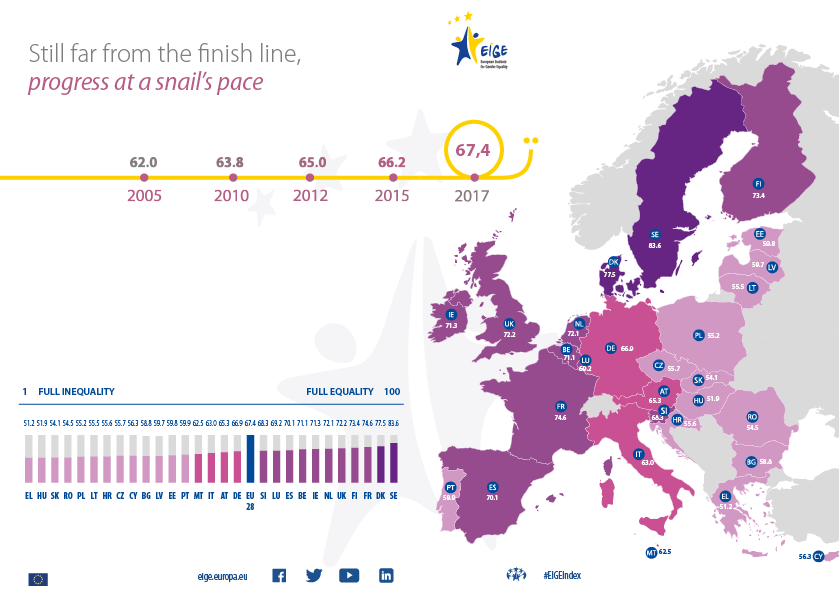
Overall, the newly published data suggest that the EU has progressed towards gender equality at a “snail’s pace”, with EU countries moving only 5.4 points closer to gender equality in the last 12 years.

“Europe is getting closer to gender equality,” Blandine Mollard, Research Officer at EIGE concluded in her presentation of the 2019 Gender Equality Index, “but not everywhere, not in every aspect, and clearly not fast enough.”

With absolute equality at 100, on average the EU scores 67.4. Sweden and Denmark remain leading countries in terms of gender equality. While some countries improved their scores, such as Portugal (+3.9), Estonia (+3.1) and Croatia (+2.5), other countries have regressed since 2015, including Poland (-1.6), Lithuania (-1) and the Netherlands (-0.8).

When looking at specific domains within the index, the greatest gender inequalities exist relating to power, knowledge and time. Slight improvements occurred related to money and work. Gender equality is greatest in relation to health, though inequalities still exist. EIGE identified gender segregation, gender norms around care and gender inequalities in pay as the main factors “stalling” gender equality.

Meanwhile, Virginija Langbakk, EIGE Director, observed that data remains lacking in many important areas, including related to violence, rape and femicide.

Gains in the power domain were strongly linked to legislative changes, namely quotas for women’s participation in politics.

“Where there are binding measures, we see progress”, observed Joanna Maycock, Secretary General of the European Women’s Lobby (EWL). Yet, there is no country in the EU that has achieved gender equality, she said. Beyond gender stereotypes, she attributed continued gender inequalities to austerity measures. She said that austerity measures are a “disaster for the EU on every level: socially, economically, and politically” and particularly for women’s rights. She emphasized the need to “invest in quality services from a gender equality lense”.

This is a responsibility of politicians and institutions to ensure state funds for childcare, early education, elderly care and other services that support the furthering of equality.

Other research by EIGE has found a shrinking space for civil society, which has had consequences for persons who have suffered domestic violence in particular.

EWL also has observed “closing democratic space for women’s organisations … from the Baltics to the Balkans”, Maycock said.

The need to invest in the women’s movement as a clear, key driver of change towards gender equality was observed by several speakers.

They also discussed the importance of reframing the dialogue and showing that supporting gender equality is not an “additional cost”, but rather an “investment” in a better society.  There was a call to ensure that the new EU Multiannual Financial Framework for the next seven years be reviewed from a gender perspective and to ensure gender budgeting, a treaty obligation. Long-term measures towards gender equality require long-term financial investments to bring about changes towards gender equality.

In addition to the EU Gender Equality Index, EIGE presented their Work-Life Balance Scoreboard, which examined parental lave, long-term care, childcare, public infrastructure, flexible working arrangements and lifelong learning in the EU. Speakers discussed how infrastructure such as public transport availability and access to childcare services affect gender equality.

For example, only 11 EU countries have reached the Barcelona Objective targets for early childhood education and care availability. Research has shown that childcare facilities have the biggest effect on reducing gender inequalities.

While some WB countries have established the Gender Equality Index, Kosovo is still in the process of developing it. The index can provide key information that supports decision-making by government officials and legislators, towards creating better informed policies that contribute to the wellbeing of both women and men.
Civil Society Invited to Submit Proposals for Furthering Women’s Labour Rights

A coalition of women’s rights groups in the Western Balkan (WB) welcomes diverse civil society organisations (CSOs) in the region to submit proposals for initiatives that will further women’s labour rights and address gender-based discrimination. An estimated 200,000 is expected to be granted to 14 CSOs for their initiatives to be undertaken between 2020 and 2021.  

Throughout the WB, women’s participation in the labour force remains low. Recently released evidence suggests that labour-related gender-based discrimination is widespread and represents a key barrier that undermines women’s participation in the labour force 

To address this, a coalition of women’s rights organisations has initiated a 46-month Action to ‘Empower CSOs in Combatting Discrimination and Furthering Women’s Labour Rights’ in the WB, funded by the European Union and co-funded by Swedish International Development AgencyThe Action aims to empower and support diverse CSOs in holding relevant institutions accountable for implementing anti-discrimination legislation related to women’s labour rights.  

The partners acknowledge the need to build a broad, diverse coalition to address the several challenges identified and forms of gender-based discrimination detailed in their recent research. Therefore, they are launching a call for proposals that will provide financial support, enabling other CSOs to engage in implementing research recommendations. The grants to be provided will support CSOs’ important work, including 

  • Legal aid and court monitoring of gender-based discrimination cases 
  • Advocacy for legal/policy changes and/or improved institutional response, as per research recommendations 
  • Awareness-raising and empowering diverse women to report discrimination 

Grants will be coupled with tailored support to CSOs and networking opportunities. Interested CSOs are invited to attend an information session at 13:00-15:00 on 17th Oct 2019 at Hotel Sirius – Prishtina 

The partners engaged in implementing this action are: Kosovo Women’s Network, Reactor – Research in Action from North Macedonia, Gender Alliance for Development Centre from Albania, Helsinki Citizens’ Assembly Banja Luka from Bosnia and Herzegovina, Women’s Rights Centre from Montenegro, and the Kvinna till Kvinna Foundation from Sweden through its office in Serbia. 

The Application deadline: 9 November 2019 

For further information please see the Call for Applications, or contact: grants@womensnetwork.org 

Press Release for sub-grantees – Call of proposals (1)

Kosovo Women’s Fund Grants €66,429 to 18 KWN Member Organizations  

18 grants recipients of a total of 16 grants from the 13th grant round of Kosovo Women’s Fund (KWF) of Kosovo Women’s Network (KWN), have been officially announced.

This happened today on Thursday, 24 October when KWN organized the Orientation Session and the Press Conference to officially announce recipients of these grants, the total amount of which is 66,429.50 €.

These grants, two of which are partnerships, are funded by European Union (EU) Office in Kosovo and Austrian Development Agency (ADA).

By supporting these women-led organizations’ initiatives, KWF contributes to positive changes that can happen in society. The implementation of these initiatives contributes to implementing KWN’s Strategy 2019-2022, which was compiled and approved in accordance with KWN’s member organizations.

During the first part of the meeting, Diellza Olluri, KWN Coordinator, shared detailed information regarding the process of narrative and financial reporting, as well as how to create and maintain a monitoring and evaluation database, which will facilitate beneficiaries during the reporting process throughout the implementation of these projects.

Igballe Rogova, KWN Executive Director, during the Press Conference highlighted that “The main purpose of the Fund is to jointly implement the Kosovo Women’s Network Strategy, and you already know that we have the new Strategy 2019-2022 for which we still have a lot of work to do. Given the motivation and commitment you have shown, indeed, it is you who are implementing it. I am confident that we will implement the strategy above 98 percent, and I am confident that we will succeed together again.”

Annette Fath Lihic, Chief Political Adviser/Executive Coordinator of EU Office in Kosovo, EU Special Representative has appreciated KWN’s work toward advancing women’s position in the society.

“We know how hard you have worked throughout all this time and EU is proud of continuing its financial support for such projects and contribute toward advancing women’s situation,” said Lihic.

Arsim Aziri, Head of Administration and Advisor Private Sector, Austrian Development Agency (ADA) said that gender equality should be included in every activity.

“This is the 13th round so far, and we are happy to continue cooperating with KWN. ADA supports KWN in other projects as well, such as activities improving the situation of women and girls, for their interests, for inclusion in politics, their strengthening in politics, and in achieving gender equality. Just like your member organizations, ADA is also focused and pays close attention to include gender equality in every activity and project that we support”, said Aziri.

KWN and its member organizations signed contracts for grants, as following:

Advocacy Grants for a Single Organization:

  • Active Women of Gjakova with the initiative “Development of a sustainable inter-institutional system for addressing gender-based violence and domestic violence in the municipality of Gjakova” (3,496.00€, supported by ADA)
  • NVO “Svet Andjela” with the initiative “Women in focus” (4,000.00€, supported by EU)
  • Initiative of Kosovar Woman with the initiative: “Improved access of women farmer and entrepreneurs of Gjakova Municipality to municipal subsidies” (3,760.00€, supported by ADA)
  • Down Sindrom Kosova with the initiative: “The kitchen X21” (3,980.00€, supported by ADA)
  • Kosovo Advocacy Group with the initiative: “Participation of Roma, Ashkali and Egyptian women in policy-making” (4,985.00€, supported by EU)
  • Udruženje Poslovnih Žena WBA with the initiative: “Gender Equality Index in Local Self-Government in North Mitrovica” (4,997.00€, supported by EU)
  • Network of Roma, Ashkali and Egyptian Women’s Organizations of Kosovo with the initiative: “Promoting employment by improving soft skills for Roma, Ashkali and Egyptian women in Gjakova” (3,000.00€, supported by ADA)
  • The Organization Lulishtja with the initiative: “Advocacy for Economic Empowerment of Women Farmers in the villages of Highlands of Gollak” (3,080.00€, supported by ADA)
  • Hareja Organization with the initiative: “Do not be silent- Speak Up” (3,140.00€, supported by ADA)
  • Moravski Biser with the initiative: “The harmonization of traditional inheritance norms with the legal framework” (3,387.00€, supported by ADA)
  • Organization for local reforms “Euloc” with the initiative: “Promotion of gender responsible budgeting in local government in Viti) (4,990.50€, supported by EU)
  • Association for Education and the care of family with the initiative: “Increasing the efficiency of social services through the provisions of the Istanbul Convention” (3,420.00€, supported by ADA)
  • Art Without Limit with the initiative: “International Movie Festival for people with disabilities” (3,750.00€, supported by ADA)
  • United Women’s Association with the initiative: “Fair advocacy for women’s employment” (3,020.00€, supported by ADA)

Networking for Change Grants:

  • Udruzenje Zena Nas Dom & Women’s Centre for Rural Development with the initiative: “Partnership for Development (of women’s entrepreneurship development-friendly environment)” (7,614.00€, supported by ADA)
  • The organization Rikotta & Women’s Centre “ATO”: “Economic empowerment and capacity building of women in Prevalla and surrounding villages” (5,810.00€, supported by ADA).

Currently, KWF has two other open calls. One of them is the Call for Applications within the 14th grant round of KWF, which is only available for KWN member organizations, which you can access online HERE. The other one is the call for Furthering Women’s Labour Rights, which is open for all civil society organizations from Kosovo and the region too, which you can find online HERE.

KWN’s Kosovo Women’s Fund offers small grants for women’s organizations that lack of other funding opportunities and that want to work for women’s rights, especially groups working in rural areas and\or with marginalized persons. Since 2012, KWF has distributed 160 grants, supported 84 organizations, totalling 753, 747.46 €. It has had more than 20,855 beneficiaries. In 2019, the Kosovo Women’s Fund is receiving support from the Austrian Development Agency (ADA), European Union and UN Women.

Watch a live streaming of this event HERE.

“Break the Silence: Ending Violence Behind Walls” encourages reporting of domestic violence

The traveling exhibition had its first stop for Domestic Violence Awareness Month in Peja.

Citizens of Peja gathered at Shkëlzen Haradinaj Square for the exhibition “Break the Silence: Ending Violence behind walls” organized by Kosovo Women’s Network (KWN) in partnership with Women Shelter Peja.

Adelina Berisha, Advocacy and Research Coordinator on Gender-Based Violence of KWN, opened the exhibition with a speech on how important it is to report domestic violence.

“An estimated 68% of Kosovar women have experienced domestic violence in their lifetimes, while many incidents go unreported” said Berisha.

The event is part of a KWN awareness campaign that has been showcased in major municipalities across the country since June. The exhibition began in Prishtina, Gjakova, Mitrovica and Ferizaj before making its way to Peja for the month of October. The exhibition will continue to travel through other municipalities as well.

“We must remember that every person can be a victim, and unfortunately always the primary need of the victim is shelter” said Ardita Bala, director of Women Shelter. “The shelter is obliged to provide a safe and secure place”.

The exhibition encouraged people to break their silence and to seek support from institutions when violence occurs. The event was organized to raise awareness about different forms of domestic violence and to provide citizens with specific information about local support institutions and how to contact them.

“Over the years we have made progress because domestic violence is being reported unlike previous years” said Sebahate Qorkadiu from the Office for Gender Equality, Municipality of Peja

Exhibition “Break the Silence: Ending Violence Behind Walls” is supported by the European Union (EU) through UN Women (#EVAW) and the Austrian Development Agency (ADASA

Find the exhibition brochure HERE. 

Read more about each of these exhibitions:

‘Break the Silence:Ending Violence Behind Walls’ Exhibition tours three Kosovo cities 

KWN Joins the Call for Revocation of The Nobel Prize to Handke

Kosovo Women’s Network (KWN) joins local and international voices by strongly condemning the awarding of the Nobel Prize in Literature for 2019 to Austrian laureate Peter Handke.

Handke, infamous as a supporter of Slobodan Milosevic’s regime, has openly denied the massacres that took place in the Balkans and opposed the NATO intervention in Kosovo. He participated in the funeral of war criminal Milosevic and publicly suggested that Sarajevo Muslims massacred themselves.

KWN seeks to remind the world that 20,000 people were sexually assaulted during the Milosevic regime in Kosovo. Today, 20 years after the end of the war, over 1,600 people are still missing.

KWN has worked towards equality, freedom and democratic values for more than two decades and believes that by awarding Handke the prestige of the Nobel Prize in Literature, the Swedish Academy has shown disrespect to the victims of Serbian aggression and chauvinism.

Criticism towards the Swedish Academy’s decision is especially strong following a recent sexual harassment scandal and the selection of only 15  female laureate in 120 years.

As a sign of solidarity with those who fight for freedom and equality as core democratic values, KWN joins the call for revocation of this decision by the Swedish Academy.

Under the slogan “Whomever Your Heart Beats For”, Prishtina welcomes the Pride Parade

For the third consecutive year the Pride Walk was hosted  by the LGBTI community (lesbian, gay, bisexual, transgender, intersex), various activists and human rights defenders.

October 10 brought together hundreds of activists under the slogan “Whomever Your Heart Beats For” at Skenderbeu Square in downtown Pristina.”

“Today is the day where we, after a very long time of being forced to hide, are taking over the streets with great pride for the third time,” said Lend Mustafa, Coordinator of the Center for Equality and Liberty (CEL), after the parade.

He also mentioned the difficulties that women and girls of this community face.

“Our hearts beat for lesbian, bisexual and transgender women who face the patriarchal system of this country every day besides facing homophobia and transphobia,” said Mustafa.

The Kosovo Women’s Network (KWN) was part of this parade organized by Center for Social Group Development (CSGD), The Center for Equality and Liberty (CEL) with partner organizations Civil Rights Defenders (CRD) and Youth Initiative Human Rights (YIHR KS).

Pride week offered numerous activities on October 7, 8 and 9th and addressed issues regarding the current situation of LGBTI people in Kosovo as well the many injustices they face in improving their position in Kosovo society.

For more information: https://www.youtube.com/watch?v=j91r-GN93aY

#WhomeverYourHeartBeatsFor

New Study Reveals Widespread Gender-Based Discrimination at Work in the Western Balkans

Download File

Today, a new research report by a coalition of women’s rights organisations from the Western Balkans titled ‘Gender-based Discrimination and Labour in the Western Balkans’  was presented at an event in Brussels. Supported by the EU and Swedish International Development Cooperation, the study is part of a broader regional initiative aimed at addressing and tackling gender-based discrimination and improving women’s rights related to labour.

Some key findings of the report presented at the launch-event include:

  • Gender-based discrimination is widespread, particularly regarding hiring, promotion, maternity leave and sexual harassment. 
  • While relevant international instruments have been ratified, the legal frameworks pertaining to discrimination are fragmented and often inconsistent across the region. Different standards of protection, procedures and sanctions applicable under various laws contribute to the confusion.  
  • Few institutions from the Western Balkans responsible for addressing labour-related gender-based discrimination maintain clear data about its prevalence.  
  • While relevant institutions seem generally knowledgeable about their responsibilities to address gender-based discrimination at work, few cases have been reported so institutions lack practical experience in treating such cases.   
  • People generally lack awareness on where gender-based discrimination can be reported. 

Gender-based discrimination is widespread, particularly regarding hiring, promotion, maternity leave and sexual harassment.

While relevant international instruments have been ratified, the legal frameworks pertaining to discrimination are fragmented and often inconsistent across the region. Different standards of protection, procedures and sanctions applicable under various laws contribute to the confusion.

Few institutions from the Western Balkans responsible for addressing labour-related gender-based discrimination maintain clear data about its prevalence.

While relevant institutions seem generally knowledgeable about their responsibilities to address gender-based discrimination at work, few cases have been reported so institutions lack practical experience in treating such cases.

People generally lack awareness on where gender-based discrimination can be reported.

During the event, Vaska Leshoska, Researcher from Reactor-Research in Action, also presented real, harrowing stories from women in the region, including a woman from Montenegro, who said:

“I was supposed to replace a girl who was on maternity leave. They planned to fire her after. They told me that I was not allowed to get pregnant for two years.”

In addition, the research report entails a number of recommendations for institutions from the Western Balkans as well as for the EU on a variety of topics, including the adoption and implementation of reforms on gender-based discrimination, improved monitoring approaches, and continued support to women right’s organisations.

Genoveva Ruiz Calavera, Director for the Western Balkans at the European Commission underlined: “There is an urgent need for more action to tackle gender-based discrimination across the region and at all levels. The EU is working with governments, private sector representatives and civil society towards the necessary reforms and actions in this area, and will continue providing other support to foster gender equality and women’s empowerment in the region. Over the past years, our assistance has already delivered concrete results in important areas, such as the fight against gender-based violence and support to women’s rights organizations.”

Background: 

The report was researched and written by a coalition of women’s rights organisations from the Western Balkans, including the Kosovo Women’s Network (KWN), Reactor – Research in Action from North Macedonia, Gender Alliance for Development Centre from Albania, Helsinki Citizens’ Assembly Banja Luka from Bosnia and Herzegovina, Women’s Rights Centre from Montenegro, and the Kvinna till Kvinna Foundation from Sweden through its office in Serbia.

It includes a comparative analysis of relevant legal frameworks in the Western Balkans, findings on the prevalence and nature of labour-related gender-based discrimination and how institutions have treated such cases, as well as targeted recommendations.

Speakers at the launch event included: Colin Wolfe, Head of Unit for Western Balkans Regional Cooperation and Programmes, European Commission; Lisa Bjuggstam, Minister Counsellor and Deputy Head of Department for Foreign and Security Policy, Permanent Representation of Sweden to the EU; Gordon Purvis, Policy Officer – European Integration Negotiator European Commission, Directorate-General for Neighbourhood and Enlargement Negotiations, Western Balkans, Montenegro; Christiane Westphal, Policy Officer – International Issues Unit, European Commission Directorate-General for Employment, Social Affairs and Inclusion; Nicole Farnsworth, Program Director, Lead Researcher, KWN; David Ryan, Co-author, KWN; and Vaska Leshoska, Researcher, Reactor-Research in Action.

The full report is available at: https://womensnetwork.org/publications/gender-based-discrimination-and-labour-in-the-western-balkans/

For further information, please contact: Nicole Farnsworth, KWN Program Director and Lead Researcher at Nicole@womensnetwork.org.


KWN and EU Election Observation Mission Discuss Women in Politics

As in past elections, on October 6, 2019 Kosovo Women’s Network (KWN) appealed for increased participation from, and the representation of, women in politics and the decision-making process. 

Under the campaign “Vote for more women in parliament”, 200 volunteers went door-to-door talking to citizens about the importance of voting for more women in parliament. Between September 25 and 29, volunteers met with citizens in over 15 municipalities of Kosovo including those that speak primarily Serbian.  

Viola von Cramon-Taubadel, Chief Observer of the European Union Election Observation Mission (EU EOM) in Kosovo and a German member of European Parliament (PE), was introduced to this campaign during a joint-meeting with KWN Executive Director, Igballe Rogova, on October 3rd. 

Rogova raised her concern about the lack of implementation of the Law on Gender Equality (LGE) by political parties. Even though the law requires equal representation of men and women, this was not achieved during these elections.

The issue of women’s participation was also raised by the EU Election Observation Mission through a Press Release following the outcome of the elections.  

The Press Release acknowledged that the elections were well-administered and transparent but also indicated that political parties have not adopted sufficient affirmative measures to achieve equal representation between genders inside political parties, especially in local levels. Gender Equality yet has not been enough incorporated in law and relevant policies”. 

The EU EOM in Kosovo operates independently under their own specific mandates.  

Note that supporting women’s participation in politics and decision-making is part of the KWN Strategy 2019-2022.  

READ ALSO: KWN Appeals: Vote for More Women in Parliament 


Once again Judiciary Fails in Legal Protection of Gender Equality

Kosovo Women’s Network (KWN) was notified about the decision by the Basic Court in Prishtina regarding the proposal for Temporary Measures submitted by the Ombudsperson in a claim against the Central Election Commission (CEC) about unequal representation of women in the electoral lists. The temporary measure was intended to suspend the legal effects of the certification of electoral lists which did not guarantee the equal gender representation as required by the Law on Gender Equality which was voted on by the deputies of the Assembly of the Republic of Kosovo in June 2015. KWN expresses its deep indignation at the lack of willingness of justice institutions to cooperate with the Ombudsperson in addressing gender inequality issues.

The Basic Court in Prishtina dismissed the said proposal for temporary measures, stating that the Ombudsperson did not make his request credible and that he failed to present facts supporting the request for temporary measures which would have required that the electoral lists of political parties be reviewed.

Furthermore, in its decision, the Court qualified the Ombudsperson’s request as ungrounded and not urgent, even though national elections have just occurred; women may not be equally represented due to this institutional inaction.

However, despite the Court’s decision, the Ombudsperson provided concrete statistics on the disproportionality of the women’s representation in the electoral lists, which indicates that gender-based discrimination exists as group discrimination. Pursuant to Article 16 of the Law on the Ombudsman, the latter is entitled to initiate investigations of violations of human rights or freedoms on behalf of a large number of citizens. Consequently, under this article the Ombudsman is considered a representative of the group affected by the violation of the law. Therefore, since the list of elections as a whole is discriminatory and the Ombudsperson is a subject of the dismissed proposal, the Court needs to act on an urgent basis

Moreover, per the Law on Gender Equality for equal representation and Article 18 of the Law on the Protection from Discrimination for group discrimination, it is explicitly stated that “Cases of discrimination affecting groups of people may be treated through a group actions undertaken on their behalf by a non-governmental organization or by the Ombudsperson, in such cases, the consent of the members of the group is not required”. The law also specifies that such legal actions are submitted to the competent court, by a claim which establishes that such conduct has violated the right to equal treatment with respect to the members of the group and prohibits the exercise of activities which violate or may violate the right to equal treatment by the competent court (Anti-Discrimination law, Article 18, paragraph 3).

The reasoning of the Court’s decision “that the Ombudsperson’s request was not concrete because the security measures that can be assigned are numerous and that the Ombudsperson failed to specify which security measure from the LCP should be issued”, does not stand and is therefore groundless.

Such a request was also included in the Ombudsman’s request for temporary measures:

“The court is required to prohibit activities that violate or may violate the right to equal treatment or to conduct activities that eliminate discrimination or its consequences in relation to unequal treatment of women that concerns their electoral and participation rights”. Also, the reasoning provided by the Court in the decision rejecting the Ombudsperson’s claim for temporary measures which required the Ombudsman to specify the subjects/individuals not included in the electoral list, is legal nonsense.  It relates to group discrimination which is clearly established by the Ombudsman’s claim as an issue thatconcerns the opportunity for equal representation under the requirements of the Law on Gender Equality.

Such a request, could be executed by a measure of temporary character, as set out in the LCP, so that the main issue is not prejudiced, and so that the actions are not taken until the facts are confirmed.. By rejecting the temporary measures, the court discriminates against resolution which relates to the main issue of the claim.

The Court’s lack of knowledge about the relevant legislation and principles of the Anti-Discrimination Law and the Law on Gender Equality is worrisome. It demonstrates a decision that excludes claims against discriminated groups from practical implementation and violates the principles of the relevant legislation, thus preventing the exercise of the right to appeal the decision of the Basic Court.

The Kosovo Women’s Network once again finds the lack of knowledge about the human rights law package in Kosovo and the lack of judicial response to legal requirements unacceptable, especially because it jeopardizes  the implementation of these laws KWN also condemns the reluctance of the relevant institutions to further investigate the issue of discrimination of women in electoral lists and their unwillingness to contribute to gender equality.

Women Economic Forum Writes Open Letter to Political Parties

On September 13, the Women’s Economic Forum addressed a letter to the candidates for deputy of the Parliament of the Republic of Kosovo regarding the elections of October 6, 2019.

Through this letter the representative organizations of Women’s Economic Forum invited all political parties to demonstrate their commitment to inclusion and gender equality in the social, economic and politic spheres, by incorporating concrete policies and measures into party curricula.


The Women’s Economic Forum called on political entities to commit to promoting women’s rights through:
  1. Addressing discrimination and absence of women in market force,

Women in Kosovo remain underrepresented and marginalized in labour market.

Only 13.3% of women of working-age are currently employed, according to an analysis of the first trimester of 2019 Labour Force Survey.

This means that Kosovo ranks among the states with the lowest rate of women’s activity in labour market in the region and in Europe as well. Research regarding this matter shows that the main challenges are: care of children and the elderly, gender-based discrimination in the workplace, fewer opportunities for women compared to men, and lack of programs designed to update the abilities accordingly to market requirements.

To address these issues, it is of crucial important to promote concrete and inclusive policies, which will encourage greater participation of women. Policies as follows:

  • Offer ffordable services for child care
  • Offer education and rehabilitation schemes for women who have been unemployed [out of the labor market] for a long period of time, by offering training in accordance to the labour market requirements
  • Award scholarships for girls, provided by the public sector and corporations with a strategic role in developing the country
  • Support the women’s entrepreneurship programs, specially self-employment schemes
  • Encourage the increase of businesses owned by women, by offering administrative and financial benefits for them
  • Support women’s participation in the workforce through active labour market policies, such as: wage subsidy programs, training and short-term interventions that strengthen and improve job search skills
  1. Paid parental leave

In addition to guaranteeing the right of fathers to play an active role in child care, equal and effective family policies are also crucial in harmonizing the disproportional employment space between women and men and the promotion of gender equality in Kosovo. Current law, as well as the proposed bill on maternity leave and parental leave, discriminate against men by failing to give them equal rights to be with their children while lowering women’s participation in the nation’s economy. According to the Law on Gender Equality, in order to achieve balance between parents in their equal role, the economic and social rights and responsibilities, then some policies should be established, the implementation of these policies would create a fundamental basis for equal role of parents.

Policies should support working parents in three ways: (i) ensuring that parents are entitled to parental leave to care for their children; (ii) providing or supporting child care; and (iii) providing financial support for childcare costs. Women’s Economic Forum advocates changing the current system by adopting a model that guaranteed maternity and paternity leave and non-transferable allocation paid paternal leave for both parents, along with overall paid and unpaid model scheme.

While you prepare your governance platforms, representative organizations of the Women’s Economic Forum remain at your disposal for advice and assistance in advancing programs that promote the rights of women in Kosovo, strengthening their position in the labour market and society in general.

Read HERE the full letter.

Sincerely,

Women’s Economic Forum

Women’s Economic Forum is an independent body, which is comprehensive and unifying, which gathers around itself stakeholders, organizations and individualsof society that have an interest, play an active part and are engaged in the development of women in the economy. The Forum is jointly founded by eleven organizations throughout Kosovo that are actively involved in improving the position of women in Kosovo.

Members:

Democracy for Development (D4D)

Kosova Women’s Network (KWN)

Kosovar Gender Studies Centre (KGSC)

Kosova – Women 4 Women

Riinvest Institute

Network of Roma, Ashkali and Egyptian Women’s Organizations of Kosovo (RROGRAEK)