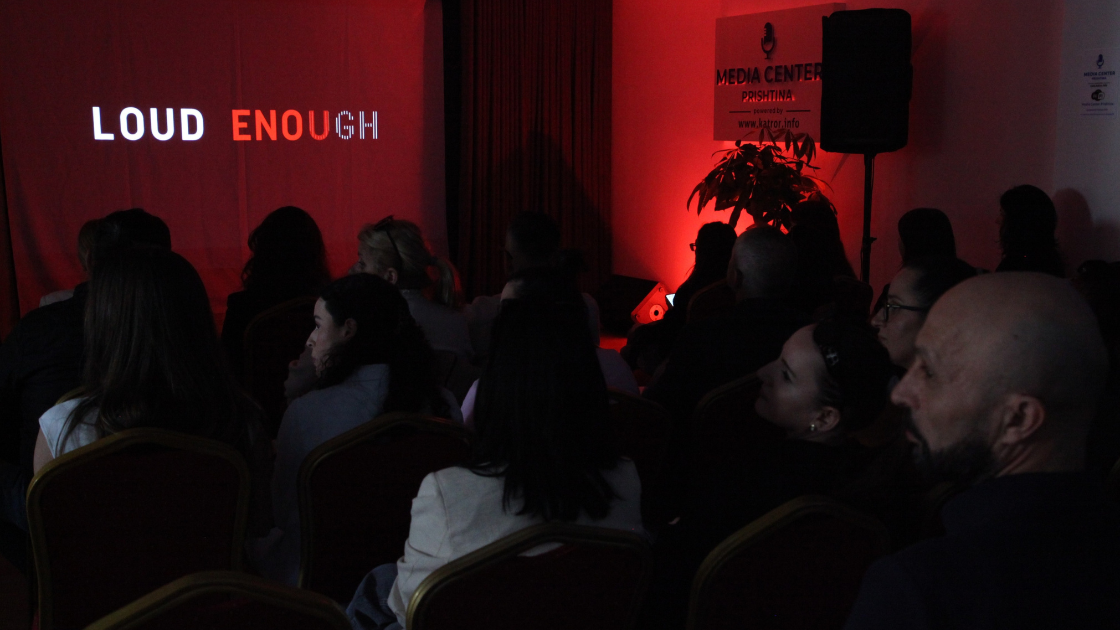
A young woman participant at the YWEI meeting in Prishtina presents her group’s action plan.

Advocacy Plays a Key Role in Young Women’s Empowerment

The Young Women’s Empowerment Initiative (YWEI) supports young women in developing their skills and taking the lead on issues that concern them. The initiative engages young women throughout Kosova in becoming catalysts of change and mobilizing their peers to do the same.

In Gjakova, young women shared the challenges they face on 24 Sep.: struggles over limited resources, insufficient job opportunities and systematic discrimination simply because they are young women.
“As [young] women we have limited options for expressing ourselves without being judged,” said a young woman from Gjakova.
Towards addressing these challenges, young women from Gjakova are developing innovative, effective ways to improve their lives.
“We can empower each other through street actions and art,” a young woman said. “We will bring together young and old women to express their talents.”
YWEI also held meetings in Prishtina and Mitrovica in Oct. They created action plans for addressing the issues they face. Young women from Prishtina decided to prepare a theatre play, raising awareness about the importance of education for young women. They also plan to hold a peaceful march in Mother Theresa Square.
In Mitrovica, young women plan to hold meetings with young women in primary schools and high schools, raising awareness about the importance of education. By meeting directly with them, they believe that they will have great impact.
“Besides having a good time, we also have learned a lot of new things,” a young woman activist said. “These kinds of meetings are very necessary for us.”

This year, Young Women Empowerment Initiative has involved 146 young women throughout Kosova. With KWN’s support, they plan to implement their action plans in 2014. KWN seeks to empower more young women to become involved in organizing and advocacy for women’s rights, strengthening the Kosovo women’s movement. The initiative receives support from Kvinna till Kvinna.

Persons with special needs exhibit their photographs at the exhibition organized by OPMDK on 22 Oct. in Prizren.

OPMDK Marks the Month of Equal Opportunities

The Organization of Persons with Muscular Dystrophy of Kosovo (OPMDK) launched an exhibition of photography created by persons with special needs on 22 Oct. in Prizren. The photographers included participants attend a professional photography course organized by OPMDK.

Through the exhibition, OPDMK marked the month of October as the Month of Equal Opportunities. OSCE and the Municipality of Prizren supported the exhibition. OPDMK also presented other work by persons with special needs.   

Several officials from the municipality, government and international organizations who helped to organize this event spoke as well.
“By having them as guests, we intend to mark the importance of equal opportunities and rights for persons with special needs,” an OPMDK organizer said.


Women members of NGO “Krusha e Vogël” visit the “Centre of Seedlings (Qendra e Fidaneve)” in Koretin, Kamenica, 2013.

NGO “Krusha e Vogël” Economically Empowers Rural Women

Members of NGO “Krusha e Vogël” expressed their interest in visiting organizations involved in agriculture in other municiplaities.

They visited the “Centre of Seedlings (Qendra e Fidaneve)” in Koretin village in the Municipality of Kamenica. The visit took place on 23 Jul., with support from the Local Action Group (LAG).
“This visit aims to support the exchange of experiences and learning in the area of agriculture,” said a founder of NGO Krusha e Vogël.
Skender Dervishi and Ibrahim Bunjaki, the owners of the seedling company, welcomed the women. They explained how they run their business, which seedlings they cultivate and other details. They also organized a reception for the Krusha e Vogël delegation. Women in this way had the chance to see concrete work on how to organize better the planting of seedlings, as well as to see new kinds of seedlings that they hadn’t seen before.
After their visit, Krusha e Vogël members traveled home using a different route, passing through the beautiful mountains of Prevalle. For many women, it was the first time they had seen these mountains or even travelled alone with other women. The experience was not only educational, but empowering.
“The trainings have been very important for us,” a member said. “And this visit was something very good and new. We had a fantastic time; we got out of our daily routine and learnt a lot of new things.”
All women members of Krusha e Vogël NGO were involved in the “Women’s Economic Empowerment in Rural Areas” project supported by the KWN Kosovo Women’s Fund (financed by Austrian Development Agency). They came from various villages such as Hasi, Krusha e Vogël, Randobrave, Pirana and Serbica.


KRCT Marks the International Day of Mental Health

The Kosova Rehabilitation Centre for Torture Victims (KRCT) screened the documentary “The Call for Help”, a documentary prepared in close cooperation with persons with mental disabilities.
KRCT organized the screening to mark 10 Oct., the International Day of Mental Health. The documentary also relates to KRCT’s field of work: preventing torture and respecting human rights.
KRCT screened the documentary on 22 Oct. in Shtime Special Institute, demonstrating support for the residents of this mental health institution.
“The purpose of this activity is to promote and support the development of working skills of persons with mental disabilities, psychiatric disorders and mental retardation, as well as their desire and willingness to take part in free activities,” said Feride Rushiti, Executive Director of KRCT.
Distinctive representatives of local and international institutions, as well as civil society attended the event.
“It was a very good idea for this documentary to be screened at Shtime Special Institute, since in this way representatives of the government, international organizations and civil society had the chance to see the environment within the institution and the good conditions they offer for the residents of this institution,” said Igballe Rogova, Executive Director of KWN.

The documentary was made in cooperation with the Shtime Special Institute and supported by Civil Rights Defenders. KRCT is a KWN member organization.

President of Kosova Atifete Jahjaga marches with NGO Jeta-Vita, promoting early detection of breast cancer.

Jeta-Vita Marches to Raise Awareness about Breast Cancer

Prishtina’s city square was covered in pink. Pink ribbons wrapped around trees and hundreds of citizens wore pink ribbons and scarfs, supporting women who suffer from breast cancer. Together, they sent a strong message: they are not alone.
For the sixth consecutive year, the Kosovo Centre for Fighting Breast Cancer Jeta-Vita gathered citizens in front of the National Theatre on 12 October. Following an informative and cultural program, they marched together with the motto: “Early Detection Equals Survival”.
This Jeta-Vita built on prior successes, seeking better cooperation with Kosovo institutions in diagnosing and treating breast cancer.
“We are not asking for mercy,” said Nafije Latifi, Executive Director of Jeta-Vita. “We are not requesting something impossible. We are only requesting quality treatment and early detection of breast cancer. This disease doesn’t affect only women, but the entire family and society.”

President of Kosova Atifete Jahjaga supported the initiative. “I ask all mothers, women, sisters and daughters to have regular medical check-ups because early detection means victory over breast cancer,” she said. “Through our symbolical walk we prove our kindness and solidarity as individuals, as a society and as institutions for all who suffer from breast cancer. Only together can we win this battle.”

Other high level state representatives also expressed their solidarity with people who suffer from breast cancer, offering their support.

KWN members, staff gather at the end of the retreat held in Durres, Albania on 3-6 Oct.

Annual Retreat Energizes, Empowers KWN Members

More than 100 KWN members gathered in Durres, Albania from 3-6 October for a weekend of recuperation, debate, entertainment and learning. Despite the dense agenda, participants energetically continued discussions outside organized activities. Diverse members readily shared their knowledge and life experiences, motivating and inspiring each other.

“One strength of KWN is its diversity,” observed Lina Andeer from Kvinna till Kvinna, the Swedish organization that supported the retreat. “You have young women and older women. You have women from cities and from rural areas, from different ethnic communities and women with disabilities.”
Indeed the diversity of participating KWN members was inspiring. Throughout the weekend, they supported each other: KWN had ongoing interpretation in Albanian, Serbian and English, as well as sign language. And when the party started, all members took to the floor, including blind women and persons with special physical needs, dancing in their wheelchairs.
During an all-day workshop on conflict resolution, the world-renowned inspirational speaker Shqipe Malushi supported members with strategies for transforming negative energy to positive energy. Fearing that she might open the wounds that many women still suffer from the war, she carefully conveyed how positive thinking can support women in dealing with their everyday realities. Positive thinking can enable activists to overcome various forms of conflict, from inter-personal to organizational to societal. Participants welcomed her unique approach and effective communication strategies.
“It was a very positive and inspiring workshop,” a participant said.
Meanwhile, in the room next door, KWN Program Manager Nicole Farnsworth facilitated a discussion on concrete steps in planning effective advocacy initiatives. Members discussed tools and “tricks” in planning related to the advocacy cycle. Then, they divided into groups where they planned advocacy initiatives to address real issues within their communities, such as physical access to public buildings for persons in wheelchairs, mothers with strollers and the elderly; health insurance for all; and sufficient pensions for retirees.
“The workshop about advocacy was very productive, especially working in groups where we had the chance to create concrete advocacy strategies,” an activist said. “Most of us plan to use these strategies when we go back to Kosovo.”
In addition to all-day workshops, the retreat involved events each evening. NGO “Artpolis” facilitated a discussion on “Women’s Empowerment.” Members viewed a series of photographs that triggered different emotions, which members then discussed together. KWN members also welcomed guests from the Albanian NGO “Gruaja tek Gruaja” (Women to Women) who amused members with a powerful and humorous monologue: “Sex. Thank you, Just to Try It.”
The next evening, activists from Albania, Delina Fico and Xheni Karaj, joined members in discussing the meanings, concepts and practices of feminism in Kosovo and Albania.
“There are many people who don’t have knowledge about feminism,” Delina Fico said. “They say that feminists hate men, but feminism has never seen men as enemies. Instead, it has seen them as part of the problem and the solution. This is obvious from the fact that throughout the world, and in Kosovo, there are men feminists who are part of the project of reviewing and reforming gender relations.”
KWN members discussed the importance of feminism as part of activism towards furthering women’s rights.
KWN marked the end of this unforgettable weekend with a party filled with music, fun and dancing.
“The party was the best way to end this meeting. We really had fun,” an activist said.
The dancing continued on the bus, all the way back to Kosovo. The retreat had served its purpose: transforming negative energy into positive energy, motivating activists, fostering collaboration among members and providing activists with new strategies for their future work.

Youth read the Albanian language alphabet in Braille using a new Braille board created by the Committee of Blind Women.

Blind Youth Demand Braille in School

Gezim, an ambitious young man, met the Director of the Special School for the Blind and Persons with Visual Impairments to request additional Braille typing machines. He plans to be persistent until the school has enough machines for all students.

“I do not plan to quit until I achieve this goal,” he said. “I don’t care how many meetings it takes.”
   
Gezim was among the blind and partially sighted youth participating in discussions for promoting usage of the Braille alphabet. The Committee of Blind Women of Kosova gathered youth on 14 Sep. at their new centre in Prishtina to inform youth about a new initiative and to collect their input.
    
Youth were excited to learn that the Committee of Blind Women will be collaborating with elementary schools and the Ministry of Education, Science and Technology to introduce Braille boards for the first time. The Braille alphabet uses different combinations of six dots, each representing an alphabet letter. Braille enables blind persons to read by using their sense of touch, rather than their eyes. By introducing Braille boards in schools, the Committee of Blind Women will help blind and partially sighted students learn the Braille alphabet and thus learn to read. They plan to introduce the first boards at “Emin Duraku” and “Anton Z. Cajupi” schools in Prishtina this year.
    
The Committee of Blind Women also plans to involve youth in raising awareness among school directors, teachers and pupils about their needs and the importance of using the Braille alphabet.
“I need you to get good grades at school and set an example of excellence for other students in order to convince people to help us achieve our aim,” said the Committee’s Director, Bajramshahe Jetullahu.
    
The Committee’s initiative encourages youth to advocate for their right to education.
“Our greatest need is to have the understanding of citizens,” said a young woman who is participating in the initiative. “They need to understand that you can never know what life will bring you. Maybe one day they will become [blind] like us, and they will need somebody to help them.”

The Committee of Blind Women’s Initiative received support from the KWN Kosovo Women’s Fund.


Ariana Qosaj-Mustafa, KWN Chair of the Board moderates the presentation of initial findings from the KWN and AH research: “Where Is the Money for Women’s Rights?”

KWN, AH Present Initial Findings: “Where’s the Money for Women’s Rights?”

On Sep. 2, KWN and Alter Habitus – Institute for Studies in Society and Culture (AH) presented initial findings from their research: “Where Is the Money for Women’s Rights?” The research involved a survey of 90 women’s organizations and interviews with more than 35 donors.The resulting recommendations seek to further efficiency and effectiveness in funding for gender equality and women’s rights organizing in Kosovo, including recommendations for “the state, donors and women’s organizations.”

Around 90 participants attended the launching and discussion, including KWN members, board members, donors and KWN supporters.
“You have done a great job in a very short time and with minimal funds,” said Advije Gashi from Norma Women Lawyer’s Association.
The survey’s initial findings suggest a clear decrease in overall funding available to women’s organizations between 2000 and 2013, with a brief increase in 2011. Other key findings include:
o Aside from a few Prishtina-based organizations, most women’s organizations encountered difficulties securing sufficient resources for
their issues, target groups, and strategies.
o Very few women’s organizations received income from individuals, assets, membership fees or income generation activities, suggesting heavy reliance on international funding and insufficient diversification of resources.
o Insufficient resources led a majority of organizations to reduce staff, cut activities, and/or work voluntarily for long periods of time. More than one-third have been in jeopardy of closing their offices, and a few have closed periodically, often with dire consequences for marginalized groups, such as persons suffering from gender-based violence.
o Of the donors participating in this research, only five had earmarked funding for women’s organizations. Some had funding available through competitions (e.g. for grants or contracts), for which women’s organizations compete with other organizations or businesses. Donors tend to provide short-term, project-based funding.
o The vast majority of women’s organizations have never received core funding.
Following the presentation, participants provided feedback regarding initial research findings and recommendations. KWN and AH also used the initial release to encourage women’s organizations and donors to supply additional information, towards developing a more complete understanding of funding provided for gender equality and women’s rights between 2000 and 2010 in Kosovo. KWN and AH will incorporate their feedback in the final report, which they will present publicly in November.
“I think this is a very useful report and it comes at a very strategic moment, as well,” said Lina Andeer, Kvinna till Kvinna representative in Kosovo. “It makes me reflect about my own organization. We are right now in a strategic planning process and I definitely can use this report for our discussions internally. What I hope will follow is a profound discussion of what to do about this negative trend […] to identify how civil society and donors can cooperate to try to change this negative trend.”
This research has received support from the Association for Women’s Rights in Development (AWID), as well as substantial in-kind contributions from KWN and AH.


Young women in Prizren strategize to address the challenges they face during a Young Women’s Empowerment Initiative meeting.

Young Women in Prizren Passionate about Advocacy

Dynamic lifestyles sometimes make it difficult for young women to meet and discuss issues impacting their rights. The Young Women’s Empowerment Initiative (YWEI) provided space for young women in Prizren to gather and strategize how to address some of the challenges they face in their municipality.

During the meeting, they developed an advocacy strategy for furthering women’s right to education and towards reducing discrimination against women at work.
In discussing women at work, they realized that most of the work that women do is not considered “work”, but rather “women’s responsibility.” As such, women do not receive any financial compensation for house work, childcare and caring for the elderly in their families, for example.
“The meeting helped us see things in a different perspective,” one participant said.
Young women also discussed other issues they face, including access to education.
“A very concerning issue, for example, is when a young woman’s family tells her that they have done everything for her, and education is not necessary for her,” said a young woman. “In this way they decide for their daughter without giving her the possibility to decide for her own future.”
After discussing these challenges, young women split into groups, creating strategies that they will use to advocate for changes within their municipality.
“This meeting is very interesting,” a young woman said. “I have never experienced something like this before. In Prizren, there are a lot of activities organized for youth, but not specifically to empower young women to fight for their rights.”

Follow young women’s discussions and advocacy initiatives on the Young Women’s Empowerment Initiative Facebook page.


Young women discuss strategies for advocating for psychologists in schools.

Young Women in Gjilan Seek Psychologists in Schools

After the successful meeting with ambitious young women in Prizren, KWN met young women in Gjilan. They knew exactly what they wanted: psychologists in schools.

“It is very important to have a psychologist at school with whom we can speak freely about the teenage problems we face,” a young woman said.
“We do not have the courage to share with our parents some of things that we can discuss with psychologists, since our parents are not patient to listen to us,” a young woman from Ferizaj agreed.
Together, young women plan advocate for psychologists in schools via debates with teachers, community members, responsible institutions and media. They also want to organize campaigns for raising awareness among parents on how to speak freely with their teenagers.
The Young Women’s Empowerment Initiative “began just at the right time,” a young woman said. “Cooperating with each other makes us feel stronger in pushing forward this issue, as well as other issues that will make Kosovo society understand the importance of gender equality.”