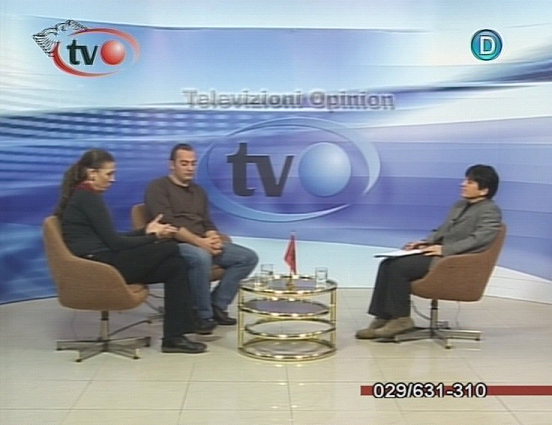
Marte Prekpalaj help s showcase women - led NGOs’ work on Prizren’s TV Opinion

Femra vizionare e shekullit XXI (Visionary Women of the XXI Century)

In Prizren, women face diverse challenges related to accessing education, economic independence, health and social inclusion. Women-led non-governmental organizations (NGOs) there have worked for years towards improving women’s position. Visionary Women of the XXI Century, a KWN member from Has, has promoted the work of women’s NGOs through a media campaign. In doing so, these visionary women have bolstered public awareness of women NGOs’ positive contributions in communities throughout Prizren region, as well as helped women’s organizations secure additional local support for their efforts.

It all started with Visionary Women of the XXI Century recording biographies that described the work of women’s NGOs in Prizren area, including Dora Dores (Hand to Hand), One to One and the Society of the Blind. Their stories then were broadcast on local TV Opinion.
“The NGOs in our Municipality often have said that they cannot afford to have their own TV or radio shows,” explained Marte Prekpalaj, Director of Visionary Women of the XXI Century. Their requests inspired her to draw from her own experience and positive relations with local media in order to help other women’s organizations promote their work.

The documentaries were well-received by viewers, who said that these programs had a very positive influence on the local community.
“We were unaware that women’s NGOs did so much work and activities,” a viewer said.
Due to popular demand, TV Opinion broadcast the program continuously for two weeks more than they had planned originally.

The programs also emphasized women’s NGOs’ need for continued community support. Touched by these programs, officials from the Municipality of Prizren have offered for women’s NGOs to use two offices in Prizren free of charge for carrying out their initiatives. This contribution is important for women’s organizations who often struggle to secure sufficient funds for their operational costs and advocacy work.

Visionary Women of the XXI Century hope that they can continue to support women’s organizations in promoting their work in the future.
Support from the KWN Kosovo Women’s Fund also enabled Visionary Women of the XXI Century to hold a roundtable with 27 women in rural areas on the International Day against Violence against Women. 

RadosavaMirkovic wears a T-shirt with the motto “Stop Violence.”

Lepsa Buducnost

In a small village of 500 inhabitants women rarely have the opportunity to speak about their problems, especially domestic violence. The gossip would be difficult to bear.Lepsa Buducnos tprovided the opportunity for women to gather and discuss the issues they face.

“This is the first time that women have had the chance to talk about their problems, especially problems related to domestic violence,”said Liljana Stefanovic. “It is very important for us.”

During a forum organized by Lepsa Buducnost, 25 Serb and Roma women shared information about family violence. They also discussed protection mechanisms, advocacy tools and ways to promote women’s human rights in Priluzje. The organization also shared information with people in their village through pamphlets and T-shirts with the motto, “Stop Violence.”

“With support from the Kosova Women’s Network, we increased our capacity for implementing small projects,” said Radosava Mirkovic, the organization’s director. “Even this small project made big changes in our lives,” she said.
 

Women in Gjakova learn about pregnancy and maternity.

Gratë Aktive nga Gjakova (Active Women of Gjakova)

The organization Active Women of Gjakova organized a lecture series for Roma, Ashkali and Egyptian women in Gjakova regarding pregnancy.

“I didn’t know anything about the methods I could use to protect myself from unwanted pregnancy,” said Tabe Maliqi,a woman who participated in the lectures.

“Thanks to KWN, around 170 women with minimal education and very bad economic conditions now have basic information about this topic,”said Valbona Rizvanolli, Director of Active Women of Gjakova. “This is something they had known little to nothing about.”

For example, “until now I thought that the period of pregnancy lasted six months,” a woman said.“It was only through this project that I learned that it’s actually nine months.”

The women participating did not only discuss issues of pregnancy and maternity; they also expressed their will to discuss issues with a gynecologist and visit her for an exam. Considering their poor economic situation, the organization plans to identify a solution for them to receive such check-ups in the future.


Gratë për Gratë më aftësi të kufizuara të Kosovës (Women for Women with Disabilities)

Bukurije Gashi, the mother of a handicapped child, has suffered from breast cancer. While she had an operation five years ago, she has not visited the doctor for the recommended regular check-ups since then.

“For three years I have not had the opportunity to visit the doctor because I could not afford it,” she explained. “Therefore, I am more than grateful to Women for Women with Disabilities, which made it possible for me to see a doctor,” she said.

The organization’s project “I love life as I am”, supported by the KWN Kosovo Women’s Fund, offered a free Pap test to 10 women with disabilities who could not afford such tests due to their economic situation. “We also, provide training for using a urinary catheter for women or members of their families, so they do not need to pay for this service. At the same time we provide people with free catheters,” said Drita Vukshinaj, the organization’s Director.

Further, the Prizren – based Women for Women with Disabilities has ensured that women receive sustainable support from the Department of Health. “Our organization successfully placed the names of individuals who use catheters on the essential list of the Department of Health within the Municipality of Prizren,” Drita Vukshinaj explained. “This department has promised to offer people catheters and the service of installing them free of charge starting in 2013.”

Women for Women with Disabilities works for the empowerment, emancipation, protection and improvement of the role of women with disabilities in society. The organization also trains women with disabilities about preventing and treating kidney diseases.
 

Women, Girls Displeased with the 2013 Budget of the Republic of Kosovo

Following the first reading of the budget in the Assembly of Kosovo, KWN issued a statement, delivered to all parliamentarians, key government officials and media, which read:

“We, as citizens of Kosovo, deplore the government’s and Parliament’s recent initial passing of the Budget of the Republic of Kosovo for 2013. We disagree with the ways in which our elected officials have decided to spend our tax monies. We do not believe that this budget represents the best interests of the citizens of Kosovo. Additionally, it largely fails to meet the specific needs of women and girls, despite Minister Kusari-Lila’s recent public commitments to gender responsive budgeting.

“We are gravely concerned that capital expenditures comprise 41% of Kosovo’s central budget. Do we need so many more government buildings? How does a one million-euro White House for the Presidency benefit average Kosovar citizens? Further, we are outraged that more than 22% of our budget has been allocated to roads (€267,700,000). Are roads more important than the wellbeing of Kosovars? And how will these investments sustainably contribute to human development – for both women and men? We do not believe that the implications of these investments on short- and long-term human development in Kosovo have been adequately assessed.

“Meanwhile, departments that hold real potential for investing in economic development and social welfare for the many Kosovars trying to make a living in rural areas remain under-funded (e.g., Ministry of Agriculture, Forestry, and Rural Development, €23,359,230; Department of Rural Development, €109,050).

“While education is crucial for ensuring that Kosovars can compete for jobs in local and global markets (e.g. towards continued remittances on which many Kosovars depend for survival), we do not believe the government has invested sufficiently in ensuring access to quality education. Half of the Ministry of Education, Science and Technology’s €44,679,592 budget will be spent on capital expenditures (€22,650,000), which will not necessarily enhance the quality of education available.

“Expenditures related to the rule of law receive a meagrely 10% of the 2013 central budget, threatening the ability of police and judiciary to ensure the rule of law. Meanwhile human development and social welfare arguably remain under-funded. Healthcare receives only 8.85% of the budget and the Ministry of Labour and Social Welfare 18.4%.

“The budgetary choices you have made do not set aside sufficient resources for crucial programs towards furthering the wellbeing of women and girls, as well as citizens in general. The Agency for Gender Equality, at €185,770, remains under-funded, which impacts its ability to ensure that gender is mainstreamed at all levels in Kosovo as per the Law on Gender Equality. Other laws and programs towards gender equality, including the Kosovo Program against Domestic Violence and Action Plan, remain just as under-funded as they were in 2012, despite recommendations made by the Kosova Women’s Network, among others.

“In sum, we believe that this budget does not sufficiently address the priorities of the Medium Term Expenditure Framework, which commits to economic development, rule of law, human development, and social welfare. We call on you to take immediate action to re-examine and revise the 2013 budget so that it better addresses the real, priority needs of women and men in Kosovo towards human development – not only towards the personal pet projects of a few government officials.”

”Enough”: citizens march to condemn violence and ask for justice on 20 May 2011.

Citizens March, Condemning Domestic Violence

On 20 May 2011, KWN organized a march to condemn violence and ask for justice. The recent murder of Diana Kastrati (age 27) deeply concerned KWN and the citizens of Kosovo. This was the fourth women this year who died as a result of domestic violence.

During the march, citizens signed a petition, which demanded:

  1. Immediate action by the Kosovo Police to find the perpetrator and gather testimonies against him;
  2. Investigative treatment of this and other unresolved cases of domestic violence, like the murder of Dr. Igballe Llalloshi, which has remained unresolved for more than a year; and
  3. Commitment of citizens to actively condemn and openly talk against domestic violence occurring in our own, our neighbor’s and our friends’ households.

The petition was sent to the police and the Judicial Council of Kosovo demanding immediate implementation of these requests. The signatures were collected during the march as well as through e-mail and the KWN website.

KGSC Reports to UN on Violence against Women in Kosova

In October, six KWN members contributed to a report written by the Kosovar Gender Studies Center (KGSC) and submitted directly to the United Nations Division for the Advancement of Women in New York that includes information about some factors contributing to violence against women in Kosova; data from and good practices on behalf of NGOs working on this issue; and recommendations for future steps to be taken by the UN, UNMIK, local government and NGOs.

KWN Contributes to Kosova National Action Plan against Trafficking

KWN representatives attended a strategic planning session in Durres, Albania toward drafting the Kosova National Action Plan against Trafficking. The Ministry for Internal Affairs took the lead in drafting the Plan with support from the UNDP Women’s Safety and Security Initiative. The Ministry officially thanked KWN for its involvement and has included some KWN recommendations in the Plan.

KWN Releases Findings from First Kosova-wide Household Survey on Domestic Violence

The first in-depth inquiry into domestic violence in Kosova, entitled Security Begins at Home was released on 27 Nov. at the Grand Hotel in Prishtina. The Agency for Gender Equality in the Prime Minister’s Office of Kosova with support from the UNDP Women’s Safety and Security Initiative contracted KWN to write the report. The findings and recommendations will serve as a basis for the first Kosova National Action Plan and Strategy against Domestic Violence.

KWN employed a mixed method methodology that involved collecting statistics from relevant institutions;
reviewing relevant law, legislation and social services available; surveying 1,256 women and men of all ages and ethnic groups across Kosova; and surveying representatives of Kosovar institutions, relevant organizations and experts. The report chapters include:

  1. Citizens’ Perceptions about Domestic Violence: What is Abusive and in What Circumstances
  2. The Pervasiveness and Main Forms of Domestic Violence in Kosova
  3. The Consequences of Domestic Violence
  4. Citizens’ Response: The Methods Citizens Use and Propose for Ending Violence or Reducing Its Circumstances
  5. Social Constraints that Deprive Particular Demographic Groups in the Private and Public Spheres, Potentially Increasing Domestic Violence
  6. Legal and Institutional Gaps in Addressing Domestic Violence

The report includes recommendations for legal and legislative reform; the Kosova Police Service; Ministry of Labor and Social Welfare and Centres for Social Work; Ministry of Justice; Kosova Judicial Council; Ministry of Economy and Finance; Ministry of Health; and Ministry of Education, Science and Technology.

KWN Releases Report on the Response of Justice Providers to Domestic Violence

From June to September 2009, KWN researched the response of justice providers to domestic violence in Kosova, contracted by the UNDP’s Women’s Safety and Security Initiative (WSSI) and supported by the Agency for Gender Equality in the Prime Minister’s Office (AGE). The research sought to support the Government of Kosova and lawmakers in drafting and later enforcing the National Action Plan against Domestic Violence and the new Law on Protection against Domestic Violence. The research focused on the justice system in Kosova with special attention to the implementation of legislation on domestic violence.

On September 22, more than 70 people participated in a workshop entitled “Access to Justice for Domestic Violence Victims” held at Villa Gërmia in Prishtina. Among the participants were officials from the centers for social work, shelters, municipal courts, regional courts, Kosova Police, Victims’ Advocacy and Assistance Division and Ministry of Internal Affairs, among others. In three working groups based on expertise, participants discussed the report’s draft recommendations. Groups focused on three sections of the report: protection against domestic violence; the Kosova Police; and safeguarding victims’ rights and access to justice. Recommendations made by the working groups were included in the final report.

On November 23, the final report entitled More than “Words on Paper”? The Response of Justice Providers to Domestic Violence in Kosova was publicly released at the Government of Kosova.

The report drew from existing data, interviews with more than 60 representatives of institutions and in-depth interviews with 96 domestic violence victims about their experiences accessing justice. The report makes recommendations to inform the drafting of the new Law on Protection against Domestic Violence, National Strategy and Action Plan against Domestic Violence, other legislation governing the prosecution of crimes committed in family relationships, operational procedures and the work of institutions responsible for ensuring access to justice.

The report assesses the performance of judges in delivering protection against domestic violence through mechanisms such as protection orders and penal prosecution of acts of domestic violence. It examines the work of the Kosova Police in investigating acts of domestic violence and protecting victims from further violence. The report assesses the work of institutions and organizations responsible for protecting the rights of victims while they seek justice. Finally, it discusses citizens’ perceptions of the justice system, which may impact decisions to seek justice or remain silent. The report concludes with recommendations for policymakers and individual institutions towards improving access to justice for domestic violence victims.

The report is available on KWN’s website.