KWN Held Regular Meeting with Members

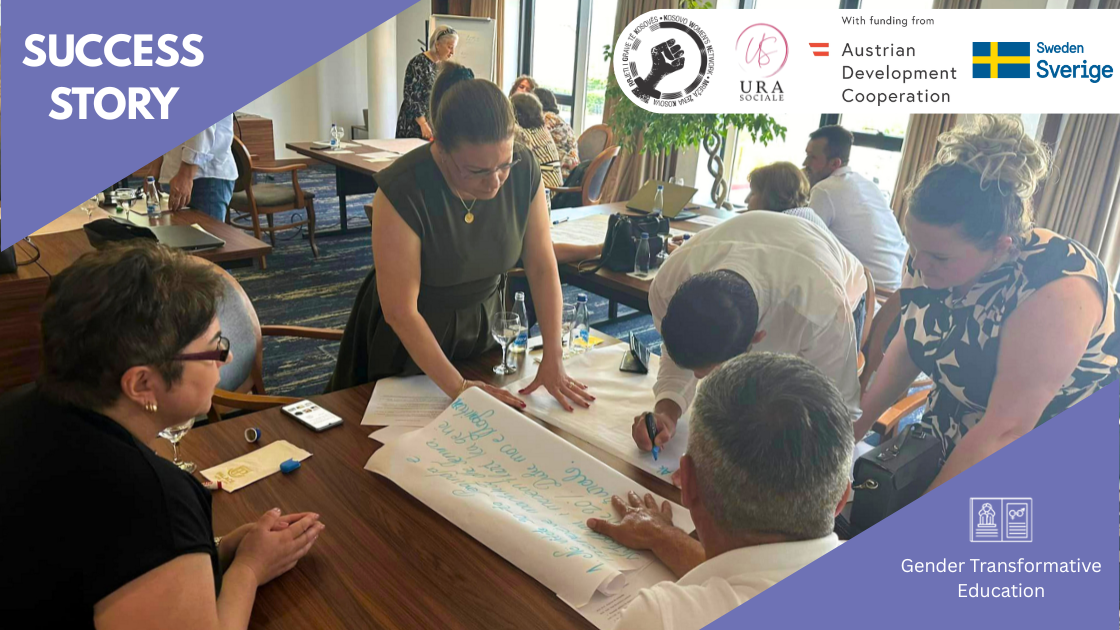
On 19 September 2022, about 50 representatives of member organizations of the Kosovo Women’s Network (KWN) attended the membership meeting.

On this occasion, the work of KWN, member organizations, and the board has done over the years has been praised.

While talking about the increasing trend of sexual violence in Kosovo, KWN once again condemned the rape of an 11-year-old girl in Pristina.

“KWN will not stop seeking justice. Violence has always existed, but thanks to women’s rights organizations’ work over the years this violence is being reported now,” KWN’s Executive Director Igballe Rogova said.

The importance of implementing the KWN’s new four-year strategy which is expected to be finalized soon was discussed, too.

Rogova said that the number of KWN members increased to 190 and stressed that the Ethical and Accountability Code should be restored.

These and other important topics will be discussed in the regular annual KWN Assembly meeting at the end of the year.

She also informed the members that the Women’s Network in Albania (AWEN)’s representatives will come to Kosovo in October to meet with KWN representatives and some of the KWN’s members.

During the meeting, KWN members discussed the Kosovo Women’s Fund (KWF) and the ways the fund will continue its long-term work in the future.

Members have proposed the fund’s continuation, since according to them “it has helped them a lot in the implementation of their projects aimed at advancing gender equality and strengthening their organizations”.

One of the ideas presented was the creation of an emergency fund for organizations facing financial difficulties.

The participation of women and girls in public consultations for gender-responsive budgeting in Kosovo’s municipalities was deemed very important. KWN’s member organizations dealing with these consultations said they managed to change the direction of budget appropriations in that way that girls and women can benefit from municipal budgets, too.

This meeting was supported by the European Union (EU) Office in Kosovo

Vienna Master Students Appreciate KWN’s Work

On 15 September, a group of students of Applied Human Rights Master from the University of Applied Arts Vienna met with Adelina Tërshani, Program Officer for Women’s Economic Empowerment (KWN).

Tërshani informed the students about KWN’s work ever since its establishment in 1996. A particular focus in this meeting was put on long-standing activities to combat gender-based violence and gender-based discrimination in the labor market.

Tërshani also informed the students about the results of KWN’s four-year strategy as well as the process of drafting the new strategy together with the 190-member organizations of the KWN.

The students appreciated the meeting, seeing it as a valuable experience and a wonderful opportunity to closely understand KWN’s work.

LYC is Another KWN Member that Promoted Successfully Family Friendly Policies at the Local Level

Kosovo Women’s Network (KWN) member organization Lipjan Youth Center (LYC) during a nine months initiative has promoted the policies that provide family-friendly workplaces.

The LYC has managed to inform business representatives, workers, municipal officials and members of civil society about the EU Directive on Work-Life Balance, which provides benefits for workers through maternity, paternity, parental and carers’ leave, as well as flexible working hours.

More than 50 women from the private businesses, Municipal Assembly and civil society have benefited from the activities organized by the LYC. More than 500 citizens have been informed about the policies that provide family friendly workplaces.

During this time, the organization held meetings with 20 representatives of the municipal assembly and 10 representatives of businesses. Also, it distributed 40 posters on the EU directive to local businesses.

The LYC representatives held discussions with the business owners regarding the EU directive. According to Valmira Marevci, manager, LYC, two of the businesses have begun to implement at least one family-friendly policy principle. Two others have pledged to apply principles related to friendly politics.

Marevci says that the EU directive on work-life balance enables a better approach to promoting women’s employment and empowering them. “To achieve this quickly and to include this policy in Kosovo’s legislation a broad institutional support is needed.  

LYC has also produced an informative video, which contains the messages of working women and job seekers about the need to incorporate “family-friendly policies according to the concept of work-life balance” in Kosovo as well.

LYC initiative was supported by the United Nations Population Fund in Kosovo (UNFPA) via KWN’s initiative “Expanding Choices: Gender-Responsive Family Policies for the Private Sector in the Western Balkans and Moldova,” financed by the Austrian Development Agency (ADA), the operational unit of Austrian Development Cooperation.

Drugëza Concludes Successfully Initiative to Promote EU Directive on Work-Life Balance

Kosovo Women’s Newtork (KWN) member organization, Drugëza during a nine-month initiative has managed to promote family-friendly workplaces policies to Skenderaj municipality’s businesses, civil society and municipal officials.

Following Drugëza’s informative sessions with 12 representatives of the businesses, two companies pledged to create family-friendly workplaces in line with the EU Directive on Work-Life Balance.

As part of the initiative “Empowerment of women in business, a good form of promoting gender equality,” Drugëza held meetings with 12 municipal councillors and the relevant directors. The councillor Mentor Mehmeti praised the initiative: “The meeting and information about friendly policies and the EU Directive will help us to have clearer ideas about this issue.”

In other meetings, fifteen representatives of civil society organizations have been guided how to achieve gender equality and promote the improvement of working conditions for workers.

Sanije Hoti from the Kosovo Center for Self-Support, said that “the application of these friendly policies in workplaces would greatly facilitate the balance of a woman’s private life and the continuation of her career.”

To have broader promotion of the EU Directive on Work-Life Balance, Drugëza has distributed 300 posters showing the benefits for workers and employers. About 1,200 workers have been informed through the posters. While, a video explaining the policies of family-friendly workplaces shared on social networks and on local television has reached more than 10,000 people.

KWN has helped continuously Drugëza in achieving its objectives.

“The support of KWN has also been important for us. Over the years many people benefited from our projects. We learnt that working with community is a responsibility but also a great pleasure, as we feel that we have done something in the improvement of the role of women in a patriarchal society that continues to exist in many villages of our municipality,” says Gentiana Zeqiri, manager, Drugëza.

Drugeza initiative was supported by the United Nations Population Fund in Kosovo (UNFPA) via KWN’s initiative “Expanding Choices: Gender-Responsive Family Policies for the Private Sector in the Western Balkans and Moldova,” financed by the Austrian Development Agency (ADA), the operational unit of Austrian Development Cooperation.

Systematic Abuse of Minors Continues in Kosovo- Disturbing Verdict Exposes the Institutional Neglect Towards Sexual Abuse of an 8-Year-Old Minor

With great concern, the Kosovo Women’s Network (KWN) has recently received the Final Judgment of the Kosovo court of Minors, acquitting a person accused of sexual abuse with persons under the age of 16.

Kosovo judiciary started to deal with the case six years after the first reporting. The trial lasted four years. The verdict says that the accused is acquitted because “in the absence of evidence” the defendant’s guilt has not been proven.

In 2012, a minor, then 9 years old, helped by her mother reported a case of abuse over the years by her stepfather. The Basic Prosecutor’s Office in Pristina received the Criminal Complaint on 27 July 2012. They have delayed the case causing trauma to the abused minor, as they interviewed the victims several times until 2022 – when the verdict was given.

According to the verdict the court and the prosecution have failed to prove the guilt of the defendant, constantly giving the reasons that KWN has decided to quote for the sake of revealing the patriarchal mentality deeply entrenched in the judicial system in Kosovo:

“The context in which the case of abuse was reported, by the mother of the minor, is controversial.”

The court says this, alluding that the minor’s mother reported the case of the girl’s abuse, only after noticing that “her cohabitation with the defendant is heading towards an irreparable end.” By “irreparable end” they refer to the constant physical violence that the defendant exerted on the minor’s mother.

Thus, although the court admits that the constant physical violence has been repeated, at the same time, the court finds that:

“The court takes it into account that in such cases when sexual assault or harassment occurs, or sexual abuse takes place within family members especially in the case when the will of one party is lacking, it is expected to notice a change in behaviour and disordered relationships between family members of the family alleged to be involved”.

Further, except that in the paragraph above, the court considers sexual abuse of minors as a “disordered relationship” and “lack of will of one party”, the same also raises the tendentious, and extremely disturbing question:

“If the relationship between the victim-witness (mother of the girl) and the defendant had not deteriorated, would she have reported the case of sexual abuse of her daughter?”

By making this question the court blames the witness for not reporting, and at the same time, raises questions that are completely subjective, and are not related to the case, which is the sexual abuse of a 9-year-old minor since 2005 (when the minor had 8 years old) until 2011.

Further, we are quoting some of the other scandalous justification of the court, namely, the Juvenile Department, regarding the acquittal of the defendant:

Referring to the fact that the injured minor has constantly provided new details, and the dates during which she was abused, the court emphasizes:

“This change in the statement over time, including other cases that were not shown earlier in the court’s assessment, reflects a tendency of the injured minor first to DRAMATIZE the situation and present the defendant as particularly abusive in relationship with children.”

The court considers that a minor, who at the time of reporting was 11 years old, is able to create scenarios of sexual abuse, even in detail, (for the reason that the court lists the cases that the minor explained to him, very clearly and fluently).

However, it considers that the defendant’s guilt is questionable, because “it is completely unbelievable if the alleged sexual assault existed, the victim would not have expressed it or had been noticed by other people, including her mother” despite the fact that there is an evidence for the constant physical violence that the defendant caused to the minor’s mother.

The legal violations in this decision are numerous, starting from the Basic Prosecutor’s Office of Pristina, which did not qualify the criminal offense in accordance with article 198 paragraph 2, related to paragraph 5 point 7 of the Criminal Procedure Code since the suspect was the victim’s stepfather, but the qualification was made only with paragraph 2 of the CPC, which was a mitigating circumstance for the accused.

Further, the Basic Court of Pristina acquits the suspect, on the grounds of “lack of evidence” even though numerous shreds of evidence have been presented to the same court and the court has refused to process and examine them, including the following evidence:

The letter written by the injured party, in which the same confesses about the serious emotional and physical condition, as a result of the abuse over the years, and which has been confirmed to be written by the daughter of the child confirmed by the Forensic Agency:

a) Testimonies of around four people involved, including police officers;

b) SMS threatening to withdraw the case report, addressed to the victim’s mother, sent by the defendant;

c) Medical reports of the injured party, which proved the serious condition of the minor;

The court, without giving reasons, refused to issue forensic expertise, even though there was a request from the Prosecution and the representative of the injured party for this which would have been the main evidence of the case.

According to the Institute of Forensic Medicine, in over 70% of cases of sexual violence, the victims are minor girls. Despite this fact, every day we are witnessing institutional failure, and further, the tendency to blame the victims, who, under very limited circumstances, are choosing to report the cases, precisely to the institutions that are neglecting them.

Bearing this in mind, KWN remains open to cooperation and assistance to victims of gender-based violence through free legal advice and referral to relevant institutions. If you need free legal aid for cases of gender-based violence or know someone who needs it, contact us at: 038 245 850.

Municipality of Klina in Cooperation with KWN Opens Exhibition “Break the silence: Ending Violence Behind the Walls”

Following the increase in the cases of gender-based violence against girls and women in Kosovo, and after the recent cases of sexual violence, the Kosovo Women’s Network (KWN) has opened again the exhibition “Break the silence: Ending violence behind the walls”. The traveling exhibition that presents a symbolic labyrinth that shares stories gathered by Kosovo Women’s Network (KWN) regarding women and men who have experienced domestic violence was open in three different municipalities, Klina, Ferizaj and Viti.

The exhibition in Klina was special, because it was organized by the Municipality of Klina, in cooperation with KWN. The deputy mayor of Klina Marqe Tanushi Selmanaj said that the exhibition aims to raise awareness against gender-based violence, especially after the recent events, where the victims are mainly girls and women.

“The exhibition came as a result of recent events. We thought of having such an installation in our municipality to raise the voice as an institution trying to fight these negative phenomena,” said Tanushi Selmani.

Citizens had the chance to visit the exhibition in Klina from 6-9 September, at the “Jehona e Dukagjini” venue.

Besarta Breznica, Coordinator of the Project for Addressing Gender-Based Violence, KWN said that the exhibition was shown in several cities, while Vitia was their next destination.

“This year, the exhibition has traveled to Malisheva, Fushë Kosova, Ferizaj, Klina, and Viti. Citizens were very interested to go inside the walls and getting informed about the exhibition. Also, we have a chance to talk in more detail about domestic violence and recent cases of sexual violence”, she said.

KWN will continue to open the exhibition in other cities. During this year there will be various online campaigns against gender-based violence, in particular against domestic violence.

The exhibition is supported by the European Union (EU) through UN Women (#EVAW) and the Austrian Development Agency (ADA)

KWN Encourages Women and Girls to Participate in Public Consultations for the Budget Appropriations at the Local Level

The participation of women and girls in public consultations related to budget planning for the upcoming year is very important. In order to increase the number of participation of women and girls in public budget hearings as well as to send recommendations to the municipalities, the Kosovo Women’s Network (KWN) has established cooperation with several of its member organizations.

For this purpose, on August 31, 2022, a coordination meeting was held with the organizations that will execute this initiative, for which contracts were signed in the same day.

Law No. 05/L-020 on Gender Equality makes gender responsive budgeting mandatory for public institutions in Kosovo, including municipalities, ministries and other budget organizations. According to this law, non-proper implementation of gender-responsive budgeting practices is considered a misdemeanor by the court, and sanctions are imposed.

It is extremely important that budget planning is addresses the different needs and priorities that diverse women and men have. Therefore, KWN is committed to ensure that gender responsive budgeting is part of the budget appropriations in every municipality.

KWN demands that the Gender Equality officers in each municipality and women’s civil society organizations be involved in these public consultations, in order to engage more women in all budgetary processes.

Apart from the recommendation on the institutionalization of gender-responsive budgeting in all budget phases, KWN recommends better funding in several lines of the municipal budget for gender equality, economic empowerment of women, addressing gender-based violence, equal quality education and health care.

This activity has been supported through the four-year initiative “Strengthening Women’s Participation in Politics” by the European Union (EU) Office in Kosovo as well as through the Gender Budget Watchdog Network supported by the Austrian Development Agency and the Swedish Development Agency and International Cooperation (Sida).

KWN and Shelters React to KJC and KPC Comments on NGOs’ Work

Kosovo Women’s Network (KWN) and all Kosovo Shelters react to the Kosovo Judicial Council (KJC) and the Kosovo Prosecutorial Council (KPK) comments on the work of the non-governmental organization.

Since their establishment, non-governmental organizations and shelters have always been there for all victims of gender-based violence, even in cases where the police, prosecutors, and judges have broken the law and failed to help victims of gender-based violence.

The language used by the KJC and the KPC that the victims were left “at the mercy of NGOs” diminishes the importance and demeans the work that NGOs have done so far, be it counseling, representation, monitoring, and sheltering of victims of gender-based violence.

The victims of gender-based violence do not feel safe and do not find support and help in Kosovo’s institutions because. These institutions have proven so far how they fail to protect the victims. The latest case shows us once again the failure of institutions in protecting and bringing justice to women.

Therefore, victims of gender-based violence will always have the support of non-governmental organizations.

Shelters also have a long experience of institutional negligence, especially regarding the judges, prosecutors, and the police. Because of this their work and safety have been jeopardized every day!

Therefore, KWN calls for inter-institutional coordination and cooperation, in ensuring the fair treatment of victims of gender-based violence. KWN will continue its work in legal counseling, representation, and monitoring of all cases of gender-based violence in the courts.

KWN Joins Mass Protest for the Protection of Girls and Women

Kosovo Women Network joined the mass protest held on Wednesday 31 August in Pristina following the rape of an 11-year-old girl in a city park at the weekend.

KWN continues to reiterate that such cases should serve as a wake-up call to all relevant institutions that violence against women and children must be urgently prioritised. The perpetrators of these crimes need to be punished to the fullest extent of the law.

KWN, after being informed by media about the case of rape of a minor girl in Pristina, has responded with a press release and demanded detention for the suspects who committed the criminal offense “rape” until a final decision is taken by the court and not to be released after 48 or 24 hours.

“KWN calls on the suspects to receive sentence commensurate with the gravity of the offense after evaluating the evidence.”

According to the Criminal Code of the Republic of Kosovo, Article 227, it is stated that “Whoever subjects another person to a sexual act without such person’s consent shall be punished by imprisonment of two (2) to ten (10) years… and in case committed against a person under the age of sixteen (16) years, the perpetrator shall be punished by imprisonment of five (5) to twenty (20) years.”

KWN specifically requests for this case to be treated with gender sensitivity, as enshrined in the Istanbul Convention, and to provide appropriate psycho-social treatment to the victim. KWN will not stop until the violence against women is not only treated as daily news or a private matter.

According to the Institute of Forensic Medicine, in over 70% of cases of sexual rape, the victims are underage girls. Sexual violence against women and girls and any other form of violence against women and girls must be combatted by the whole of society and every perpetrator of violence must receive deserved punishments from the competent bodies.

We also call for a focused approach to the victim when working with the juvenile and for her to receive the necessary assistance.

Despite the fact that children and women are the most affected by gender-based violence, and that serious cases of rape against girls have recently been made public, we are witnessing an institutional silence and mishandling of these cases by the judiciary.

KWN will follow the case closely and seek justice. KWN will not stop until violence against girls and women is treated with the gravity and urgency it deserves.

KWN remains open to cooperation and assistance to victims of gender-based violence through free legal advice and referral to relevant institutions. If you need free legal aid for cases of gender-based violence, or know someone who needs it, contact us at: 038 245 850.

SDK Organizes First Public Meeting Only with Women on Gender Responsive Budgeting

The beneficiary organization of the 17th round of the Kosovo Women’s Fund (KWF), Rule of Democracy in Kosovo (SDK), organized on 23 August a public discussion on gender-responsive budgeting among municipal officials, assemblywomen and girls and women from the municipality of Podujeva.

The deputy mayor of the Municipality of Podujeva, Marigona Lahu, emphasized that this was the first public debate that was held only with women.

“As a municipality we have tried to focus on women, and we will continue in the future. However, we need your support, criticism and suggestions,” she said. These hearings make it possible for budget planning to respond to the problems of women.

Fatlum Osmani, Director for Budget and Finance in the municipality of Podujeva, after showing a general summary of the budget data, said that he is keen to listen to the demands and problems of the citizens so that the municipality of Podujeva has a more comprehensive budget.

The women raised the problem of the functionalization of urban traffic to better address the connection of villages with the city of Podujeva, the construction of childcare centers especially in rural areas, the provision of gynecological and oncological services, public lighting and the problem with stray dogs.

Some of the citizens asked for support and subsidies for businesses, and among them the demand for subsidies in agriculture was emphasized.

Osmani said that for 2023 there is almost a doubling of funds for subsidies in agriculture:

“From €430,000, in 2023 we have €700,000… and this normally means that for many women and many of the families who until now have not received any necessary subsidy, now the opportunities will be incomparably greater.”

Furthermore, vice-president Lahu informed the attendees that the Municipality of Podujeva, in cooperation with the central level, for 2023 has allocated €165,000 for a day stay center for elderly people.

“There are many women who sometimes cannot work because they have to take care of older people at home, so from next year there is some relief because these people will be able to send them to day care and to perform their different activities”, said Lahu.

Satisfied with this organization and the fact that she was given the opportunity to present her requests to the municipality, Xhemile Hykolli from the village of Shajkovc in Podujeva remarked:

“This organization seemed very good to me and I am very satisfied, it does not mean that today I made the request and today it will be implemented, but the main thing is that our requests are presented and then the implementation goes step by step”, said Hykolli, who requested the opening of a childcare center in the village of Shajkovc.

This meeting was organized within the project “Strengthening mechanisms for responsible gender budgeting” which was implemented by SDK and supported by FGK of the Kosovo Women’s Network (KWN).

This activity is organized within the KWN initiative, ““Enhancing the Capacities and Resilience of CSO’s: Furthering Gender Equality Amid the COVID-19 Pandemic”, financed by European Union (EU) in Kosovo.