KWN Contributes to Informing OSCE Work for Gender Inclusivity in Conflicts

How can the OSCE work for inclusive and gender just peace throughout the conflict cycle? This side-event was organized on May 19, by the Kvinna till Kvinna Foundation in collaboration with the Swedish Chairpersonship of the Organization for Security and Co-operation in Europe (OSCE) and co-sponsored by the Finnish Permanent Delegation to the OSCE.

Kosovo Women’s Network (KWN) Executive Director, Igballe Rogova, was among the panellists discussing the obstacles they have faced and their individual contributions to building sustainable peace in their respective context.

During her introduction, Rogova emphasised the crucial importance of local women’s rights organisations taking part in peacebuilding processes.

“Local women’s rights organisations and activists have the information and the trust of their communities. Without their involvement in all parts of the conflict cycle, we will not prevent conflict or build inclusive peace”, she emphasized.

“There is no peace, without justice”, Rogova added, while demanding for implementing the United Nations Security Council Resolution (UNSCR) 1325 on Women, Peace, and Security.

Rogova further invited all panellists to read the Facts and Fables, as a collection of stories about implementing this resolution in Kosovo since 2000.

Petra Tötterman Andorff, Secretary General of the Kvinna till Kvinna Foundation, also highlighted the significance of including women’s rights groups and women’s needs in all conflict-solving processes.

“The exclusion of women from peace and transition processes means that women’s specific perspectives and priorities are not considered. Women’s participation needs involvement of local women and women’s rights organizations throughout the conflict cycle.”

Other panellists were: Ekaterine Gamakharia, Head of Tbilisi Office, Cultural Humanitarian Fund “Sukhumi”, Nina Potarskaya, National Coordinator Ukraine, Women’s International League for Peace and Freedom, and Liliana Palihovici, OSCE Chairperson-in-Office’s Special Representative on Gender.

The message was clear from all the panellists- local women have the expertise, and the trust of their communities, and there is no meaningful and inclusive peacebuilding process without their involvement.

This side-event was organised as part of the online Conflict Cycle Seminar for delegations of OSCE taking part States and Partners for Co-operation hosted on 17-19 May by the Swedish OSCE Chairpersonship, in collaboration with the OSCE Secretariat. It’s intent is to inform stakeholders on how different OSCE mechanisms and other multilateral organisations can be improved in order to enable greater inclusivity of civil society and women peacebuilders throughout the different phases of the conflict cycle.

Read more HERE.

**

Related articles:

Resolution 1325 Requires Consultations with Women’s Rights Groups in Kosovo

KWN part of the Conference Celebrating 20 years of Resolution 1325

20 Years of Resolution 1325: Kosovo Needs to Implement This Resolution  

KWN Supports the Protest Against the Sexual Harassment of the Minor

Following the case of sexual harassment of a minor by three boys, also minors, in the primary school “Faik Konica” in Prishtina, Kosovo Women’s Network (KWN) supports today’s protest organized by the Collective for Feminist Thinking and Action. This protest took place at the Ministry of Education, Science, Technology and Innovation starting at 12:00 pm. 

Although gender-based violence is quite common, even among juveniles, there is still a lack of proper reporting and handling of these cases. KWN calls on the responsible institutions to treat this case with due diligence, as should any other case of sexual harassment and assault. It is clear that schools urgently need to establish mechanisms that address cases of violence, harassment and sexual assault. 

We recall that KWN recently published the report “From Laws to Action: Monitoring the Institutional Response to Gender-based Violence in Kosovo” where we recommended to the Ministry of Education, Science, Technology, and Innovation: 

  • Provide trainings for educators and psychologists on forms of gender-based violence; how to identify signs of gender-based violence; and how to refer to these cases. 
  • Include literature on equality between women and men, mutual respect, non-stereotypical gender roles, gender-based violence and how to report it. in educational curricula appropriate for different age groups, as provided by the Istanbul Convention. 
  • Allocate sufficient budget to increase the number of psychologists in schools. 

In conclusion, it should be noted that as with other cases of gender-based violence, KWN will seek justice and closely monitor this case and measures taken to address it. 

OPDMK Holds “Advocacy and Lobbying for the Rights of Women with Disabilities” workshop

Despite the challenges faced with the COVID-19 pandemic, the Organization of Persons with Muscular Dystrophy of Kosovo (OPDMK), a member organization of the Kosovo Women’s Network (KWN), held a one-day workshop on advocacy and lobbying for the rights of women with disabilities on May 15 in Prizren.

This workshop was supported by KWN Project Coordinators Valmira Rashiti and Majlinda Behrami, who spoke with participants about ways to advocate for the rights of women and girls with disabilities, the mechanisms that can be used, and the importance of their equal participation in public life.

The Executive Director of OPDMK, Antigona Shestan, spoke about the importance of this training for women and girls and disabilities.

“This workshop has a very positive effect on the motivation of our representatives in the Women with Disabilities Group. What I would like to highlight is the enthusiasm that radiated from each girl with their proposals on how to push the institutions to cooperate with our community and for all of us to benefit”, she says.

According to Shestan, this is the only way to make a change in society and have equal rights for all.

Resmije Rrahmani, activist within the initiative “Strengthening Women’s Participation in Politics”, says that trainings like this are essential to enable these women and girls to take their deserved place in public life.

“For us, to attend workshops like this is very significant and welcomed by all girls and women with disabilities. I hope that in the future we will have as many such workshops from other organizations that focus on women with disabilities “, said Rrahmani while expressing gratitude for the contribution given by KWN staff during of this workshop.

This activity was supported by the European Union (EU) Office in Kosovo through the initiative “Strengthening Women’s Participation in Politics”. For more about these activities click HERE.

KWN Joins Two International Feminist Organisations, Promoting Solidarity and Cooperation

Kosovo Women’s Network (KWN) has expanded its relations between European and global women’s networks, by recently joining the European Women’s Lobby (EWL), as a supporting member, and the Associations for Women’s Rights in Development (AWID).

EWL represents over 2000 organisations in 26 EU Member States, three Candidate Countries, one former EU Member State and one European Free Trade Association country, as well as 17 European-wide organisations representing the diversity of women and girls in Europe, whereas AWID currently has over 6,000 members, from over 180 countries.

Connecting with a wider feminist movement is very important for the work of KWN, its member organisations and its partners. Involvement in global networks will enable partners to disseminate information from Kosovo to various international women’s networks and to cooperate with them in advocacy and other initiatives.

Collaborating closely with other EWL members to defend women’s interests and furthering gender equality, and re-joining with an international, feminist organization committed to achieving gender equality and sustainable development, such as AWID, is of a crucial important for KWN’s aim to further strengthen the feminist movement in Kosovo, the region and beyond.

KWN treasures EWL and AWID as partners in working together towards advancing and empowering women to involve in ongoing issues and debates in Europe and wider, as well as enhancing our cooperation with women’s global networks.

Develop relations between women’s networks in Kosovo and Europe is also foreseen by KWN initiative “Strengthening Women’s Participation in Politics”.

READ MORE: New Action Seeks to Empower Women’s Participation in Politics

Activist Lokaj: Thanks to KWN, We Build Partnerships Toward Achieving Gender Equality

Midwife Xhejrane Lokaj dedicated her life to women’s health and improving the living conditions of women in Kosovar society.

In this journey, for many years she collaborated with the Kosovo Women’s Network (KWN), by being part of many activities.

KWN’s Unique Contribution for Women’s Rights  

In this conversation, Lokaj elaborates on what were the most important activities and advocacies that KWN has undertaken over the years to improve women’s rights, and also how the COVID-19 pandemic has affected her commitment as women’s rights activist. 

“For years KWN has been implementing very democratic standards with member organizations, through regular meetings and the KWN Annual Meeting, with detailed narrative and financial reporting. Through equal treatment of all member organizations and through continuous capacity building.” she says.

As a precious opportunity for women’s rights activists, she mentions the grants given through the Kosovo Women’s Fund, networking and building partnerships through the establishment of Lobby for Gender Equality and Coalition for Quality.  

She recalls KWN’s contribution to advocacy and demands to relevant institutions, protests regarding protecting women’s rights and opposing violence against them, as well as initiatives for necessary legal changes.

“Meetings hosted by KWN have enabled us not only to get to know each-other but also to recognize the problems of women in Kosovo. […] Building partnerships has a special importance to us. In creating this opportunity, the credits go to KWN with its brilliant staff who always reminded us to respect the principles we use in our work and joint activities.”

Challenges Brought by 2020  

The past year has been difficult for everyone, especially for women’s rights organizations. Lokaj elaborates on how this year affected her as an activist. 

“For all of us, 2020 was the hardest year since the Kosovo war in 1998/98. During 2020, we experienced the unknown and the unexpected. The COVID-19 pandemic was a challenge for the state institutions, the citizens, and to a large extent a responsibility and a challenge for me as a women’s rights activist.”

Lokaj adds that although the pandemic is a global problem, Kosovo’s economy created even more difficult circumstances. 

“I have been active through individual health advises and with small groups with pregnant women and breastfeeding mothers. Women, single mothers and mothers with poor economic conditions, referring to social work centres, non-governmental organizations, Kosovo Red Cross branches and donors, and often mediating for help and support.” 

KWN as a Good Example for Women  

At the end of this conversation, she says that every step of the journey has its turns that aren’t easy to overcome, but we must not forget that in life there is always hope, work, commitment, success, joy, strength, and pride.

“We overcome together obstacles with the help of others, with family, friends, and colleagues, always by working hard, giving respect and love. […] “

According to her, KWN is a good example that can serve to many women and young women.

“In KWN you find a big family, a family that always thinks of you, teaches you and helps you, gives a helping hand and does not let you go, raises you up and helps you get through the obstacles more easily.”

Conclusively, Lokaj gives a message for all the women out there. 

“Do not surrender to challenges and difficulties, they will pass. You, as a woman, continue walking, walk bravely because you are not alone. There are other women like you, who will not leave you alone. We are all together in this and we will walk together until the sun rises for us.”

*This article is a continuation of KWN series of publications on the work and contribution of human rights activists in Kosovo.  

KWN Marches for May 1: Workers Unite Against Oppression

On May 1, Kosovo Women’s Network (KWN) joined the International Workers’ Day protest, demanding equal employment opportunities, a dignified life, health insurance, job security, and work without discrimination, regardless of ethnicity, age, sexual orientation or gender identity.

The march was organized by the Collective for Feminist Thinking and Action, Myriad, and the Anarcho-Syndicalist Group of Prishtina. Workers and the currently unemployed, and trade unionists gathered in the streets of Prishtina to demand justice, equality and solidarity for all.

 [KWN Marks 1 May by Protesting, Seeks Employment without Discrimination]

The march came at a time when the challenges of women in the labor market were compounded by the COVID-19 pandemic, making women’s welfare and economic indpenence even more difficult to achieve.

“We want decent wages,” “Employers ask me about pregnancy, not my CV” were some of the banners held by protesters to emphasize the discrimination and injustice women and girls face in the labor market.

KWN aims for economic empowerment of women, working to improve conditions for women’s participation in the workforce, and increasing the percentage of women who have access to inheritance and property.

According to KWN research, over 80% of women are not part of the labor force in Kosovo as a result of gender discrimination, but even when employed, women are paid less than men for the same work, hold lower positions, are deprived of the right to paid maternity leave and are exposed to sexual harassment in the workplace. This type of discrimination is especially pronounced for women who are employed in the private sector, which in most cases belong to the informal sector.

HERE you can complete the questionnaire that aims to identify the best ways to address the forms of discrimination that occur in labour market.

[KWN Demands the Improvement of Women’s Working Rights]

KWN Demands for Including Women and their Needs in Dialogue with Serbia

Kosovo Women’s Network (KWN) is following with concern the latest development regarding the engagement of experts for the dialogue between the Republic of Kosovo and the Republic of Serbia. This team of experts comprises men only.

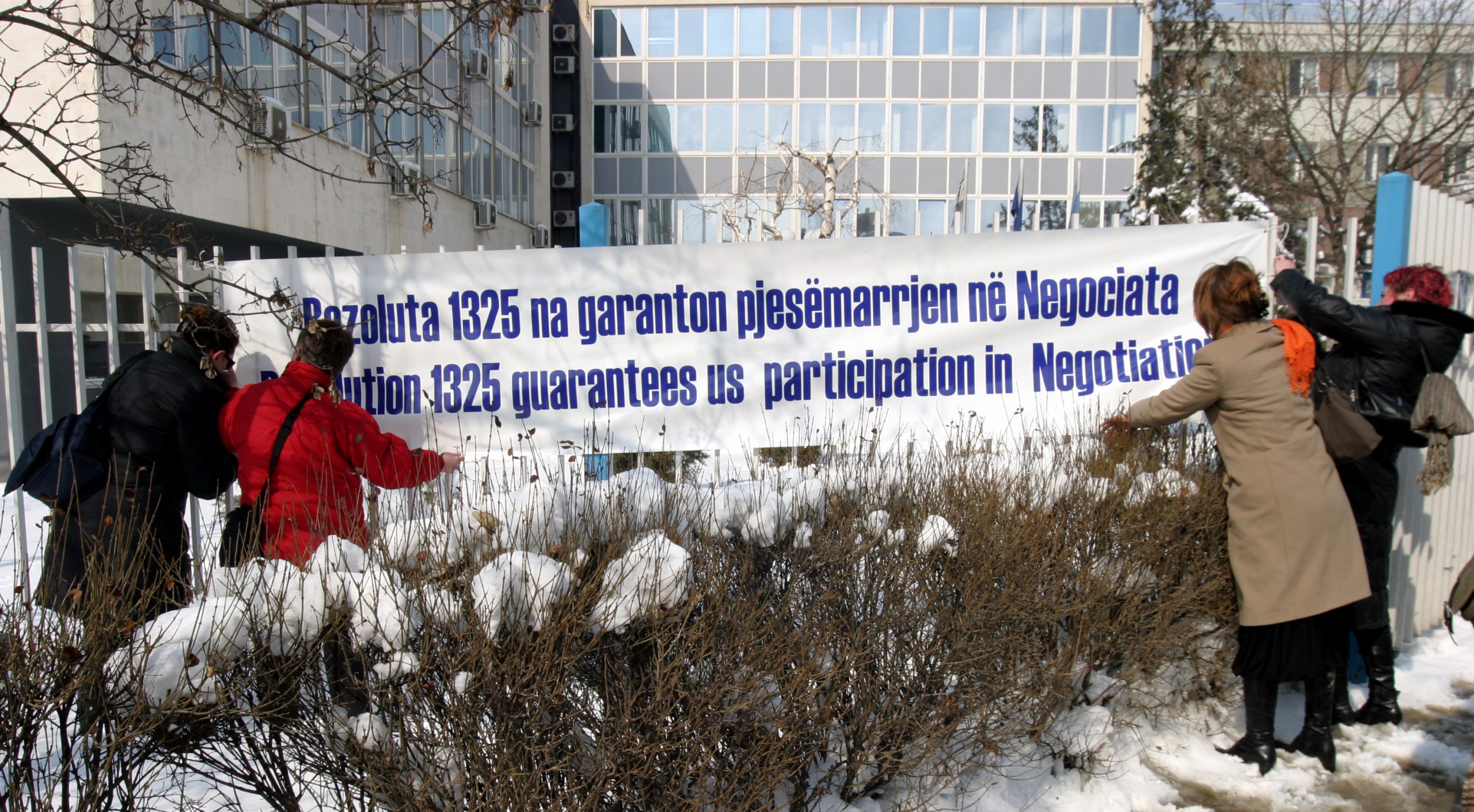
Through this public letter, KWN, as a network representing the interests of 158 member organizations, pledges to monitor the entire dialogue process, constantly asking for the negotiating team to be inclusive and that women’s priorities be part of the agenda. KWN calls for including women in the dialogue team, as well as including women’s priorities in the topics to be discussed. We also recall that KWN has in the past called for the involvement of at least one experienced civil society woman in dialogue, as defined by Resolution 1325 on Women, Peace and Security. The Law on Gender Equality requires an equal representation of women in such decision-making positions.

Thus, KWN reiterates we stand ready to provide the names of qualified women, as well as support in organizing public consultations towards achieving a democratic, transparent and inclusive process, which is essential to achieving lasting peace and security in Kosovo, and the region.

During the past year, which marked the 20th anniversary of the adoption of Resolution 1325, KWN sent an open letter to the then Government of Kosovo and the European Union Special Envoy for the Kosovo-Serbia Dialogue, Mr. Miroslav Lajčák. KWN have had complained about the non-inclusion of women in negotiating teams and the willingness to cooperate with the Government of Kosovo to propose the names of women with experience in this field, as well as listing the needs identified in our latest report “A Seat at The Table: Women’s contributions to and expectations from peacebuilding processes in Kosovo “.

This report has identified that the needs of women and girls towards this process remain similar to those that women have raised since the end of the war in Kosovo. This report also highlighted the fact that lasting peace is achieved only with equal inclusion of women and men. In addition, women do not sign agreements they could not implement.

We urge the Government of Kosovo to include in the dialogue agenda the needs and priorities of the various women and girls in Kosovo, newly identified in this report:

•       To ensure substantial participation of women in decision-making regarding negotiations and dialogue, both through involvement in the formal negotiation team and in public consultations;

•       To seek recognition of Kosovo by Serbia and public apology from the Serbian state for crimes committed against Albanian civilians;

•       To ensure the return of missing persons;

•       To ensure the prosecution of persons who have committed war crimes in Kosovo, including sexual violence committed during the war, thus achieving justice; and

•       To provide compensation and compensation for material damage, including the return of pensions.

Since 2006, KWN has been active in following the dialogue between the Republic of Kosovo and the Republic of Serbia, including the topics and composition of the dialogue team, and we will continue to be an active voice as long as women and their needs are addressed.

KWN Launches the Report: From Laws to Action

Download File

On 28 April 2021, the Kosovo Women’s Network (KWN) and the Agency for Gender Equality in the Office of the Prime Minister of the Republic of Kosovo co-hosted the online launching of the report From Laws to Action: Monitoring the Institutional Response to Gender-based Violence in Kosovo.

With financial support from the Austrian Development Agency (ADA) the operational unit of Austrian Development Cooperation, this report written by KWN assesses the extent to which Kosovo’s legal framework has been aligned with the Istanbul Convention, ratified by the Assembly of Kosovo last year; and responsible institutions’ implementation of the relevant legal framework for addressing gender-based violence, including the National Strategy on Protection from Domestic Violence and Action Plan (2016-2020).

The report launching brought together representatives of Kosovo institutions, international organizations and women’s rights organizations to discuss recommendations and a joint way forward.

Ariana Qosaj-Mustafa, KWN Chair of the Board, highlighted the importance of this report towards addressing gender-based violence in Kosovo.

From Laws to Action looks at the implementation of some of the most important principles defined in the Istanbul Convention on Combating Gender-based Violence and shows to what extent Kosovo institutions are willing to implement them. KWN’s work, once again, shows a strong voice in preventing and combating violence against women.”

Edi Gusia, Chief Executive Officer of the Agency for Gender Equality in the Office of the Prime Minister of the Republic of Kosovo emphasized the timeliness of the report.

“We are witnesses that in the last two years we have lost the lives of women precisely as a result of recidivism, cases which have been a warning chronicle of murder and unfortunately, we have not managed to save the lives of these women. I believe this is an alarm for all of us as a society which aims at the implementation of the law. This is our final call to coordinate, agree and take over separate responsibilities. To have much more institutional accountability towards the phenomenon of treatment, but, above all, also prevention”, she emphasized. She stated the Agency’s commitment for further cooperation with KWN.

Further, Nita Shala, Deputy Minister of Justice and National Coordinator on Protection from Domestic Violence said that institutional address of the phenomenon of domestic violence is one of the priorities of the Government.

“In fulfilment of my mandate, as Deputy Minister of Justice and National Coordinator on Protection from Domestic Violence, I aim at inter-institutional coordination and activation in prevention, protection and security, support, treatment and reintegration, with the will to build an effective institutional response against this phenomenon.”

Whereas Sandra Horina, Counsellor and Head of the Austrian Development Cooperation’s Coordination Office in Pristina, expressed her interest in continuing the fight for a world with no gender-based violence.

“ADA is honoured to support this research report written by KWN. Fighting gender-based violence must be a priority for Kosovo institutions and it is a priority for us as well. We are optimistic to believe that, thanks to the efforts of KWN and all respective institutions, this path is going in the right direction”.

Some of the key recommendations include:

  • Establish a new Law on Protection from All Forms of Gender-based Violence to replace the Law on Protection from Domestic Violence.
  • Adopt the Draft Criminal Procedure Code to strengthen victims’ rights.
  • Develop and adopt a comprehensive National Strategy and Action Plan addressing all forms of gender-based violence.
  • Amend the Law on Social and Family Services to include all protection, rehabilitation, and reintegration services foreseen in the Istanbul Convention.
  • Ensure obligative training for all responsible institutions on all forms of gender-based violence, particularly sexual violence, and using a compassionate, victim-centred approach.
  • Ensure institutions discontinue the practice of trying to reconcile couples, which often places victims at risk.
  • Institutionalize education that will transform traditional gender norms and power relations, towards preventing violence.
  • Improve financial and human capacities of municipal coordination mechanisms and social workers to create and implement comprehensive plans for the rehabilitation and reintegration of victims.
  • Ensure adequate budget allocations for appropriately treating gender-based violence.
  • Ensure all municipalities have a prosecutor specialised in gender-based violence cases and that such cases are allocated to them.

The full report will be published on KWN’s website soon, in Albanian, English and Serbian.

Please click HERE to watch the livestreaming of this launching.

KWN: Women Are Being Murdered and Violated, Justice Turns a Blind Eye

Violence against women continues to be one of the least punished forms of violence.

A few days ago, police officer R.Sh had been sexually abusing a minor for six months in Gjilan as reported by the media, as per today the Court of Appeals annulled the sentence of life imprisonment for Nuhi Mavrovqanin, who killed his wife with a metal bar back in July 2020 in  Berivojcë village, Municipality of Kamenica.

In both cases, as in many other cases of violence against women in Kosovo, institutions which are responsible to protect citizens’ lives are failing to do so. In addition, they are risking it.

We recall that, since 2019, domestic violence has been defined as a crime in the Criminal Code of Kosovo, owing to the efforts of women’s organizations. However, although many actions have been taken to criminalize domestic violence, judicial institutions are still reluctant to impose deserving punishments for murderers and rapists. On the contrary, following this culture of impunity, institutions encourage the continuation of violence, rape and murder of women.

With this press release, Kosovo Women’s Network (KWN) expresses deep indignation over these two cases, pledging at the same time that it will raise its voice to seek justice for these women, as well as for all women violated, injured and killed.

KWN will not stop until the violence against women is not only treated as daily news or private matter.

 Justice for murdered women! Justice for every woman killed and violated!

PEA Conducts Door-to-Door Medical Visits in The Villages of Gjilan

Osteoporosis, diabetes and hypertension are silent diseases mainly related to the genetic factor and also to the way of life, but which cause problems and have great consequences for the health of the individual.

The main goal of the initiative “Health and treatment of silent diseases in third age women” is to prevent these diseases, through information.

NGO ” Psychotherapists in Action ” – PEA with the support received from the 14th Round of the Kosovo Women’s Fund (KWF) held meetings mainly in rural areas of the municipality of Gjilan who face many basic health problems.

This image has an empty alt attribute; its file name is 51351563_244170659808131_7449839560546058240_n-768x1024.jpg

“Such an activity enables the detection of cases, cure and prevention, taking preventive measures to reduce cases with consequences that can be fatal,” said Sevdije Musliu, Executive Director of PEA, regarding the importance of this initiative.

This image has an empty alt attribute; its file name is Screenshot-2021-04-15-120339-1024x576.jpg

Citezens of the villages of Malisheve, Verbice e Zhegovcit, Ponesh, Pogragje, Gadish and Uglare of Gjilan municipality, as never before had the opportunity to be informed about silent diseases and to undergo free medical examinations.

A total of 245 people directly benefited from the visits, moreover 70 participants discovered diseases from which they did not know they were suffering. However, the number of indirect beneficiaries, through information sharing and consultancy, reaches 1000.

This initiative is financed by the Austrian Development Agency (ADA) and co-financed by UN Women.