KWN asks Institutions to Condemn two Brothers Accused of the Rape of a 20-year-old Kosovo Woman in Kukës

Kosovo Women Network (KWN) asks for reactions from Kosovo and Albanian institutions, regarding two brothers who kidnapped, held hostage, and raped a 20-years-old woman from Kosovo. She was reported missing for some time and is believed to have been held captive by the perpetrators where she was sexually assaulted.

Based on media reports from both Albania and Kosovo, the two brothers have already been handcuffed by the Kukes police, and the evidence been taken to the Prosecutor’s Office in Kukes.

“Their arrest was made after it is suspected that they raped a Kosovar citizen, 20 years old, taking advantage of her physical and mental incapacity”, it is stated in the notification by the Kukes police. Kosovo Women’s Network would like to add, that this is the definition of rape, not sexual intercourse, and the Kukes police should be more careful in how they talk about victims of assault.

Through this statement, KWN demands that this case must be taken seriously by the justice institutions of both countries, taking all necessary measures to address it and punish those responsible.

The rape of women in our society remains a main concern, for which we must all raise our voices, constantly and without any compromise. However, the mishandling of these cases by police, advocates, judges, and other justice institutions effects reporting to and trust in these institutions.

EULOC Presents the Research on Gender Budgeting

Organization for local reforms “Euloc” organized a roundtable on 18 June in Viti, in order to present the findings and recommendations from the the project “Gender budgeting policies and practices at the municipal level”. 

Participants in the discussion panel were municipal officials, as well as representatives from NGO Euloc, Florim Brahimi, Executive Director of EULOC, Latife Neziri, Project Trainer, and Melihate Osmani, Manager at EULOC. 

The results from the research were presented by Florim Brahimi where he showed graphics and corresponding percentages from the survey conducted in 11 villages of the Municipality of Viti. 

Based on the meetings with various groups, it has been recommended that more women and young people should be more involved in municipal committees so that their voices can be heard.” said Brahimi. 

The project coordinator, Melihate Osmani, added that in the framework of this research, during the period of November 2019 to January 2020, volunteers interviewed 200 random respondents (women and men) from small villages in the Municipality of Viti, such as: Viti, Smirë, Pozheran , Drobesh, Beguncë , Fshati Ri , Kabash , Vërban , Skifteraj, Tërpezë, Bincë. 

“This survey research focused on gender equality, gender representation and economic empowerment of women, and the obtained results show that the citizens of the Municipality of Viti do not have much knowledge in these areas. Therefore, we as an organization need to continue this project to have more gender involvement in the future.” said Osmani. 

The findings of this project, as well as the recommendations obtained from the trainings, can be found in the report of the Organization for local reforms “Euloc”. 

This initiative is supported by the Kosovo Women’s Fund (KWF) and funded by the European Union (EU) Office in Kosovo.  

In addition to the EULOC organization, there are 17 other member organizations benefiting from the 13th round of the KWF. You can read the full list HERE

NGO Luna Raises Awareness of Women in Reporting Domestic Violence Cases

Domestic violence remains one of the most prevalent forms of violence perpetrated in Kosovo. Although this is a serious criminal offense, every day women continue to be victims of domestic violence, which sometimes end in homicide. These cases are common in communities throughout the country. The 2019 statistics on domestic violence are extremely concerning. 

To address this, the “Luna” organization has been doing fieldwork for six months, working closely with women from the Serb community in the village of Plemetin/Obilic, from Mitrovica, from the village of Ranillug in the Municipality of Gjilan, from the village of Uglarje/Fushe Kosove, and with women from Novo Brdo and Gracanica.  

Executive Director of this organization, Stanislava Kovacevic talked about the necessity for the implementation of such an initiative.  

“The situation [of the prevalence of domestic violence] is worse among minority groups, such as those of Serbs, Roma and others. Although we do not possess official data, we still know the situation because we are in daily touch with them. Therefore, we implemented the initiative ‘Promoting and Protecting Women’s Rights from Domestic Violence’”, Kovacevic said.  

This initiative made possible the implementation of the following activities:  

  • Informing women about their rights in cases of domestic violence,  
  • Aa roundtable discussion on the Impact of patriarchal mind set on women suffering from domestic violence  
  • Aa meeting held within the observation of 16 Days No Violence.  
  • The Kosovo Police has been visited, in order where to show women that it is the first step in reporting domestic violence.  
  • A visit was also made to the Safe House/Novo Brdo, which is available to Serbian women and women from other communities as well, who are victims of domestic violence.  

One of the female beneficiaries of this initiative expressed her gratitude for being among the participants, adding that the information gained has been very helpful for her well-being.   

An information session was held as part of this initiative. Over ten Serb women in the village of Uglarje/Fushe Kosovo discussed Informing women of their rights in cases of domestic violence, addressing institutions, and recognition as well as support for minority women suffering from domestic violence. Ariana-Qosaj Mustafa, Chairwoman of the KWN Board, Program Director and Senior Researcher at KIPRED lectures, was at this meeting, where she spoke about the most common causes of violence and domestic violence victims.  

Mustafa informed the participants about the Law on Domestic Violence Protection, as well as the institutional steps to be taken in case of experiencing violence.  

“A life free from Gender-Based Violence” is one of KWN’s key programs aiming to empower women and girls of all communities to live a life free from gender-based violence.  

This initiative is supported by Kosovo Women’s Fund (KWF), financed by Austrian Development Agency (ADA).  

KWN: Attacks Against Vjosa Osmani Must Stop

Kosovo Women’s Network (KWN) expresses concern over ongoing attacks and defamatory statements against Kosovo’s first woman parliamentary speaker, Vjosa Osmani.  

By repeating the demand for the attacks against women in politics and decision-making to stop, we hereby call for Osmani’s integrity and contribution in public sphere not to be violated.  

Osmani has been engaged in politics for a long time and should therefore, be judged on her work and performance, not on patriarchal mentality or family-centred discourse. 

KWN considers that political objections, as well as institutional disputes, should be expressed without threats against the families of the parties involved.   

Defamation and insults are punishable by law in the Republic of Kosovo. In order to build a democratic society that promotes freedom of expression, but averts defamatory and insulting language, KWN demands that the defamation against Osmani to be treated in accordance with applicable law.   

Any attempt to diminish women’s contribution to politics and public sphere is only a step backward in achieving our common goal and aspiration of a free, democratic and equal society.   

KWN Presents the Report “Where is the Money for Women’s Rights”

On 9 June KWN presented to European Union (EU) representatives the report “Where is the Money for Women’s rights.”

This report provides information about funding trends related to gender equality and financial support of women’s civil society organisations (WCSOs) in the Western Balkans to better understand WCSOs’ needs.

The research was conducted in 2019 in six Western Balkan countries, by eight women’s organisations, led by the Kosovo Women’s Network, supported by Kvinna till Kvinna. It includes interviews with 71 funders and 241 diverse WCSOs.

At the forefront in addressing the widespread gender inequalities that exist in Western Balkan (WB) countries are women’s rights organisations (hereafter referred to as “WCSOs”). They are change-makers, advocates, service providers, researchers, teachers, and experts who have contributed significantly to several social, political, legal, economic, and individual level changes within their countries and beyond. WCSOs remain well-positioned to continue addressing pervasive gender inequalities in the WB and more broadly. For this work, WCSOs require resources. This report examines the funding available for their work.  So the aims of this research were to provide information about funding trends related to gender equality and in support of women’s rights organizations in the Western Balkans from 2014 through 2019, and to better understand women’s rights organizations funding needs.

Speakers in this event included: Petra Tötternam Andorff, Secretary General, The Kvinna till Kvinna Foundation; Lisa Bjuggstam, Minister Counsellor and Deputy Head of Department for Foreign and Security Policy, Permanent Representation of Sweden to the European Union; Katarina Barley, Vice-President of the European Parliament; Nicole Farnsworth, Programme Director and Lead Researcher, Kosovo Women’s Network; Massimo Mina, Team Leader, MFF, Programming and Comitology, European Commission, DG NEAR; Liselotte Isaksson, Head of Sector, Civil Society and Social Inclusion, Western Balkans, European Commission, DG NEAR.

In her opening remarks Petra Tötternam Andorff, Secretary General, The Kvinna till Kvinna Foundation, said that it is crucial that everyone, collectively reflect if it’s being done enough to respond to the needs of women’s rights organizations. “I think is fair to say that the least the international community can do is to make sure that women’s civil society organizations have the proper funding to do the important work that they do.”

Commitments to furthering gender equality have been made by the European Union and the Gender Action Plan in the Women, Peace and Security agenda. Several funders also have made commitments to furthering gender equality in their work and through their strategies and policies.

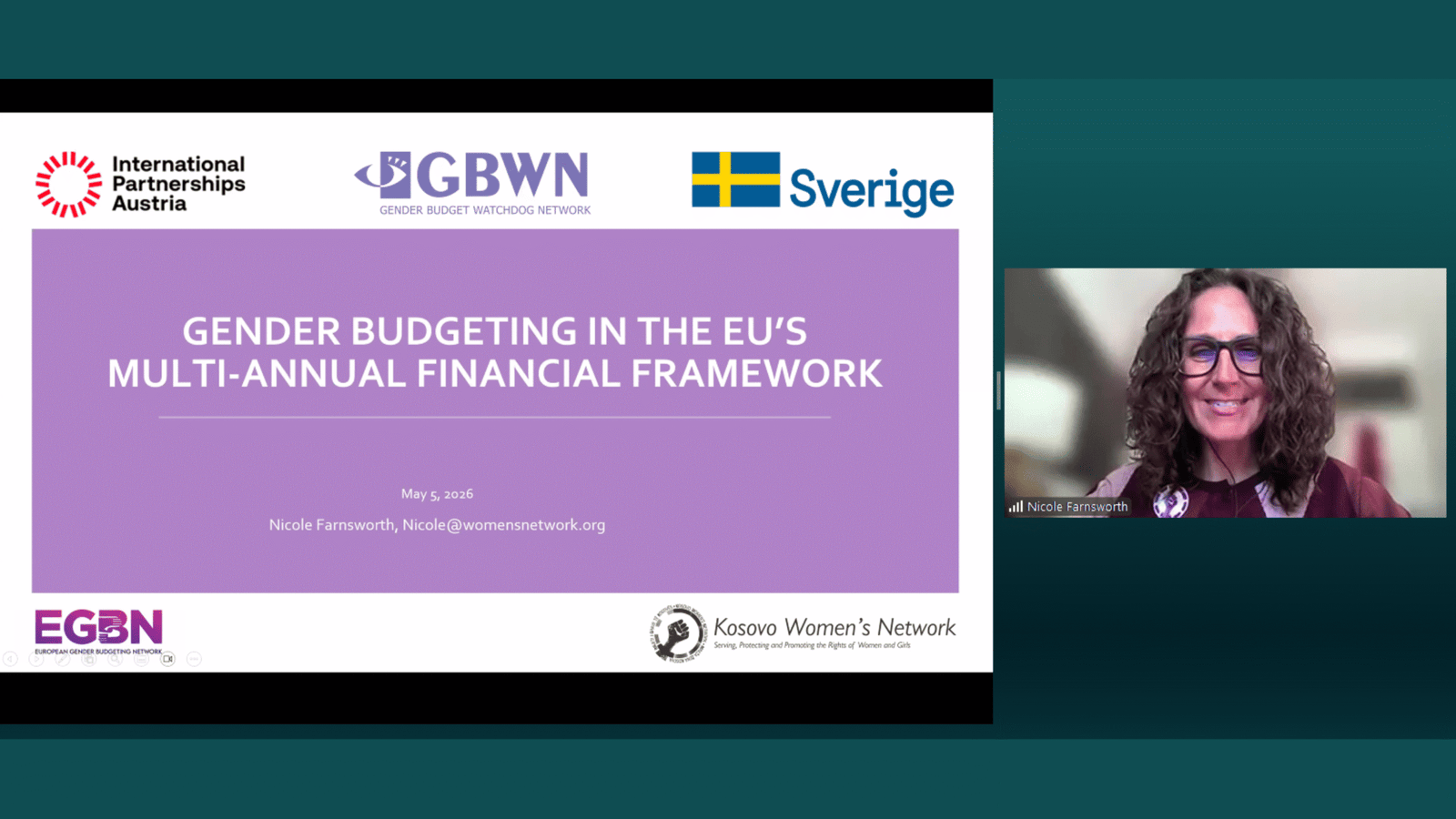
“We believe that the European Union in particular is well positioned to further gender equality in the Western Balkans. Governments have pledged in our countries to the European Union policy agenda, which includes furthering gender equality,” said Nicole Farnsworth while presenting the findings of the report.

Further, Massimo Mina, Team Leader, MFF, Programming and Comitology, European Commission, DG NEAR considered very impressive all the work done for this report!

This report was written by KWN in close cooperation: The Albanian Women Empowerment Network, Autonomous Women’s Centre (Serbia), Centre of Women’s Rights (Bosnia and Herzegovina), Kosovo Women’s Network, National Network to End Violence against Women and Domestic Violence (North Macedonia), Rights for All (Bosnia and Herzegovina), Sandglass (Serbia), and Women’s Rights Centre (Montenegro). 

The official launch of this report is expected to happen in September. You can find the report here: https://womensnetwork.org/wp-content/uploads/2020/06/Funding-WCSOs_FINAL_2020-06-11.pdf

Students from Amsterdam Show Appreciation for KWN’s Activism

On June 9, a group of students from the University of Amsterdam in the Netherlands held an online meeting with the Executive Director of the Kosovo Women’s Network (KWN), Igballe Rogova. 

For several years, the students of this university have been visiting Kosovo to learn more about KWN’s work and activities. Although the meeting was held online due to the pandemic, the discussion was fruitful and welcomed by the students.

During this meeting, Rogova discussed the peacebuilding processes in Kosovo and the Western Balkan region, and the various political and socio-cultural perspectives surrounding it. 

They also discussed the numerous KWN advocacy activities that have been undertaken to improve and strengthen the position of women and girls in the country, as well as women’s rights and their impact on the history of Kosovo.

Over the past years, Rogova has discussed with the students of this university the rights of women and their impact on the history of Kosovo and peacebuilding.  

Read more about the 2019 visit HERE.   

Medica Kosova and Djepi i Buzëqeshjes Show Great Support for War-time Sexual Survivors of the Kosovo War

Approximately twenty thousand women were sexually assaulted during the Kosovo War of 1998-1999. The suffering of these women continues today through social stigmatization, more than two decades after the war ended. 

In order to further assist these women, Medica Kosova and Djepi i Buzëqeshjes, implemented the five-month initiative “Using Community-based and Trauma-informed Approach for Improving Access of Additional Survivors of War Rape to their Status Recognition”, supported by Kosovo Women’s Fund (KWF) of the Kosovo Women’s Network (KWN).  

54 people from the Municipality of Gjakova, Deçan and Rahovec directly benefited from this initiative. Specifically, 44 women participated from these three municipalities, as well as 10 representatives of civil society organizations and institutions. 

19 women participated in trauma recovery sessions. 8 women gained assistance in fulfilling the application form for the status of survivors of sexual violence during the war, while eleven women are in ongoing counselling sessions to regain a certain level of emotional stability in order to cope with their trauma.  

These women, civil society activists and institutional representatives jointly-discussed topics as follows:  

  • Causes and consequences of sexual violence,   
  • The impact of trauma in psychological, cognitive, emotional aspect and in well-being as well, 
  •  How can we increase safety and confidentiality for the survivors?   

The participants were also introduced to the Law No. 04/L-054 on the “Status and Rights of Martyrs, Invalids, Veterans, Members of the Liberation Army of Kosovo, Civilian Victims and their Families”, as well as the work of the commission to recognize and verify the status of war civilian victims.  

The discussion of these topics was warmly welcomed by all present, each of who have a crucial role towards furthering the rights of women survivors of sexual violence during the war. Special importance and value were placed on the impressions of the survivors. Two of them expressed as follows: 

“If there was no counselling on how to cope with the process, I would not have been able to describe the details of what happened to me in the application form. I would be feeling worse than I did before I came to apply”.  

“I did not think that I could come apply for status recognition without having to go directly to the members of the Commission to tell my story. I even thought that there would be cameras around to record my story”.

More than 1,800 people from the participating municipalities had the opportunity to hear more about these achievements, thanks to a program on the Gjakova local radio. During this radio program, the Executive Director of Medica Kosova, Veprore Shehu, appealed to families and communities for supporting the survivors. 

Veprore Shehu, Executive Director of Medica Kosova during a discussion for the local radio of Gjakova, March 2019

In addition to women, Medica Kosovo and Djepi i Buzëqeshjes also held meetings with the Gjakova Gender Quality Office, and the Department for the Families, Martyrs, and War Invalids within the Municipality of Gjakova. They were there to advocate for the adequate therapy treatments and other assistance that these survivors need.  

“I thought I knew a lot about the effects of trauma in relation to sexual violence and ways that we can guide survivors to receive the necessary support. This training showed me how to balance my desire to support without doing more harm than good.”, said the Gender Equality Officer from Gjakova.    

In March 2014, the Assembly of the Republic of Kosovo approved the amendment of Law no. 04 / L-054 on the “Status and Rights of Martyrs, Invalids, Veterans, Members of the Liberation Army of Kosovo, Civilian Victims and their Families”, to officially recognize and include the status of civilian victims of sexual violence during war in Kosovo. The status entitles survivors of sexual violence in Kosovo to monthly pensions and other benefits stipulated by law. The necessary legislation and sub-legal acts were developed by the National Council for the Survivors of Sexual Violence during the Kosovo War, established in 2014 by former President Atifete Jahjaga. 

Acknowledging that in 2017, the Kosovo Government authorized Medica Kosovo along with three other women’s organizations, to represent the survivors during the process of recognizing the Status of Survivors of Sexual Violence during the War; the support that the survivors gained about the process of application for status recognition was highly professional and productive.  

By supporting these two member organizations, KWN has proved its continuous and longstanding efforts seeking dignified treatment of Survivors of Sexual Violence during the War. 

This initiative was supported by the Kosovo Women’s Fund (KWF) of Kosovo Women’s Network (KWN) and funded by the Austrian Development Agency (ADA).

Gjakova’s Women Assembly Members Meet with Rural Women to Discuss Their Concerns

On February 26, a meeting was held with three women assembly members and survivors of the war to hear women’s concerns from rural areas.  Villages such as Babaj of Boka, Ponoshec, Korenic, Rracaj, Dobrosh, Molliq and Hereq, were in attendance as part of the project “Mobilizing women assembly members to address the needs of women traumatized by the war”.  

Arbnore Shehu Bunjaku, Project Coordinator, discussed the main purpose of the project and how Medica Kosova together with  Cradle of Smile Center had come to identify this problem. 

”There are obstacles that prevent women’s voices from being heard at Assembly meetings in the Municipality house. Women are reluctant to challenge traditional attitudes and lack the defensive abilities to strengthen their voices”, Bunjaku said. 

The purpose of the project is to mobilize female assembly members to advocate for the basic needs of rural women. In doing so, they can help these local women improve their living conditions and facilitate the registration of joint property on behalf of both spouses.   

On March 6, assembly members, together with the project coordinators, made a site visit to identify problems addressed at the meeting.  

Through these activities, female assembly members can advocate on these women’s behalf in order to address their needs; in particular their health rights and the right to inheritance. This Initiative also intends to improve the level of implementation of the administrative instruction on property registration on behalf of both spouses. 

This initiative is supported by the Kosovo Women’s Fund, and is funded by the Austrian Development Agency (ADA) and UN Women. 

READ ALSO: Kosovo Women’s Fund allocated € 59,266 for 20 KWN Member Organizations in Kosovo 

AEFC Successfully Completes the “Istanbul Convention and National Strategy Against Domestic Violence” initiative

On March 11, the Association for Education and Family Care (AEFC) held a roundtable to discuss the findings and recommendations collected during the implementation of the Istanbul Convention and National Strategy Against Domestic Violence initiative. 

Present at the roundtable were members of AEFC, representatives of women’s organizations, as well as stakeholders and officials of Gjakova Municipality. The need to raise awareness about and the lack of knowledge surrounding the Istanbul Convention was discussed during the meeting, as well as the legal and practical interpretation of this convention in the direct work of NGOs that deal with victims of gender-based violence in Gjakova, Junik and Rahovec. 

Bahrije Vehapi, project coordinator, emphasized that the aim of the project is to provide access to rehabilitation and preventive services for survivors of domestic and gender-based violence. It will also serve to implement the National Domestic Violence Strategy 2016-2020 in accordance with the Istanbul Convention. 

Arbnore Shehu, lawyer, presented all the recommendations gathered during the workshops with 6 organizations from the three aforementioned municipalities, such as: KVRL (Local Youth Action Council (Gjakova), Qershiza (Junik), Farmer Woman (Rahovec), Sustainable Development Goal 5 , Institute for Gender Equality (Gjakova), and NGO Prosperity (RAE Gjakova). 

These recommendations are: 

  • Information sessions for citizens regarding Istanbul Convention. 
  • Create programs for NGOs to deal with the rehabilitation of abusers. 
  • Allocate the budget for the implementation of the Istanbul Convention. 
  • Provide training for professionals and provide social housing for victims. 
  • Anticipate the action plan and strategy including the Istanbul Convention. 
  • Prepare a joint project for the training of police officers on the Prevention of Secondary Victims. 
  • Harmonize the law on domestic violence with the Istanbul Convention. 
  • Members of the Coordination mechanism against domestic violence mechanism to be involved in a broader joint training and action plan activities to be integrated with the Istanbul Convention. 
  • Have a better focus on prevention and instead of the recovery; to hold family planning sessions so that there are no further consequences for children as cases of domestic violence. 
  • Establish counseling centers for child victims and couples counseling in every family medicine center. 

This initiative is supported by the Kosovo Women’s Fund (KWF) and funded by ADA Austrian Development Cooperation in Kosovo. 

In addition to the AEFC organization, there are 17 other member organizations benefiting from the 13th round of KWF. You can read the full list HERE

KWN Joins Workshop to Increase Volunteerism in Kosovo

The Kosovo Women Network (KWN) has continued its commitment toward raising volunteer culture in Kosovo.

On March 11, Etleva Malushaj, KWN Project Coordinator participated in the workshop “Volunteerism in Kosovo”, hosted by Lens organization. This workshop was organized to build the capacity of civil society organizations to recruit and manage volunteers in Kosovo.

In the first module, participants were introduced to the “Kosovo Volunteers” platform, which is a great opportunity for organizations to recruit volunteers. This platform comprises about 12,000 volunteers and helps formalize volunteer work as well.

Kastriot Mehmetaj, Administrator of the Platform for recognition of volunteering work in Kosovo, within the Ministry of Culture, Youth and Sports, informed the participants about the required procedures for an organisation registering on this platform.

Malushaj highly appreciated the participation in this workshop, recalling that KWN worked on building a program for volunteers that helps to better organize volunteer work and their involvement in the feminist movement.

“With such workshops, women’s civil society organizations can be taught to build their capacities, and will be able to raise many gender equality topics through the recruitment of volunteers. Thus, encouraging even more involvement of women and girls in public life and in decision-making processes”, Malushaj said.

A series of activities were held during the workshop to increase the capacity of organizations in several stages of volunteer management. Special emphasis was given to the methods of volunteer recruitment, employment contracts, daily expenses coverage and health insurance.

The participants received a certificate for the successful completion of the workshop.

KWN believes that volunteer work is a precondition for promoting solidarity, equality and social cohesion, thus has constantly included volunteers, both within the organization and through various campaigns.

KWN is committed to furthering volunteer work in Kosovo in the future.