KWN Contributes with Recommendations to Amend the Civil Code 

Pristina – Executive Director of Kosovo Women’s Network (KWN), Igballe Rogova has participated in a panel discussion “Marriage, spouses and civil union in the Civil Modern Code of the Republic of Kosovo”, hosted on April 4 from the European Information and Cultural Centre (EUICC).  

Rogova highlighted the most important issues, such as early marriages, marriage, engagement and cohabitation.  

The reformulation of article 16 regarding the early marriages; the reformulation of articles, which define engagement; the marriage and cohabitation; eliminating such definitions with genderbased discrimination, were among the KWN’s recommendations.  

According to the KWN’s analysis, the compilation of the above articles directly conflicts the constitutional principles and legal acts that regulate gender equality and non-discrimination. 

Representatives of the Ministry of Justice have recognized the work done by KWN with these recommendations also 

Ardian Mehmeti, representative of this Ministry acknowledged the contribution of the KWN’s recommendations, that he considered them constructive. 

“We have received the recommendations of the Kosovo Women’s Network, the CEL organization and the other partners, we are reviewing the draft laws based on the status,” Mehmeti said. 

Blert Morina, Executive Director of Centre for Equality and Liberty (CEL), has stated that the Civil Code is contrary to the Constitution.  

Morina called that the article for marriage of the Civil Code to be in accordance with the definition of the constitution in regard to the right of family creation which is equally guaranteed to all.  

Whereas, Alfons Benjamin Lentze, Head of the EU Civil Code Project, said that if Kosovo wants to move forward, then it should work towards developing equal rights for all.  


Activists Learn How to Hold Officials Accountable for Treating Violence  against Women 

On 2729 Mar., activists from Kosovo Women’s Network (KWN) member organisations that are involved in assisting women who have suffered violence gathered in Durres, Albania to hone their skills in holding responsible institutions accountable for properly treating cases of violence against women.  

The interactive workshop taught women’s rights activists exactly where to refer women who have suffered violenceas well as how to assist women in instances when relevant institutions do not perform their duties in accordance with the applicable legal framework.  

Participants shared their experiences and frustrations, including concerns over how some representatives of relevant institutions have treated cases of violence against women and girls in the past.  

In the last few years, the Agency for Free Legal Aid opened its offices in our region, but they were later closed,” said Nevenka Rikalo from NGO Ruka RuciIn addition, “At the Agency in Pristina, there isn’t anyone who knows the Serbian language, she added.  

Other participants also raised issues of concern, including courts prolonging the processing of cases, which leaves opportunities for interference in cases and for mediation between the victim and the offender, even though this is not foreseen in criminal casesSometimes, judges also provide punishments that are very low considering the crimeFurther, participants criticized the unprofessional attitude of some social workers, their profession not aligning with their work description and their lack of timely response to cases of violence against women.  

“If institutions do not perform their duties, we as civil society have a responsibility to hold them accountable,” emphasized Adelina Berisha, KWN Advocacy and Research Coordinator on Gender Based Violence, who moderated the interactive workshop.  

Valmira RashitiKWN Legal Assistant, presented and clarified the relevant legal framework.  

During the workshop, activists learned instances in which they could support women in referring cases of poor institutional performance to the Ombudsperson Institution. 

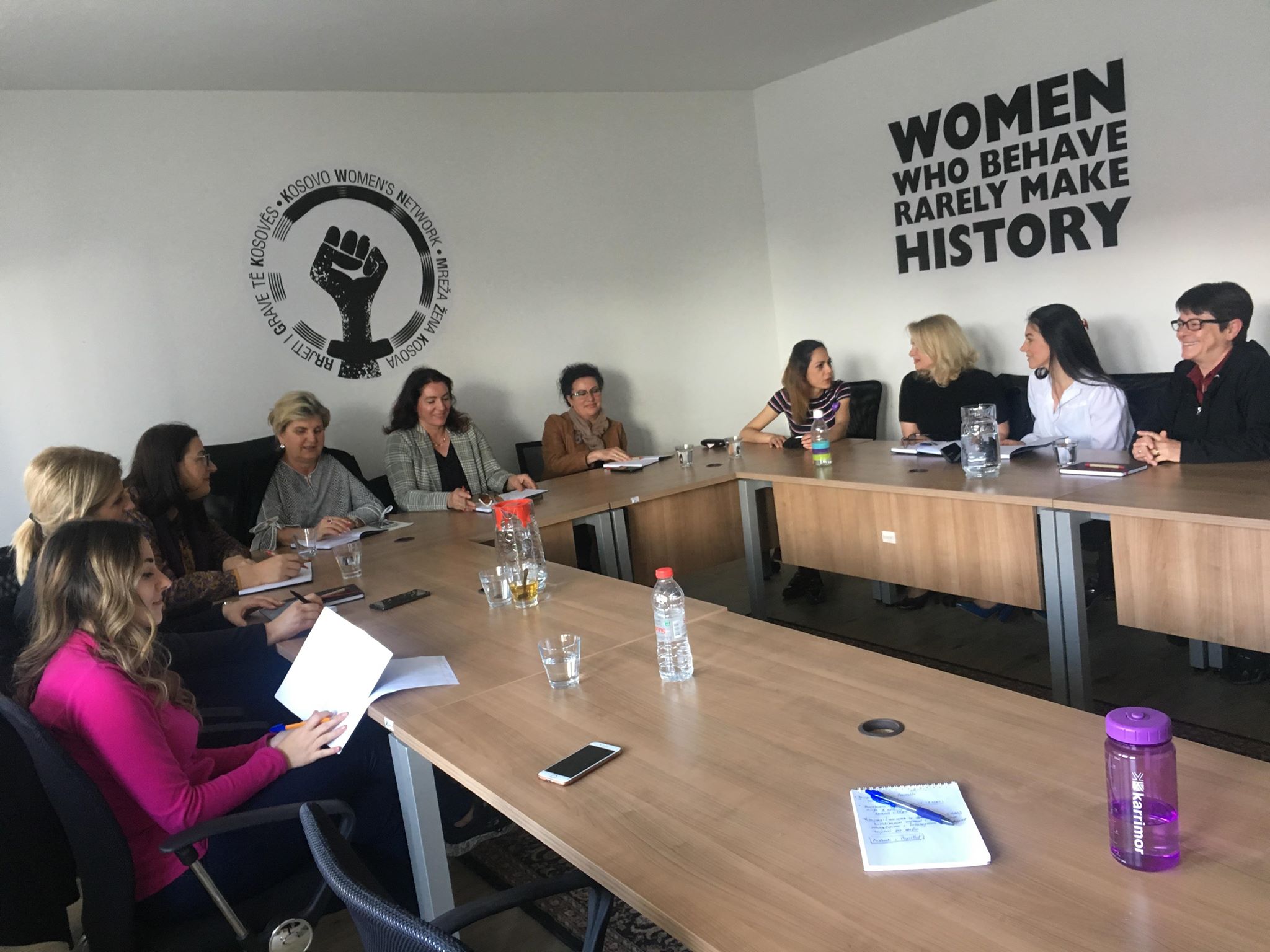
Activists discuss, resolve scenarios involving various potential challenges in referring women who have suffered violence to the appropriate authorities, during a workshop in Durres on 28 Mar.


It was important to see that one institution has higher and higher instances,” said Diellza Bezera from Arpolis, referring to the information provided about how to report officials’ poor performance to their superiors, and then, if not treated, to the Ombudsperson InstitutionNot all of us are jurists to know all of this information, and this [workshop] provided a good basis for all of us, she said.  

“Yesterday realized that I haven’t gone to the end of things, perhaps due to a lack of trust and tiredness go herego there’... maybe even due to a lack of information,” Xhejrane Lokaj reflected in agreement. If it is like this for me, what about those women who are not very educated? During this workshop, you have convined me that I have to take things to the end. [] My message: Don’t give up! 

KWN will continue to support these diverse 33 activists from throughout Kosovo, among others, in supporting women who have experienced violence in navigating relevant institutions, in order to seek justice and support.  

This workshop was financed by the European Union through the UN Women “Implementing Norms, Changing Minds” Programvia a KWN initiative on increasing access to services for women”.  


KWN and the Lobby in support of Podrimqaku-Subashi

The Kosovo Women’s Network (KWN) and the Lobby on Gender Equality in Kosovo (Lobby) on the 29th of March through a Press Release have expressed their concern regarding the pressure and the unfair treatment of Zahrie Podrimqaku-Subashi, Coordinator of the Municipal’s Human Rights Unit and Gender Equality and Equal Opportunities Officer in Drenas by the Mayor of this municipality, Ramiz Lladrovci.

Podrimqaku-Subashi is being a target of the pressure by the Mayor of the Municipality, who unlawfully tried to demote and replace her with his sister’s daughter-in-law.

In this letter, KWN and Lobby have recalled Podrimqaku-Subashi’s work and activism in the protection and promotion of human rights, with particular emphasis on the protection of women’s rights. To this understanding, KWN and Lobby have also demanded that the pressure towards  Podrimqaku-Subashi’s demotion has to be stopped.

Podrimqaku-Subashi enjoys the full support of KWN and the Lobby for continuing to exercise the public function for the benefit of citizens, as she has performed so far.

Read HERE the full Press Release.

Early Marriages still a Burden for Kosovar society

Network of Roma, Ashkali and Egyptian Women’s Organizations of Kosovo (NRAEWOK), a member organization of Kosovo Women’s Network (KWN), on Feb. 26 held its last meeting under the initiative “Supporting the prevention of early marriages of Roma, Ashkali and Egyptian communities in Kosovo”.

Xhulieta Devolli, Gender Equality expert stated that this action took place in the top three municipalities that are populated with non-majority communities such in Mitrovicë, Graçanicë and Lipjan.

Early marriages by Devolli are viewed as “a very common occurring”, emphasizing that they should be dealt by the society itself. She also spoke about the Report on the Istanbul Recommendations on the Implementation of the Istanbul Convention on the situation of early marriages of Roma, Ashkali and Egyptian communities in Kosovo.

Executive Director of NRAEWOK, Shpresa Agushi said that the lives of these women will be improved to a small extent due to this report. She also mentioned that “the first support for us [NRAEWOK] came from KWN”.

Ariana Qosaj-Mustafa, Programme Director and Senior Researcher at KIPRED, which is among the drafters of this report, expressed her concern regarding the lack of law’s implementation.

Amongst other things, she highlighted that “statistics of early marriages do not exist, this because only few cases are being reported”.

A closing conference of this action will be held in the end of April, as an opportunity for state actors to be introduced with the initiative’s achievements.

This initiative is implemented by NRAEWOK, supported by UN Women and financed by the European Union.


KWN and Lobby Support Podrimqaku-Subashi

The Kosovo Women’s Network (KWN) and the Kosovo Lobby for Gender Equality (Lobby) express their deep concern regarding the unfair treatment and pressure applied against Zahrie Podrimqaku-Subashi, Coordinator of the Municipal Human Rights Unit and Gender Equality and Equal Opportunities Officer in Drenas, by the Mayor of this Municipality, Ramiz Lladrovci.

Since his arrival, he has pressured Podrimqaku-Subashi to leave her position. In January, the Mayor called her into his office, pressuring her to resign from her workplace. This was illegal and without respect for Kosovo laws pertaining to recruitment and transfer. Lladrovci’s exerted this pressure with the intention to replace Podrimqak-Subashi with his sister’s daughter-in-law.

After news broke regarding this case, Mayor Lladrovci decided on 1 Mar. to temporarily transfer Podrimqaku-Subashi to the position of Head of Assembly Services in the same functional category.

Podrimqaku-Subashi challenged this decision, based on Law No. 03/L –149 on The Civil Service of the Republic of Kosovo.

Among the reasons for refusing this transfer, Podrimqaku-Subashi referenced that her transfer was “intentional, unreasonable, without a time limit, violent, and forced”.

Recalling Podrimqaku-Subashi’s work and activism in defence of human rights, particularly towards women’s rights, a contribution affecting all periods of Kosovo’s recent history, KWN and Lobby express unreserved support for Podrimqaku-Subashi.

Moreover, they demand that the Municipality of Drenas, as well as other relevant institutions, immediately stop pressuring Podrimqaku-Subashi and allow her to continue exercising her merited public function and the benefitting citizens, as Podrimqaku-Subashi has done to date.

The New Family Law is cherished

On March 5, the Initiative for Justice and Inequality (INJECT) organized a roundtable conference to inform the public on amendments made to the Family Law.

The new Family Law entered into force on 17 January 2019 with proposed changes from Luljeta Aliu, Executive Director of INJECT. According to Aliu, “the purpose of these changes [in the Family Law], relies in eliminating inequalities occurring towards the most marginalized group in Kosovo – women.”

INJECT has proposed that Article 47 of the Family Law be added the paragraph equalizing the work of one spouse translated into monetary value, with the contribution of the other spouse on the welfare of the family. Accordingly, the work of women in childcare and home care should be accounted for as part of the economic contribution when deciding on the division of property, such as in divorce cases.

Aliu emphasized the support she received from Kosovo Women’s Network (KWN) on publishing her findings based on the law’s analysis. “KWN was amongst the first NGO’s I asked for support for changing the Family Law, and I got it right away” she said.

Albulena Haxhiu, Head of the Legislative Committee expressed her gratitude on the initiatives that aim to eliminate patriarchy and support accomplishing gender equality. “It is a major issue the fact that according to the latest statistics, 80 % of women in Kosovo belong to the inactive category of the population. Whereas according to findings from KWN, 30 % of employed women work without contracts. This is scandalous”, said Haxhiu.

Other panelists also recognized the importance of this legal initiative. Jo-Anne Bishop, Gender Advisor of UNMIK and Rozafa Kelmendi from UN Women conveyed their optimism that this change will lead to open more doors of hope for women, and it will provide them financial stability.

DIS Students are Introduced to the work of Kosovo Women’s Network

On March 27, a group of students from the Danish Institute for Studies Abroad (DIS) program for Humanitarian Law and Armed Conflicts visited the Kosovo Women’s Network offices (KWN). Over the recent years, various generations of students from this program have visited KWN during their study visits to Kosovo.

Nertila Qarri-Gërguri, KWN’s Project Coordinator, informed the students about KWN’s work and activities ever since its establishment in 1996. A particular focus on this meeting was put on the role that women play in social processes and toward achieving gender equality.

The students appreciated representatives of the KWN for the time to welcome them, emphasizing that such meetings help them acquire a hands-on experience about the best practices regarding contributes that women and girls carry on post-conflictual societies.

Wheelchair users mark their Day by Marching and Dancing

March 1st marks The International Wheelchair Day. Dancing, marching and playing basketball were among the ways to celebrate this day in Kosovo.

The ceremony event was organized by Handikos, a members of Kosova Women’s Network (KWN), under the motto “This is how we move” (Ne kështu lëvizim) and it gathered many people in wheelchairs, and others supporting their equal rights too.

Drita Kluna, a member of Handikos Drenas, shared her happiness for participating in this march, while spreading a message for everyone. “We do not need remorse. All of us are missing something, but this does not imply that we cannot live by ourselves, this does not mean that we cannot have access. We are all equal”, Kluna stated.

Sulltane Qafleshi, a member of Handikos Prizren considers that nowadays people are more aware of the conditions of people in wheelchairs.

“I can only talk for Prizren, I am pleased with a number of activities taking place for us there. As from where I stand, we [women] are equal to men”, said Qafleshi.

In the meantime, not far from the place where she was giving this statement, a basketball field was being prepared only for men with wheelchairs to play.

Durim Gashi, representative of Handikos , has an explanation why there is not a single girl or woman playing basketball.

“In basketball tournaments there are more girls involved, but in this particular case it was more difficult. We have only two girls who play basketball. One of them is not in Kosovo, and the other one couldn’t join us today”, said Gashi, while adding that the game carries a symbolic meaning that people with wheelchairs can move too.

This event was held in order to appreciate the positive impact of using the supporting equipment for people in wheelchairs.

In several recent years women with disabilities have been supported through KWN’s work and activities, as member organizations.

Notably, a newly action launched by KWN in 2019 seeks to Strengthen Women’s Participation in Politics, aspiring to engage more women with disabilities in decision-making processes.

KWN Calls for Respect, Recognition for Survivors of War-time Sexual Violence in Kosovo

Kosovo Women’s Network (KWN) on March 19. through a press release has expressed its concern regarding the statements made by the Council for Defence of Human Rights and Freedoms (CDHRF) in relation to compensation for persons who suffered sexual violence during the war in Kosovo.

KWN calls for continued public support for survivors of sexual violence.

“There has been manipulation of the number of victims of sexual violence during the war. Without any evidence or evidence-based list, it is speculated on the list of 20,000 victims of sexual violence that has been misused and is being abused by both politics and the non-governmental sector”, is CDHRF’s statement which KWN strongly condemns with the following arguments.

First, in this statement, CDHRF contradicts itself; it states that there is no list and then immediately suggests that there is a list. There is no list and there can never be any list, given the specific nature of this heinous crime. Internationally, evidence has proven that all victims will never come forward, for several reasons. Therefore, as with the prevalence of any such crime, it is impossible to ever arrive at a specific number.

The estimate of “more than 20,000 women” derives from several sources. Among the most convincing, based on a survey of women refugees conducted by the Center for Disease Control and Prevention, Hynes and Lopes Cardozo, estimated that between 23,200 and 45,600 Kosovar Albanian women were raped between August 1998 and August 1999.

Other authors from outside Kosovo, with absolutely no political interests at stake, have provided similar estimates, as detailed in KWN’s prior reports. These estimates do not include women of other ethnicities, or men, who suffered sexual violence and who also qualify for state benefits under the amended Law on the Status and the Rights of the Martyrs, Invalids, Veterans, Members of the Kosovo Liberation Army, Sexual Violence Victims of the War, Civilian Victims and Their Families.

Related to the fact that such awful crimes rarely are reported, it is completely unsurprising that only 968 persons applied for status recognition. Rather, this demonstrates that many brave women came forward.

“In Bosnia and Herzegovina, there were an estimated 60,000 women raped, but only 1000 applied,” said Igballe Rogova, KWN Executive Director. “Why? Because of stigma they did not want to come forward. The majority of survivors may not apply, but for them it’s important that the society stops stigmatizing them”.

KWN and its members know from experience that some survivors do not want to come forward for their own personal reasons. Society must respect their choice. We have no right to expect or demand that they come forward if they choose not to do so. What is important is that survivors feel recognized and fully supported by Kosovo institutions and society.

In conclusion, we are deeply saddened that such hurtful statements would come from CDHRF, which historically has been a defender of human rights and freedoms in Kosovo.

KWN continues to voice its strong support for all women and men who have suffered sexual violence during the war. We continue to demand justice, as well as seek recognition and respect for all survivors.


KWN Supports Childcare

On March 14 Kosovo Women’s Network (KWN) participated in a conference dedicated to childcare. This event was organized in the Assembly of Kosovo by the Self-Determination Movement (VV) organization with members of political parties and civil society.

Referring to earlier research conducted by KWN, Advocacy Coordinator Adelina Berisha presented information and stressed that the prerequisite for gender equality is the funding and support of day care centers for children.

“Women’s free work for childcare usually goes unnoticed, though it is of crucial importance to the functioning of the household economy, the community, human well-being, and the economy,” said Ms. Berisha.

In conclusion, Ms. Berisha urged the government and the members of the parliament to raise their initiatives in increasing the number of day care centers for children, and in this context for the elderly and people with disabilities, in order to encourage employment of women and the division of responsibility for child care between men and women.