Baroness Catherine Ashton Replies to Activists

Women’s rights organizations from Kosovo, Serbia and Sweden, including KWN, Mitrovica Women’s Association for Human Rights, Women in Black and Kvinna till Kvinna sent a letter to High Representative of the Union for Foreign Affairs and Security Policy, European External Action Service (EEAS), Baroness Catherine Ashton on 4 Dec. 2013.
In the letter, they said that United Nations Security Council Resolution 1325 on Women, Peace and Security had not been implemented during recent talks between Kosovo and Serbia.
Baroness Catherine Ashton responded on 21 Jan. 2014. She thanked activists for their interest in contributing to the process of normalising relations between Belgrade and Prishtina.
“I look forward to meeting you in the course of my next visit to Pristina and Belgrade,” she wrote.
Click here to view her letter.
OPDMK Advocates for Accessibility Ramps for Institutions in Prizren

Persons with disabilities do not enjoy opportunities equal to the rest of the population in Kosovo. In many cases, they remain isolated from society. In order to address this, the Organization for Persons with Muscular Dystrophy in Kosovo (OPDMK) held roundtable discussions with representatives from responsible institutions, other non-governmental organizations (NGOs), and media. During meetings,

OPDMK advocated for persons with disabilities to have access to public institutions. They also raised awareness among responsible institutions about the importance of actively engaging all stakeholders to respect the rights of persons with disabilities. Representatives of the local assembly promised greater engagement and proposed that a regulation would be initiated, which would better regulate issues faced by persons with special needs. “We achieved for 27 out of 50 points of access to public buildings to be accessible for persons with muscular dystrophy,” stated Antigona Shestan from OPDMK. “This was to address the isolation that many people with disabilities face, OPDMK also gathered people with special needs from throughout Kosovo so they could socialize and discuss issues of mutual interest. They held electronic and regular wheelchair races at a local private high school, “Loyola”. realized through close cooperation with the Public Services Department of our Municipality. In total, the initiative directly benefitted 139 people.

However, indirectly many more people with limited mobility and parents with strollers also have benefitted from improved access to public buildings in Prizren. Another achievement is that a representative of OPDMK was proposed to become a member of the Municipal Council for Community Security. Within the council, she will be able to continue advocating for the rights of persons with disabilities.

During the “Know Your Rights” campaign, famous performers interact with women in various municipalities.

“Know Your Rights” Campaign Uses Culture to Education Citizens about Rights

The National Action Plan, Gender Equality Law, Anti-discrimination Law and Family Law, all promulgated in 2003 and 2004, are huge accomplishments for gender equality. They facilitate the promotion and protection of human rights in Kosova. However, social problems such as violence against women, trafficking for prostitution, low enrollment of girls in schools and at the University, a high female poverty rate, gender discrimination in the business world, and lack of female representation in politics still plague Kosova.

While gender mechanisms exist at the political level, many men and women remain unaware of their rights, how to access the protection provided by the new laws, or how to utilize the services of the Ombudsperson. Thus, implementing the laws and fully realizing the potential for social change remain difficult.

The KWN “Know Your Rights” campaign aimed to inform citizens about their rights and existing gender mechanisms through artistic plays. Five famous Kosovar performers gathered to tell stories that explained the aforementioned gender mechanisms. Performers utilized popular media including plays and songs as education tools in hopes of better reaching Kosovar citizens. The actors used monologues and dialogues to interact directly with the audience and to draw the audience into their act. Dialogues between actors dramatized women’s experiences, portraying situations in which gender mechanisms could be used. The plays were based on women’s real life experiences.

The campaign was launched on November 29 in Prishtina, marking the International Day against Violence against Women. The performance was repeated in Prizren on December 2nd and in Mitrovica on December 3rd. The campaign continued in 2005, reaching municipalities throughout Kosova. It was financially supported by UNIFEM, and RTV 21 was the media sponsor.

KWN visits the new Mayor of the Municipality of Gjakova, Mrs. Mimoza Kusari-Lila on 20 Jan.

Activists Congratulate Kosovo’s First Woman Mayor: Kusari-Lila

 For the first time since Kosovo’s Independence citizens have elected a woman to serve them as Mayor. A Kosova Women’s Network (KWN) delegation visited Mrs. Mimoza Kusari-Lila, the new Mayor of the Municipality of Gjakova on 20 January.
“Mrs. Kusari-Lila is legendary,” activists said. “She broke the ice by becoming the first woman mayor of a municipality in Kosova.”
During the meeting they discussed strategies for economically empowering women in the Municipality of Gjakova; reviving the professional theatre Corps of Gjakova; preserving the cultural heritage of Gjakova; encouraging women to participate in annual craft fairs; ensuring gender responsive budgeting; and supporting women’s organizations in the Municipality of Gjakova.
The Mayor expressed her appreciation for KWN’s work and her readiness for future cooperation.
“I will ensure women in the Municipality of Gjakova play a greater role in decision-making and are included in various spheres of life, especially business,” said Kusari-Lila.
KWN also asked when the “Museum House” of the Qerkezi family would be officially recognized (see below). Kusari-Lila already had a plan in place.
“In addition to declaring it a museum, this house also will have a person who will maintain it and will serve as a tourist guide,” said Kusari-Lila.
After meeting Kusari-Lila, the KWN delegation met representatives of the Association Mothers’ Call (Thirrjet e Nënave) at the museum house of the Qerkezi family in Gjakova. They recognized the loss suffered by this family during the war, when 11 men were taken by Serbian forces and remain missing today. KWN and Mothers’ Call discussed organizing another joint action with regard to missing persons. Together, the two organizations will undertake a street action on 8 March 2014 to call once again for progress with regard to missing persons in Kosovo.
Despite dozens of protests and hunger strikes, more than 17,000 people remain missing since the war. Mothers’ call is an organization of women with missing family members, still tirelessly advocating for their loved ones be found.

Hilmijeta Apuk from Mitrovica received the Human Rights Award from UN Secretary- General Ban Ki-moon on 10 Dec.

Hilmijeta Apuk Receives UN Human Rights Award

Marking the International Day of Human Rights at UN headquarters in New York, UN Secretary-General Ban Ki-moon recognized on 10 Dec. six people who have fought for human rights. Among them was Hilmijeta Apuk from Mitrovica, Kosovo.
Apuk has advocated in Kosovo and abroad for the rights of persons with disabilities for more than 30 years.  She served as a member of the Ad Hoc Committee of the UN General Assembly, which drafted the Convention for the Rights of Persons with Disabilities. She cofounded and directs the Little People of Kosova, a non-profit organization.  She also serves as the national coordinator for an awareness campaign towards employing persons with disabilities. In her spare time, Apuk is an artist, working to promote the rights of persons with disabilities through her art. 
     “This award is very important for me in my work and for Kosovo, my country,” Apuk said. “It strengthens the voice of people with disabilities, including myself, and encourages us to continue our work towards human rights.”
     The UN Secretary-General gives this award every five years to persons and organizations that have contributed to protecting human rights. Prior recipients have included Nelson Mandela, Martin Luther King and Benazir Butto.


KWN gathers 120 participants at its 11th Annual Membership Meeting, held on 7 Dec. 2013, at Sheshi 21 in Prishtina.

KWN Recognizes Artists Contributing to Women’s Rights

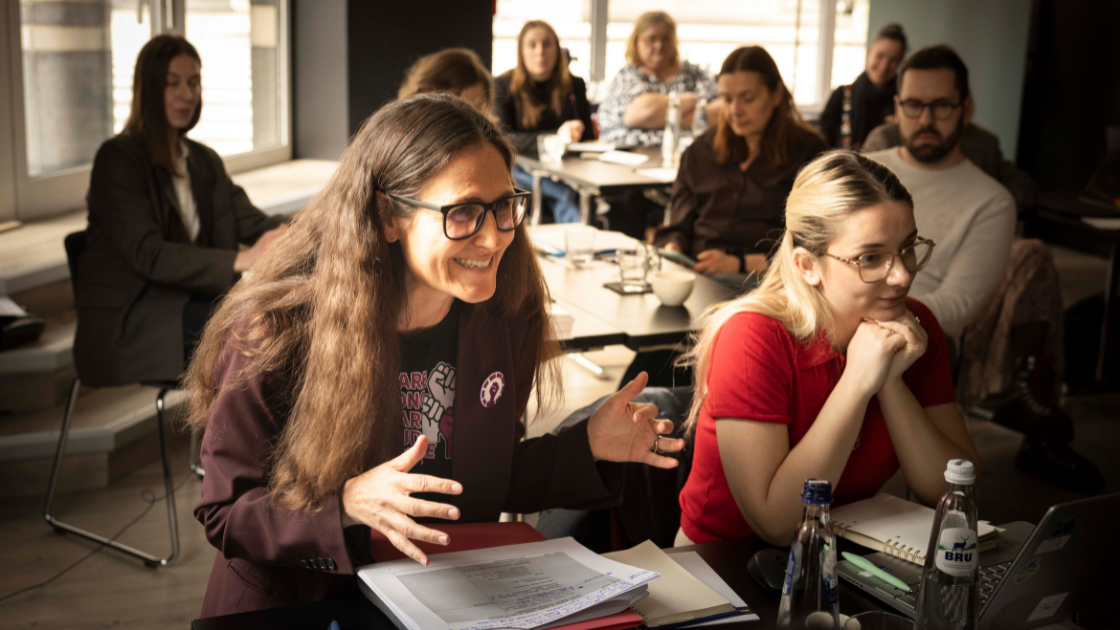
Approximately 120 representatives of KWN member organizations, donors, partners, supporters and media attended the Kosova Women’s Network’s 11th Annual Membership Meeting on 7 Dec. at Sheshi 21 in Prishtina. During the meeting, KWN recognized 17 artists and organizations that have contributed to furthering women’s and girls’ rights.    
     “This event was very good and necessary,” said Kadire Tahiraj from the Centre for the Promotion of Women’s Rights. “The work that KWN did this year was very successful. KWN is the only place where women’s organizations can find support.” 
     Following a performance by “Lira” Women’s Choir, a KWN member organization, Ariana Qosaj-Mustafa, KWN Chair of the Board, opened the meeting. On behalf of KWN, she recognized the following women artists for their contributions to women’s and girls’ rights: NGO Artpolis, Arta Dobroshi, Antoneta Kastrati, Blerta Zeqiri, Burbuqe Berisha, Doruntina Basha, Eliza Hoxha, Flaka Haliti, HAVE IT, Iliriana Loxha-Basha, Kaltrina Krasniqi, “Lira” Women’s Choir, Rona Nishliu, Rita Ora, Sevdie Kastrati, Venera Mustafa and Zake Prelvukaj.
     Then KWN Executive Director Igballe Rogova reported to members regarding KWN’s work and achievements in 2013, showing short films to tell our story. Nermin Mahmuti, a KWN Board member and member of the Kosovo Women’s Fund’s Grant Review Committee, spoke about the challenges faced and results of the Fund this year. Representatives of the following member organizations that received grants from the Fund also shared their experiences, challenges and successes: the Organization of Persons with Muscular Dystrophy of Kosovo from Prizren; Rikotta from Prishtina; the Committee of Blind Women of Kosova from Prishtina; and the Centre for the Promotion of Women’s Rights from Drenas.
     “KWN has empowered all of us member organizations that work for women’s rights,” a member said. “Creating the Kosovo Women’s Fund was of great importance because it gave organizations that lack funds the opportunity to work.”
     During the meeting, members completed anonymous evaluation forms regarding KWN’s performance in 2013, and evaluation results will be distributed in 2014. The evaluation process provides members with the opportunity to express their thoughts, as well as their needs and requests for future KWN services.
     KWN members also elected three new Board members, as part of the regular board rotation process.  The new members of KWN’s seven-member board are: Sevdije Ahmeti (48 votes), Zana Hoxha-Krasniqi (36 votes) and Belgjyzare Muharremi (29 votes). Members also agreed that Sevdije Ahmeti should remain a permanent member of the KWN Board. All members present at the meeting unanimously approved this proposal. Other candidates who did not receive sufficient votes for joining KWN’s Board included Valdete Idrizi (24 votes), Sarah Maliqi (16 votes) and Nita Luci (13 votes).
     “It is my pleasure to be part of 11th Annual Membership Meeting of KWN,” said Drita Vukshinaj from the Association of Women with Disabilities “Women for Women”. “KWN gathers us all and reports on the work they have done. They are very transparent. They empowered not just me, but all of the organizations that are part of this network.” 

OPMDK gathered people with special needs from throughout Kosovo in a competition that included chess, street ball, ping pong and wheelchair races, on Dec. 14 in Prizren.

OPMDK Holds Competition for People with Special Needs

 The Organization of Persons with Muscular Dystrophy of Kosovo (OPMDK) gathered people with special needs from throughout Kosovo in a competition that included chess, street ball, ping pong and wheelchair races. The competition created a space for having fun and meeting new friends.
“I feel very good,” said Fatime Gerguraj, a participant. “I like the games a lot. Also, this is very good for us because we are meeting new friends.”
     Since participants came from diverse cities, the competition provided an opportunity for them to socialize, as well as to become involved in various sports.
    “I myself have special needs, and I think this enabled effective organizing,” said Resmije Rrahmani from OPMDK. “I don’t like it when people without disabilities organize these types of events because they don’t understand our needs in the same way that we understand each other. When we organize something, I plan everything because I have the same problems that others face with stairs, bathrooms and transportation.”
     In the end, OPMDK recognized the winners and persons who support OPMDK. 

KWN representatives took part in an exchange visit in Austria on 9-12 Dec.

KWN Exchanges Experiences with Activists in Austria

KWN and Sudwind organized a five-day study visit in Austria. During the visit, women activists from Kosovo learned more about the position of women in Austria.
The visit began in Sant Polten (Sankt Pölten), the capital city of the region of Lower Austria. Participants met successful women politicians, discussing participation in politics and decision making, domestic violence and women’s inheritance rights. The next day, participants drove to another city, Hibps, where they visited a women’s shelter, learned how they deal with domestic violence and discussed the legal mechanisms in place for punishing abusers and treating victims. On the third day they visited Danube University in the city of Krems. Participants discussed women’s position within institutions and criteria for selecting job applicants.
In Sant Polten, they visited NGO Sudwind, learning about their work related to fair trade: selling products for their real value so those who make products do not face discrimination. On the last day they visited the Ministry of Women’s Affairs in Vienna. Participants learned about the Ministry and its work.
“This exchange of experiences has been very useful for us,” said Shefkije Mehmet, Head of the Municipal Assembly in Novoberdo. “We had the chance to meet women leaders working in various high level government institutions; visit those institutions; and learn from the experiences of these women.”
Following this very informative exchange, participants from Kosovo concluded that women in Austria (a “developed” country) face very several similar issues as women in Kosovo: they continue to fight for women’s rights as human rights; several women still suffer domestic violence; women who possess the same qualifications as men receive lower salaries; and there are fewer women in decision-making positions than men. The only difference, they concluded, was that women in Austria have stronger legal mechanisms towards furthering women’s rights.
The exchange visit was made possible with support from the Austrian Development Agency.

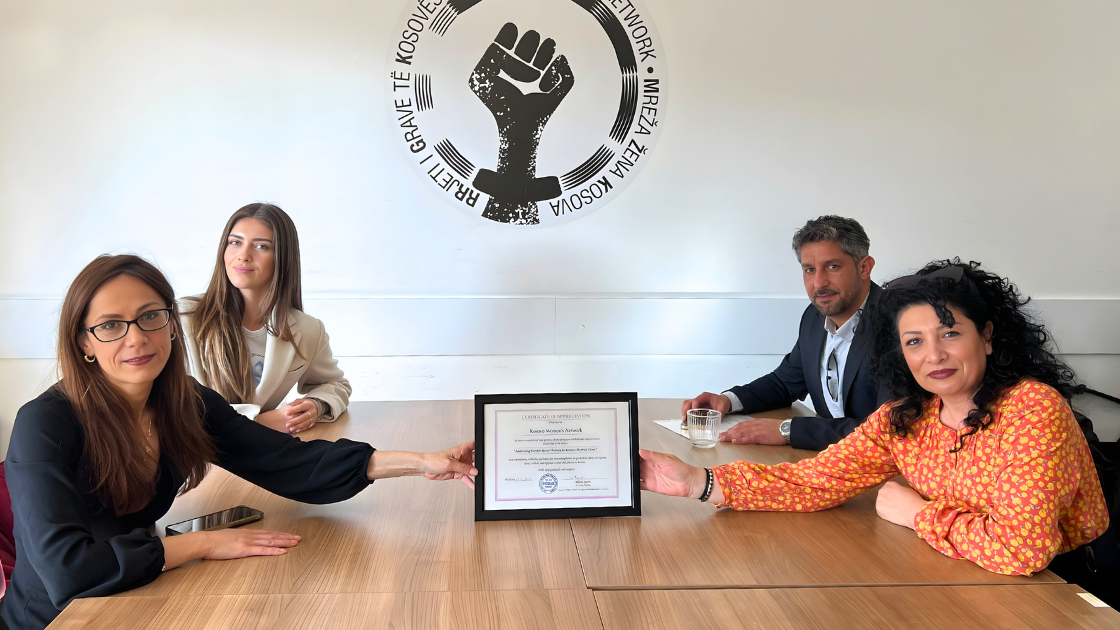
Nafije Latifi from Jeta-Vita recognizes President Jahjaga with a Certificate of Appreciation for her contribution in fighting breast cancer.

Jeta-Vita Recognizes President’s Fight against Breast Cancer

On 17 Dec., the President of Kosovo Atifete Jahjaga welcomed Nafije Latifi, Executive Director of the Kosovo Centre for Fighting Breast Cancer Jeta-Vita, Minire Zuna-Bunjaku, a member of the Centre’s Board and Igballe Rogova, KWNExecutive Director.
During the visit, Jeta-Vita expressed their gratitude for the President’s contribution and commitment to fighting breast cancer. On 12 Oct., President Jahjaga supported Jeta-Vita’s annual initiative that gathered citizens in marching with the motto: “Early Detection Equals Survival”.
During their visit, the delegation presented President Jahjaga with a Certificate of Appreciation.
“In this way we want to express our gratitude for Mrs. Jahjaga’s contribution and commitment in fighting breast cancer,” said Nafije Latifi.

The innovative documentary “SEVEN” was screened on 30 Nov., at the Palace of Youth and Sports in Prishtina.

SEVEN Involves Women’s Rights Activists in Kosovo

On 30 Sep., the innovative documentary “SEVEN” was screened at the Palace of Youth and Sports in Prishtina. SEVEN is a Swedish documentary that portrays the stories of seven women’s rights activists around the world, including women from Nigeria, Afghanistan, Pakistan, Russia, Northern Ireland, Cambodia and Guatemala.
     The innovative concept of the show involves bringing on stage seven women’s rights activists, public figures and politicians to read the stories of the seven women portrayed in the film.
     SEVEN’s ensemble in Kosovo included: Suzana Novoberdaliu, Member of the Parliament of the Republic of Kosovo and Head of the Parliamentary Committee for Human Rights; Anamari Repic, Deputy Head of public television station RTK; Saranda Bogujevci, an artist and survivor of the Bogujevci family massacre that occurred in March 1999; Rajmonda Sylbije, a Human Rights Activist from NGO CEL; Linda Gusia, a sociologist and feminist; Vesa Qena, a playwright and performer in “Have It” performance group; and Shpresa Agushi, Director of the Network of Roma, Ashkali and Egyptian Women’s Organizations of Kosovo.
   SEVEN was initially created by Paula Cizmar, Catherine Filloux, Gail Kriegel, Carol K. Mack, Ruth Margraff, Anna Deveare-Smith and Susan Yankowitz, together with the Vital Voices Global Partnership. The Swedish International Development Cooperation Agency (Sida) and Civil Rights Defenders (CRD) supported SEVEN’s screening in Kosovo.