Kosovo Women’s Fund Allocates €109,312 for 23 Organizations in Kosovo

Download File

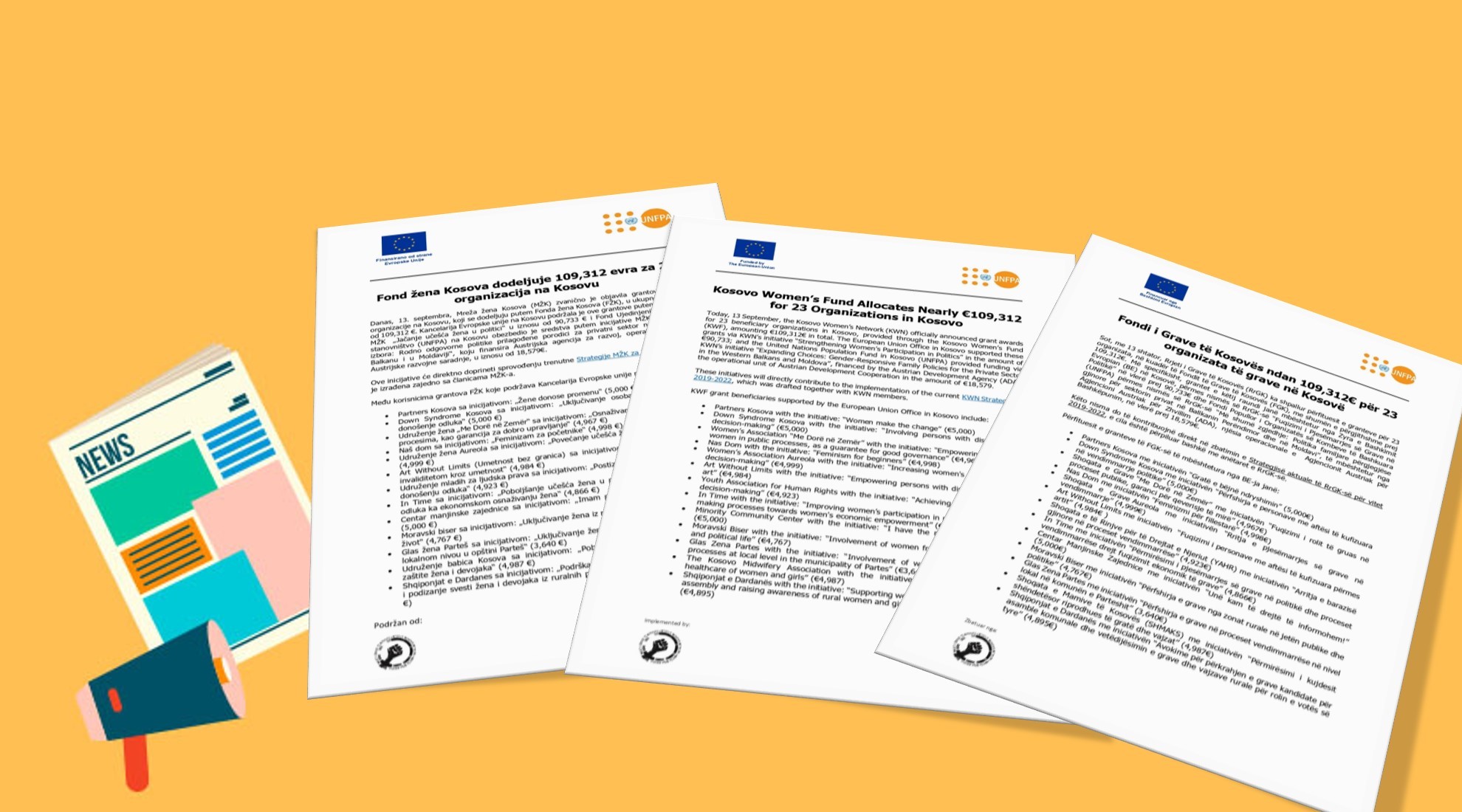
Today, 13 September, the Kosovo Women’s Network (KWN) officially announced grant awards for 23 beneficiary organizations in Kosovo, provided through the Kosovo Women’s Fund (KWF), amounting €109,312€ in total. The European Union Office in Kosovo supported these grants via KWN’s initiative “Strengthening Women’s Participation in Politics” in the amount of €90,733; and the United Nations Population Fund in Kosovo (UNFPA) provided funding via KWN’s initiative “Expanding Choices: Gender-Responsive Family Policies for the Private Sector in the Western Balkans and Moldova”, financed by the Austrian Development Agency (ADA), the operational unit of Austrian Development Cooperation in the amount of €18,579.

These initiatives will directly contribute to the implementation of the current KWN Strategy for 2019-2022, which was drafted together with KWN members.

KWF grant beneficiaries supported by the European Union Office in Kosovo include:

  • Partners Kosova with the initiative: “Women make the change” (€5,000)
  • Down Syndrome Kosova with the initiative: “Involving persons with disabilities in decision-making” (€5,000)
  • Women’s Association “Me Dorë në Zemër” with the initiative: “Empowering the role of women in public processes, as a guarantee for good governance” (€4,967)
  • Nas Dom with the initiative: “Feminism for beginners” (€4,998)
  • Women’s Association Aureola with the initiative: “Increasing women’s participation in decision-making” (€4,999)
  • Art Without Limits with the initiative: “Empowering persons with disabilities through art” (€4,984)
  • Youth Association for Human Rights with the initiative: “Achieving gender equality in decision-making” (€4,923)
  • In Time with the initiative: “Improving women’s participation in politics and decision-making processes towards women’s economic empowerment” (€4,866)
  • Minority Community Center with the initiative: “I have the right to be informed!” (€5,000)
  • Moravski Biser with the initiative: “Involvement of women from rural areas in public and political life” (€4,767)
  • Glas Zena Partes with the initiative: “Involvement of women in decision-making processes at local level in the municipality of Partes” (€3,640)
  • The Kosovo Midwifery Association with the initiative: “Improving reproductive healthcare of women and girls” (€4,987)
  • Shqiponjat e Dardanës with the initiative: “Supporting women candidates for municipal assembly and raising awareness of rural women and girls about the role of their vote” (€4,895)
  • Vizionida with the initiative: “Promotion of women in politics and decision making in the Municipality of Shtime” (€3,795)
  • Jeto Vepro dhe Krijo with the initiative: “Promoting and supporting women and girls to participate in decision-making” (€4,993)
  • Independent Initiative for Blind Peoplewith the initiative: “Access of people with disabilities to public services” (€4,992)
  • Okarina e Runikut with the initiative: “Women’s Empowerment in Politics and Decision Making” (€4,951)
  • Era Fruit with the initiative: “Empowerment through higher representation of women in local politics” (€4,997)
  • Svet Andjela with the initiative: “Increasing women’s participation in the electoral process” (€3,975)

Beneficiaries supported by UNFPA include:

  • Business Women Mitrovica with the initiative: “Promoting employment through family-friendly workplace” (€4,537)
  • Women’s Association Drugëza with the initiative: “Empowering women in business, a good practice of promoting gender equality” (€4,530)
  • Organization for Local Reforms – EULOC with the initiative: “Promoting family friendly policies and workplaces in municipality of Vitia” (€4,512)
  • Lipjan Youth Centre with the initiative: “Promoting family friendly policies at the local level” (€4,999).

Through this round, the Austrian Development Agency (ADA) will also provide support via KWN’s “Further Advancing Women’s Rights in Kosovo II” co-funded by the Swedish International Development Cooperation Agency (Sida), in the amount of around € 50,000. We will announce beneficiaries of these grants in the coming days.

KWN’s KWF provides small grants to women’s organizations that do not have access to other sources of funding and who seek to work for women’s rights and gender equality, prioritising funding for groups working in rural areas and/or marginalized persons. Since 2012, KWF has allocated 216 grants, supporting 111 organizations, with a total amount of € 1,120,779€. In 2021, KWF receives support from the European Union, ADA, Sida, UNFPA, Sigrid Rausing Trust and the Kvinna till Kvinna Foundation.

KWN Holds its Third Membership Meeting for 2021

On September 6, about 80 participants came together to discuss at the third meeting of members of the Kosovo Women’s Network (KWN) for this year. 

Executive Director of KWN, Igballe Rogova, initially emphasised the importance of getting vaccinated against COVID-19, hoping that future meetings will be held with physical presence. 

Rogova also mentioned that even in these local elections, KWN will continue the campaign to call on for more votes for women. 

“As we have agreed upon, we will again continue the door-to-door campaign, through which, together with our members, we will call on citizens to vote for more women in the local elections scheduled for next month”, she said.  

Rogova also emphasized the murder of the 18-year-old M.O. by her husband, and recalled that KWN will continue to seek justice for this murder, as well as for any other femicide case.   

[Read HERE KWN’s response to this case, whereas HERE you can read about the KWN protest organised in Ferizaj, to seek justice for this case]. 

After this, Gentiana Murati, Grant Manager at KWN, informed the participants about the 16th round of the Kosovo Women’s Fund, which for the first time offers core support to member organisations.  

“Our research Where is the money for women’s rights shows that core support enables women’s organisation to focus more on influencing, rather than surviving. KWN has long wanted to offer core support for its members, but was unable to do this due to financial limitations. Now, through support of Sigrid Rausing Trust, KWN will provide this support to eight or more member organisations”, Murati said.    

Further, Rita Berisha, Project Coordinator at KWF, informed the members about the importance of core support to empower organisations that try to achieve gender equality in Kosovo.  

“We invite you to browse this call, and to consult us for anything you feel we could be of help. KWN is pleased to announce today that we will provide core support for you – support that will greatly assist you in your work and implementation of your strategies, because they are not just funds allocated for one project, but for every expense that your organization might have, and until today you have had it more difficult to meet”, said Berisha.  

KWN members highly appreciated this opportunity to receive the support they need to further advance their strategies, toward improving the lives of young women and women in Kosovo.  

This meeting was supported by the European Union office in Kosovo (EU), through the four-year initiative “Strengthening Women’s Participation in Politics”, about which you can read more HERE

Kosovo Women’s Fund Announces Core Support!

With great pleasure, today the Kosovo Women’s Network (KWN) announced that, for the first time, the Kosovo Women’s Fund (KWF) will proudly provide “core” support to KWN member organisations.  

What is core support? 

Core support, also sometimes referred to as general budget support, organizational support, or unrestricted or untied funding, is a form of flexible funding given to enable an organisation to realize its overall strategy and aims. It differs from funding provided through a project, which must be used only for specific, set objectives and activities (often referred to as ‘tied funding’ because it is ‘tied’ to a certain activity and cannot be used for other purposes). Rather than making an organisation follow a donor’s procedures and priorities, core support usually allows the organisation to use its own preferred procedures for auditing, procurement, and reporting. Core supports focuses on the results achieved. Thus, core support contributes to any costs that an organisation has, towards realizing its strategic aims.  

Why core support? 

There are several reasons why KWN believes core support is important:  

  • KWN trusts activists: We believe that women’s rights activists are best placed to know their communities’ needs and priorities. Therefore, they should make decisions on how to spend funds. 
  • Focused on priorities: We believe core support rightfully provides member organisations with more control over how funds are used, ensuring that funds reach thematic areas, geographic regions, and groups most in need.  
  • Sustainability and capacity-building: Core support allows organisations to strengthen their internal capacities and enhance their staff’s capacities. This enables them to enact more long-term changes in their communities, rather than ad hoc activities. It also enables them to build their organisational capacities and systems for the future, towards more sustainable work. 
  • Flexibility: Core support provides member organisations with the flexibility to pursue their own priorities and reduces the administrative workload associated with specific donor requirements. Core support can adapt quicky and easily to shifting situations.  
  • Mission-driven, independence: Core support enables organisations to strategize independently and be less donor-driven. 
  • Deeper impact: Our research shows that core support allows women’s rights civil society organisations to focus on impact, rather than mere survival. The time spent seeking to secure fragmented funds for basic operations, and reporting on the use of various piecemeal funds, takes time away from their important work towards social change. Ensuring basic costs and needs are covered enables organisations to focus on making impactful changes. 

Considering the benefits that core support brings activists, women’s rights organisations, and feminist movements, KWN has continually advocated for funders to allocate more funds for core support. KWN has long wanted to provide core support to its members but has struggled given its own funding limitations. Now, through the generous support of the Sigrid Rausing Trust ( >€78,000), KWN plans to distribute at least €78,000 to eight or more KWN member organisations this November.  

KWN members can submit applications until 4 October 2021, following the guidelines on the KWN website. Funding decisions will be made by KWF Grants Review Committee, elected by KWN members. 

Please click HERE to access the documents required for applying.

Officials Discuss Municipal Needs for Implementing Gender-responsive Budgeting during Report Launching

Today UN Women launched a report Capacity and Skills Development needs on Gender Mainstreaming, GRB, and Gender Responsive COVID-19 Interventions at the Local Government Level in Kosovo, prepared by IDRA. Key stakeholders participated, including Edi Gusia from the Agency for Gender Equality (AGE) in the Office of the Prime Minister who spoke about important allocations for gender equality and the urgency of institutionalising gender budgeting; Salvador Elmazi, Budget Director from the Ministry of Finance, Labour and Transfers (MFLT) who emphasized that gender budgeting is a legal obligation and requested within budget circulars; Sazan Ibrahimi, Director of the Association of Municipalities of Kosovo; and municipal officials who showcased best practices in Kamenica and Gjakova. The event was hosted by Vlora Nushi, Head of UN Women in Kosovo, supported by Sida.

On behalf of KWN, Nicole Farnsworth presented key recommendations that have arisen from KWN’s research and monitoring of institutions’ implementation of their legal obligations related to implementing gender-responsive budgeting in Kosovo. KWN’s main recommendations included:

  • AGE and MFLT must urgently finalize the draft Concept Document for Gender-responsive Budgeting in Kosovo, introducing it systematically into Kosovo’s public finance management system as obligatory.
  • Municipalities should undertake gender analyses, as per the Law on Gender Equality, best practices in gender-responsive budgeting, and budget circulars. They should use these to inform budget planning and implementation, establishing objectives and indicators towards furthering gender equality in every sector. This is not relevant only to a budget line for gender equality officers or shelters, though these are important. Additionally, furthering gender equality must be integrated into every sector, including the environment, transport, sports, culture, and infrastructure investments, among others. KWN’s Practical Guide explains how this is possible.
  • MFLT needs to better control budget proposals, ensuring budget organizations submit the requested gender-responsive budgeting annex and that it is of sufficient quality. They can turn back budget requests if the annex is not submitted or done properly.
  • Municipalities need to budget for furthering the capacities of finance officers in gender-responsive budgeting by allocating funds for officers to attend the already-established training curriculum on this provided by the Kosovo Institute for Public Administration (KIPA). This should be followed by mentoring during the budget process until officers fully understand how to undertake gender-responsive budgeting.

Based on its research, KWN has made several other recommendations for municipalities to consider for their 2022 budgets, towards furthering gender equality, available here.

          KWN has been engaged in gender-responsive budgeting since 2011, including supporting KIPA and AGE in developing the curriculum on gender-responsive budgeting. KWN is part of the Gender Budget Watchdog Network, through which civil society organizations are monitoring and supporting government efforts to institutionalize gender-responsive budgeting in the Western Balkans and Moldova.

Demolli: Decades of Activism have shown us that Women’s Unity is a Value Challenging the Surrounding Reality

This month, KWN brings the profile of a women’s rights activist, Executive Director of the Kosovar Gender Studies Centre (KGSC), Luljeta Demolli.  

Since 2004, Demolli has been involved as a researcher, manager and then Director of KGSC - a journey and activism which, according to her was built undoubtedly by feminist ethics and education.  

In this conversation with KWN, Demolli talks about her work as an activist, engagement in KGSC, as well as the important cooperation between KGSC and KWN to strengthen the feminist movement in Kosovo –in more than a single direction.   

KGSC Background  

KGSC, as an organization whose mission is gender mainstreaming in all analyses, programs and policies of all sectors of Kosovo society, has been vocal since its establishment at the central and local level, in the feminist contextualized knowledge production, documenting the history of women’s political activism, and promoting feminist activism among the younger generations.  

“The missions of organizations such as KGSC, besides being vital to the development of a social dialogue between women and activists, are also to change the political status quo which goes to the detriment of women and other underprivileged groups,” said Demolli at the beginning of the interview with KWN.  

KGSC, also a member organization of KWN, has played a vital role in promoting women’s rights and gender equality, and has been and remains a defender of the women’s movement, despite challenges which have been expected considering the prevailing patriarchal culture and institutions.  

“We have created an address which, in addition to welcoming activists, also encourages and promotes feminist thinking, solidarity and political commitment to change the socio-economic and political situation of women.”  

Whereas, while talking on a personal level as an activist, Demolli considers that this experience, besides challenging her, has also shaped her even more as a feminist.  

KGSC and KWN: Together for Women’s Rights  

In this part, Demolli gives special importance to the cooperation and advocacy that were undertaken over the years together with KWN.  

She mentions some of them.  

“As a member of KWN for many years, we have joined in some very important initiatives for the country. One of them I would like to share in this article is advocating for parental leave 50/50 within the Labour Law. This activity has lasted for years and we still continue to advocate together. We collaborated on many other gender equality issues, which has strengthened our role in advancing women’s rights and the recognition of these issues by local and national authorities.”  

She recalls that KGSC and KWN stand as key actors in combating discrimination against women and girls in the country.  

This cooperation so far, she trusts, is giving signals that both organizations should focus cooperation on strategies to respond more to taboo topics that affect women’s rights. This no matter how challenging these topics will be in Kosovo.   

Among these topics are; sexual harassment, gender selective abortion, sexual assault - with particular emphasis on 13-15-year-old girls.  

According to Demolli, another dimension that should be more and more internalized within the feminist causes, both at the level of organizations and the movement, is LGBTI + persons  

As a last point, as part of the “Advancing Women’s Rights at the Workplace” initiative, KWN supported KGSC to implement the “Preventing Any Form of Discrimination at the Workplace” initiative. Finally   

She claims that this initiative, besides enabling them to deepen research on the position of women in the economy, has also provided them with possibility to continue and advance advocacy with institutions.  

“These interventions, among others, have contributed to cooperating with other institutions and organizations that deal with similar issues and to coordinate activities and work in order to advance the situation in the field for women in the labour market.”  

Decades of Activism have shown us that Women’s Unity is a Value Challenging the Surrounding Reality 

Recalling the accomplishments made by women’s rights organizations, Demolli emphasizes those issues that remain the fundamental difficulties for women in Kosovo.  

“We as KGSC bring two key challenges, the slow pace of law implementation and the significant presence of violence against women and sexual harassment,” she added.  

In conclusion to this article, Demolli says that two decades of activism and work have shown that unity among women is valuable against the reality that surrounds us.  

“We should not deal with who is “more “or “less “of a feminist. We have to ask if our goals are useful to our feminist cause.” she says.   

*This article follows a series of KWN publications on the work and contribution of human rights activists in Kosovo.     

READ ALSO:  

Krasniqi: KWN Conveys an Important Message – That of Women’s Power   

Activist Lokaj: Thanks to KWN, We Created Partnerships to Achieve Gender Equality 

Protest in Pristina: Murder of women must be treated as a national emergency

Today, August 26, numerous citizens and activists joined the protest to demand institutional responsibility for the murder of Marigona Osmani as well as many other women.

The protest organized by the Kosovo Women’s Network (KWN), Center for Information, Criticism and Action, Feminist Thinking and Action Collective (QIKA), Kosovo Gender Studies Center (KGSC) and Youth Initiative for Human Rights (YIHR), started in front of the Ministry of Justice, continuing with a march to the building of the Ministry of Internal Affairs and ending at the Government of the Republic of Kosovo.

This image has an empty alt attribute; its file name is IMG_4713-1024x683.jpg

This protest had the following demands:
1. Treatment of femicide as a national emergency;
2. Establishment of a department within the Ministry of Interior for prevention and treatment of femicide;
3. Monitoring, sanctioning and dismissal of Kosovo Judges, Prosecutors, and Police Officers who do not treat cases with seriousness and gender sensitivity, according to the Criminal Code of Kosovo and the Istanbul Convention; Accountability from the Kosovo Judicial Council, the Kosovo Prosecutorial Council, and the Police Inspectorate for these cases of violations;
4. Concrete plan by the Government of the Republic of Kosovo for combating gender-based violence;
5. Safety for girls and women in all spaces.

This image has an empty alt attribute; its file name is IMG_4864-1024x683.jpg

KWN will continue to monitor the case and hold institutions accountable until the case is resolved and the perpetrators convicted.

“Life Free from Gender-Based Violence” remains one of KWN’s key programs. Every the organisation engages both in activism and lobbying institutions so that women and girls can live a life free from violence. This includes raising awareness amongst officials and citizens in tackling gender-based violence. including domestic violence, rape and sexual harassment.

Read HERE KWN’s response regarding this case.

Read more: Protest in Ferizaj, maximum punishment for the murderers of the 18-year-old

MWAHR Advocates for Gender Responsive Budgeting in the Municipality of Mitrovica

Mitrovica Women Association for Human Rights (MWAHR), has been working towards institutionalising gender responsive budgeting (GRB) in Kosovo since January.

Its initiative “Gender perspective for sustainable economic planning” focuses on inclusion of a gender lens in all the budgeting processes, making government budgeting, programming and planning more responsible from a gender perspective in Municipality of Mitrovica.

In order to achieve this, MWAHR has met with several representatives of the municipality of Mitrovica to advocate for a fair allocation of the municipal budget.

They recently launched their research report titled “Gender Responsive Budgeting in the Municipality of Mitrovica”. Here, MWAHR monitors the implementation of gender responsive budgeting in the Municipality of Mitrovica, and the commitment of relevant officials who adopt decisions on the fair and responsible distribution of municipal budgets for women and men.

“The budget is an important instrument for the development and transformation of a country, every unit of the local and central government, including the municipality of Mitrovica, hence without income there is no development and pre-prosperity for citizens.” said Vetone Veliu, Executive Director, MWAHR, during the debate organized on August 25 to present the recommendations of the final report to the officials of the Municipality of Mitrovica.

This image has an empty alt attribute; its file name is IMG_4585-1024x683.jpg

“Gender budgeting is a strategy for integrating a gender perspective into municipal budgeting. With it, we aim to acquire a perspective for improving equality between men and women, based on a gender analysis in each year of budget planning of the municipality of Mitrovica.” added Adem Fazliu, Financial Officer in the Municipality of Mitrovica.

This activity and report was funded by the Austrian Development Agency (ADA) and Sida – Styrelsen för Internationellt Utvecklingssamarbete. through the Gender Budget Watchdog Network (GDWM).

KWN is a partner organization of this network, in the following link you can read about other initiatives supported by this cooperation:

https://womensnetwork.org/3348946/

Protest in Ferizaj, maximum punishment for the murderers of the 18-year-old

Today, on August 24, many citizens and activists joined the protest in Ferizaj, to seek justice for the murder of 18-year-old young women with the initials M.O.

The protest organized by the Kosovo Women’s Network (KWN), Artpolis – Center for Art and Community, Kosovo Center for Gender Studies and the Ferizaj Youth Assembly, started in front of the Police Station and continued with a march to the Court and Prosecution building in Ferizaj.

This image has an empty alt attribute; its file name is IMG_4429-1024x683.jpg

With numerous slogans and calls for justice, the protesters demanded the maximum punishment for the murderers of the 18-year-old.

“End patriarchal institutions”, “Women’s Life, a joke for the state”, “Maximum sentence for Dardan Krivaqa”, “Maximum sentence for Arbër Sejdiu”, “We want justice for Marigona “, “Justice for all murdered women”, “Maximum sentences for murderers of women”, “Police have blood on their hands”, were some of the slogans that activists held in their hands during the protest.

This image has an empty alt attribute; its file name is IMG_4538-1024x683.jpg

The demands of the protest are:

1. Addressing the phenomenon of femicide as provided by the Istanbul Convention;

2. Maximum punishment for the murderers;

3. Security for girls and women in all spaces;

4. Fair treatment of gender-based violence by the Government of the Republic of Kosovo.

KWN will continue to monitor the case and hold institutions accountable until the case is resolved and the perpetrators convicted.

“Life Free from Gender-Based Violence” remains one of KWN’s key programs. Every the organisation  engages both in activism and lobbying institutions so that women and girls can live a life free from violence. This includes raising awareness amongst officials and citizens in tackling gender-based violence. including domestic violence, rape and sexual harassment.

Read HERE KWN’s response regarding this case.

KWN Demands the Maximum Sentence for the Murder of the 18-Year-Old Girl

Sunday was fatal for an 18-year-old girl , whose lifeless body was brought to the Emergency Centre in Ferizaj.

Kosovo Police has described the case as “Aggravated Murder”, and so far one suspect has been arrested, while the second suspect is on the run. This case reveals once again the institutional shortcomings in treating the women’s killings and femicide.

The killing of this girl is by no means an isolated case or a coincidence – this girl lost her life in a country where every murder of women is accompanied by institutional silence, delays in investigations, and low sentences for killers. As for every murder of women by men here we have a chain of culprits within the institutions.

How is it possible to leave a lifeless body of a woman in a health institution, without any accountability?

Let us recall here that hospitals have an obligation to report to security institutions of all cases where there are signs of violence, and to ensure that perpetrators of violence do not escape.

Kosovo Women’s Network (KWN) demands that the investigation of the killing of an 18-year-old girl be a priority for the investigative bodies, and that the perpetrators receive the maximum sentence. We also announce through this press release that KWN will follow the case closely and seek justice.

At the same time, we call on citizens to cooperate in finding the second suspect, and we call on the media to report with the focus on preserving the dignity of the victim – only in this way will each of us play our role in the uncompromising fight against the murder of girls and women.

KWN will not stop until the killings of girls and women are not treated only as a daily news or private matter.

Below you can find KWN’s latest research on violence against women and the institutional response to it:

From Laws to Action

KWN with Recommendations for Municipal Budget for 2022: Implement Gender Responsive Budgeting

While we are on the eve of local elections, Kosovo municipalities are dealing with the budget drafting for 2022, in which case they have the obligation to organize public consultations with citizens.

When earmarking the budget, municipalities must implement the Law on Gender Equality , which makes gender responsive budgeting mandatory for public institutions in Kosovo, including municipalities.

Therefore, based on the recommendations received from KWN member organizations, as well as our research findings, we have summarized the key points that should be addressed to municipalities during public consultations regarding budget drafting. Only by taking into consideration these recommendations can we ensure that public money contributes to the further advancement of gender equality in Kosovo, bearing in mind that the government is committed to this through several laws and policies. The main requirements are listed below, and the document with all the requirements you can find HERE

  • Allocate sufficient resources, based on gender analysis and gender-responsive budgeting, to fully implement municipal responsibilities to address all forms of gender-based violence, especially in terms of rehabilitation and reintegration into society (as shown by findings from KWN’s From Words to Action”, research there were no sufficient recourses so far). For example, allocate a sufficient budget for more social service staff and implement a rehabilitation case management plan.
  • Provide shelter facilities / buildings in municipalities where they are not available, as well as provide social housing for persons who have suffered gender-based violence.
  • Allocate funds to increase the number of child care centers and pre-school centers in proportion to the number of children in need at the local level. It will also increase children’s educational performance, help create new jobs, and enable more women to enter the workforce, according to KWN research.
  • Provide from the budget of the Directorate of Education at the local level that teachers at the levels of Lower Secondary and Upper Secondary Education be trained on gender-sensitive teaching
  • Provide sufficient budget for the provision of reproductive health services in all municipalities.
  • Approve fiscal policies and incentives to develop women’s businesses, including in the agricultural sector. The municipality should analyze the main obstacles faced by women’s businesses during and after the pandemic, as well as develop policies that would help overcome these obstacles.
  • Increase the number of inspectors or build the capacity of current inspectors to develop a gender-responsive Do no Harm approach through interventions to combat the informal economy.

The Kosovo Women’s Network (KWN) has been striving and working for years to institutionalize gender responsive budgeting, which requires that the funds spent address the different needs and priorities of women and men, as identified by the gender analysis.

HERE you can read the practical guide developed by KWN for Gender Responsive Budgeting at the Local Level.